Airports Can Serve as Hubs for Transportation Innovation
Oct. 28—Like it or not, airports are primed to become the sandbox for any number of transportation innovations, ranging from autonomous vehicles (AVs) to delivery robots.
"A lot of the technologies that we see, and are tracking in an airport setting, we're also anticipating appearing or becoming in more common use outside of airport settings," said Andrew Duvall, senior research scientist at the National Laboratory of the Rockies, during a Transportation Research Board webinar Oct. 20 to explore how airports are becoming hubs of transportation technology advancements.
"And so, understanding and testing things at airports are likely to inform practices in a much more broad setting eventually," Duvall said.
A primary area of research has centered on how airports are, and will be, served by autonomous vehicles. Today, six airports are now served by Waymo, the robotaxi operator: facilities in San Francisco and San Jose, Calif.; San Antonio, Phoenix, Las Vegas and Nashville.
"That's something pretty exciting, and something [we] will see in the coming years," said Loup-Giang Nguyen, aviation planner at WSP, a global engineering and professional services firm, during the panel.
A question for airports is not as much when automated vehicles will arrive, Nguyen said, but what types of automated vehicle they will be, where they will operate at airports and what airports need to do to accommodate them.
The deployment of robotaxis at airports will likely be more ordered than the somewhat chaotic introduction of ride-hailing vehicles if only because AVs and their need to map the area will require at least some coordination with airport officials, Nguyen said.
The researchers identified three strategies for accommodating AVs at the curbside. In one scenario, there would be a dedicated curbside for robotaxis, much as some airports already do for transportation network companies such as Uber and Lyft.
Another strategy would have AVs sharing the curbside with other vehicles. This option would likely occur where "the curbside is very constrained," Nguyen said.
In a third option, airports may choose to place robotaxis in a remote staging area farther from the terminal. In this scenario, the vehicles would drive up to the curb when called by a passenger, Nguyen said.
These are all questions airports are already considering.
"There's a lot of complexity when thinking about how to move people through this area," Duvall said, reflecting on research the National Lab conducted for Dallas Fort Worth International Airport, which aimed to explore policies or programs the airport should consider to best serve these new forms of mobility.
"The goal was to try to develop reasonable time-frames so that they could plan toward either adopting new technologies, or getting AVs into the mix as far as their planning and operations go," Duvall said.
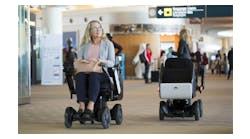
Airports are planning for new forms of transportation, serving passengers well past the curbside, all the way to the boarding gate. These can include all levels of "people-movers." Airports such as Baltimore/Washington International Thurgood Marshall Airport, Detroit Metropolitan Wayne County Airport and Seattle-Tacoma International Airport have introduced autonomous wheelchairs.
In a related initiative, Cincinnati/Northern Kentucky International Airport has deployed devices known as Auto-DollyTugs — electric AVs with "robotic arms," — to handle baggage and cargo on flight lines.
"It's not uncommon for passengers to need to move between gates and distances well beyond the willingness of many people to walk, including a mile or farther," Duvall said, noting these could be people who are not necessarily wheelchair dependent but have mobility challenges.
"And so, thinking about how to move people within the airport facilities," he said, "especially people who might need assistance, who the idea of walking long distances might not be very appealing to them."
© 2026 Government Technology. Visit www.govtech.com. Distributed by Tribune Content Agency, LLC.