Why Airport Passengers Still Drive — And What It Will Take to Shift Them to Transit
Five Things You'll Learn from this Article
- Why transit investment alone isn’t changing traveler behavior
- How airport design can influence mode share
- Why employees may hold the key to reducing congestion
- The economic tension shaping ground access decisions
- What the next generation of airport access could look like
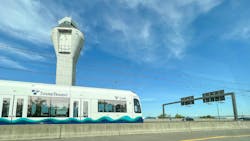 As airports face growing capacity constraints, investments in rail and regional transit are becoming a critical component of long-term ground transportation strategy.
As airports face growing capacity constraints, investments in rail and regional transit are becoming a critical component of long-term ground transportation strategy.
Airports across the United States have invested billions in rail lines, bus connections and multimodal facilities designed to reduce congestion and improve access. Yet despite the growing availability of public transportation, most travelers still arrive by car — a disconnect that is increasingly shaping how airport leaders, planners and designers think about the future of landside mobility.
A recent report from the U.S. Government Accountability Office (GAO) underscores the challenge. While nearly all large hub airports now offer some form of public transit, adoption remains limited, revealing a gap between infrastructure investment and traveler behavior that could have long-term implications for capacity, sustainability and capital planning.
For airport executives already grappling with roadway congestion, curbside pressure and emissions targets, the findings suggest that building transit is only part of the equation. Influencing how passengers choose to get to the airport may ultimately depend just as much on design decisions, operational strategies and economic realities.
Infrastructure Alone Doesn’t Shift Behavior
The GAO’s review found that public transit access is no longer rare at major airports — but usage patterns have been slower to evolve.
“Transit is a difficult problem to solve,” said Heather Krause, managing director of physical infrastructure at GAO. “Even if transit is available, you still have to get people to use it.”
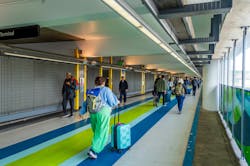
Traveler decisions often come down to practical considerations rather than environmental intent. Reliability, total travel time and familiarity with the system heavily influence whether passengers choose transit over driving, according to the report.
Those behavioral factors help explain why mode share remains modest at many airports despite significant investment.
Andrew Blaisdell, national practice consultant for aviation planning at HNTB, said the issue is rooted in the full passenger journey — not just whether a rail station exists.
“It really comes down to travel time and cost from curb to gate,” Blaisdell explained. “If transit introduces friction — whether that’s transfers, escalators or managing luggage — many travelers will default to driving.”
In fact, seemingly minor inconveniences can quickly tip the balance.
“All those little pieces add time and uncertainty,” he said.
Planning frameworks may also play a role. Many airport ground transportation strategies historically begin with roadway access and curbside flow, reinforcing car-centric patterns even as transit options expand.
The result is a structural tension: airports are investing in multimodal access while operating within systems largely designed around automobiles.
Complicating matters further is the financial importance of parking. Revenue generated from parking facilities can be easier to justify than large-scale transit investments, creating competing incentives for airport operators.
Krause acknowledged the challenge, noting that airports must balance transit goals with economic realities. Parking remains a significant revenue source even as agencies look for ways to encourage alternative modes.
Together, those forces suggest that shifting traveler behavior may require more than infrastructure — it may demand a fundamental rethinking of how airports design and manage landside access.
Seattle-Tacoma Tests the Multimodal Model
Seattle-Tacoma International Airport (SEA) offers a real-world example of both the progress and complexity involved in increasing transit use.
Today, roughly 10% of SEA passengers arrive via public transportation, while about 20% of airport employees use transit for their commute.
Those figures exceed many national benchmarks, yet airport leaders view them as part of a longer trajectory rather than a finished milestone.
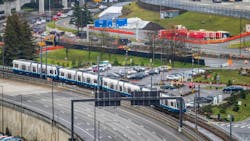
“We’ve seen steady growth in transit mode share over time,” said David Tomporowski, transportation access program manager at SEA.
Regional investment has helped. Expansion of Sound Transit’s light rail system has strengthened connections between the airport and surrounding communities, while planned overnight service is expected to close one of the most persistent gaps for shift workers.
Still, physical realities shape what is possible.
SEA operates within significant geographic constraints that limit roadway expansion, forcing the airport to focus heavily on operational strategies rather than large-scale capacity projects.
In some cases, constraints can accelerate innovation by making multimodal solutions less optional.
But transit adoption is influenced by factors well beyond airport property lines.
“We don’t control the regional transit system,” Tomporowski noted, emphasizing the importance of partnerships with local agencies.
Workforce commuting has emerged as one of the airport’s most promising opportunities. Employees travel frequently, often on predictable schedules, making them more likely than passengers to adopt transit when service aligns with shift hours.
Yet even where transit exists, economic dynamics continue to shape behavior. Subsidized parking tied to labor agreements, for example, can discourage employees from switching modes.
For airport leaders, such realities reinforce the idea that transportation policy, workforce programs and financial structures all influence outcomes.
Sustainability goals add another layer of urgency. Ground transportation accounts for roughly 20% of SEA’s overall emissions footprint, making it a meaningful lever in the airport’s broader climate strategy.
“We see mode shift as critical to reducing emissions,” said Leslie Stanton, sustainability manager at SEA.
The airport is also experimenting with tools designed to influence behavior indirectly. Its environmental key performance indicator program sets emissions-related standards for transportation network companies operating on airport property, encouraging cleaner vehicle fleets.
Taken together, the approach reflects a growing recognition across the industry: airports may not control every variable, but they can shape the ecosystem that supports traveler choices.
Designing the Next Generation of Airport Access
If infrastructure alone cannot drive mode shift, planners say the next phase of airport access will likely hinge on design integration and long-term capital strategy.
For Blaisdell, one of the most important shifts involves reconsidering where the passenger journey begins.
“Historically, planning starts at the curb,” he said — a perspective that can unintentionally prioritize vehicle access over other modes.
Rebalancing that approach could mean designing terminals and landside environments that make transit feel intuitive rather than secondary.
Yet large-scale transformation will not happen overnight.
“The U.S. aviation system isn’t going to flip a switch and become transit-first,” Blaisdell said, noting that meaningful change may align with major redevelopment cycles that occur only once every few decades.
In the meantime, airports are increasingly exploring strategies that do not require building entirely new rail lines — from improving wayfinding and passenger flow to aligning transit schedules with workforce needs.
The GAO also pointed to employees as a particularly practical audience for mode shift efforts, given their familiarity with local transportation networks.
Looking ahead, passenger growth is likely to intensify the pressure to act.
As airports approach the limits of their roadway capacity, multimodal access may evolve from a sustainability initiative into an operational necessity.
Geography will continue to influence how quickly that transition occurs. Airports with limited space for expansion may face earlier inflection points than those with room to grow.
What is becoming clearer, however, is that the future of airport access will not be defined by a single project.
Instead, it will emerge through a combination of infrastructure, policy, design and partnerships — each shaping whether travelers see transit as a viable option or simply an alternative.
For airport leaders navigating long planning horizons, the message is less about abandoning the automobile than about expanding the playbook.
Building transit is a critical step. Designing airports that encourage people to use it may be the harder — and more consequential — challenge.
About the Author
 Joe Petrie
Joe Petrie
Editor & Chief
Joe Petrie is the Editorial Director for the Endeavor Aviation Group.
Joe has spent the past 20 years writing about the most cutting-edge topics related to transportation and policy in a variety of sectors with an emphasis on transportation issues for the past 15 years.
Contact: Joe Petrie
Editor & Chief | Airport Business
+1-920-568-8399
>> To download the AviationPros media kits, visit: Marketing Resource Center
>>Check out our aviation magazines: Ground Support Worldwide | Airport Business | Aircraft Maintenance Technology