Autonomous Airfield Maintenance Is Moving Beyond the Pilot Phase
Five Things You'll Learn
- How autonomous mowing enables airports to reallocate labor without reducing headcount
- Why “doing two jobs at once” is the defining use case for airfield automation
- What performance metrics matter most, from cost per acre to acres per hour
- How autonomous systems integrate into existing safety, SMS and maintenance workflows
- Where automation could expand next across airfield operations beyond mowing
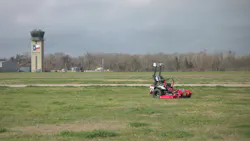 Autonomous mowers operate within geofenced zones on the airfield, allowing maintenance teams to maintain turf while crews are deployed to higher-priority runway and infrastructure work.
Autonomous mowers operate within geofenced zones on the airfield, allowing maintenance teams to maintain turf while crews are deployed to higher-priority runway and infrastructure work.
At many airports, mowing is one of the most time-consuming and least strategic uses of skilled maintenance labor.
It is also unavoidable.
Large airfields can require tens of thousands of acres of turf to be cut annually, often with aging equipment and limited staff. At the same time, those same teams are responsible for higher-priority work tied directly to safety, compliance and revenue generation, including pavement maintenance, lighting systems and runway markings.
For some airports, that imbalance is becoming unsustainable.
The emergence of autonomous mowing is starting to change that equation. Not as a replacement for labor, but as a way to fundamentally rethink how routine airfield maintenance gets done.
From Task-Based Work to Autonomous Operations
At Sugar Land Regional Airport in Texas, the shift toward autonomy was driven by a familiar set of pressures: aging equipment, limited staffing and expanding operational demands.
The airport’s maintenance team was responsible for mowing more than 17,000 acres annually, with roughly 400 acres turning over each week. At the same time, upcoming airfield projects, including runway rehabilitation, were expected to demand more labor for pavement and marking maintenance.
That created a direct conflict.
“We were looking for something to break from the status quo,” said Ken Durbin, assistant director of aviation at Sugar Land Regional Airport. “By easing the maintenance burden, we could free up staff to focus on other critical airport priorities.”
Rather than simply replacing older diesel mowers with newer models, the airport evaluated whether autonomous systems could deliver equivalent or better productivity at a comparable cost per acre.
That evaluation reflects a broader shift underway across airport maintenance operations. The goal is no longer just to complete tasks efficiently, but to build systems that can operate with greater consistency, predictability and flexibility.
Autonomous mowing fits into that model through what operators describe as “supervised autonomy,” where one trained staff member oversees multiple units rather than manually operating a single piece of equipment.
“The goal isn’t to replace operators,” said Colin Busse, autonomous operations director at RC Mowers. “It’s to move them into a supervisory role where they can scale their impact across larger areas with better consistency and documentation.”
The result is not fewer employees, but a different allocation of labor across the airfield.
Doing Two Jobs at Once
The most compelling value of autonomous maintenance is not incremental efficiency. It is the ability to run parallel operations.
At Sugar Land, that became clear during overnight runway maintenance.
Like many airports, the team regularly conducts nighttime work to clean mold and mildew from runway markings, a critical safety task that preserves reflectivity and visibility. Because the airport operates a single runway, that work must be completed at night to avoid disrupting flight operations.
Historically, that meant shifting the entire maintenance team to overnight work. While crews focused on runway cleaning, mowing operations stopped completely, creating a backlog that had to be addressed later.
With autonomous mowing, that tradeoff disappeared.
“In the past, if I moved my whole crew to nights for a week, nobody was mowing,” Durbin said. “This time, we didn’t lose any ground. We were doing two jobs at once.”
During a November 2025 overnight maintenance operation, the airport deployed its full crew to runway work while autonomous mowers continued operating across the airfield at the same time.
For the first time, routine turf management and critical infrastructure work were no longer in competition.
That moment has become a defining use case.
Instead of choosing between competing priorities, airports can begin to maintain continuity across routine and high-value maintenance activities. Autonomous systems effectively extend the capacity of existing teams without adding headcount.
Measurable Gains Without Workforce Reduction
For airport operators, the value proposition of automation often comes down to measurable outcomes.
At Sugar Land, leadership set an initial goal of reducing labor hours tied to mowing by 8 to 20 percent. Early results have exceeded the lower end of that range and are trending toward the higher target.
At the same time, the airport identified the potential to reduce labor cost per acre from more than $13 to below $10, aligning with initial projections.
Those gains are not coming from workforce reductions.
Instead, labor is being redirected toward higher-value tasks such as pavement inspections, airfield lighting maintenance and runway marking upkeep. This shift is particularly important as airports face increasing regulatory and operational demands with limited staffing flexibility.
Automation is also reducing safety exposure.
Fewer hours spent operating heavy equipment translates to less time crews are exposed to rotating blades, flying debris and prolonged airside driving. Even modest reductions in exposure can have a meaningful impact on overall risk profiles.
From a performance standpoint, autonomous systems are delivering consistent output across varying conditions. At Sugar Land, units have operated in uneven terrain, nighttime environments and inclement weather while maintaining productivity.
Integrating Autonomy Into Airfield Operations
One of the key barriers to adopting automation in airport environments is integration with existing safety and operational frameworks.
Unlike commercial landscaping, airfield maintenance must align with strict safety management systems, airside access controls and regulatory requirements.
Autonomous mowing systems are designed to operate within those constraints.
Geofenced operating zones ensure equipment remains within pre-approved areas, avoiding runways, taxiways and critical infrastructure. Human supervisors remain responsible for coordination, clearances and mission initiation, maintaining a human-in-the-loop model aligned with airport safety protocols.
“Airside mowing requires precision, traceability and repeatability,” Busse said. “Those are areas where autonomous systems can deliver consistent performance shift after shift.”
Each mowing session is logged, creating a record of location, duration and any operational interruptions. That data can support maintenance reporting, performance tracking and long-term planning.
For airport teams, the transition has proven less disruptive than expected.
At Sugar Land, staff initially operated a hybrid model, manually running one unit while deploying others autonomously. As confidence grew, the team expanded autonomous operations and adjusted workflows to maximize utilization.
Today, autonomous mowing runs alongside traditional operations as a standard part of the maintenance program.
Equally important is workforce adoption.
Early concerns about job displacement were addressed through clear communication that automation would not replace staff but would shift their focus. Over time, maintenance crews developed new technical skills and began to view autonomous systems as an extension of their capabilities.
“They love the units as their own,” Durbin said. “They’re building new skills and taking pride in being on the cutting edge.”
A Foundation for Broader Airfield Automation
While mowing is the current entry point, airport operators are already looking beyond turf management.
The same principles that enable autonomous mowing—geofenced operations, precise positioning, conservative safety protocols and supervised control—can be applied to other repetitive airfield tasks.
Airport leaders have pointed to potential applications such as runway and taxiway painting, pressure washing and other routine maintenance functions that require consistency and can benefit from extended operating hours.
For now, adoption remains in the early stages.
Autonomous systems perform best in well-defined, lower-complexity environments and require careful planning, training and change management. But the early results are providing a clear signal.
Automation in airport environments is not about replacing people or deploying fully independent systems.
It is about building more resilient operations.
By enabling parallel workflows, improving consistency and freeing skilled labor for higher-value work, autonomous maintenance is starting to shift how airports think about capacity on the airfield.
For operators facing growing demands with limited resources, that shift may prove to be one of the most important operational changes of the next decade.
About the Author
 Joe Petrie
Joe Petrie
Editor & Chief
Joe Petrie is the Editorial Director for the Endeavor Aviation Group.
Joe has spent the past 20 years writing about the most cutting-edge topics related to transportation and policy in a variety of sectors with an emphasis on transportation issues for the past 15 years.
Contact: Joe Petrie
Editor & Chief | Airport Business
+1-920-568-8399
>> To download the AviationPros media kits, visit: Marketing Resource Center
>>Check out our aviation magazines: Ground Support Worldwide | Airport Business | Aircraft Maintenance Technology