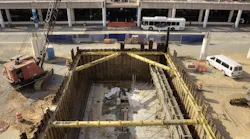
Columbia Regional Airport Terminal Project Before Council
Monday night's Columbia City Council meeting will feature a major discussion of the upcoming construction of a new terminal at the Columbia Regional Airport.
The new terminal, which is slated to cost $20 million in the first stage and around $35 million overall, will be built where the current hangar sits to the right of the airport's only terminal. A new hangar will be built on the western outskirts of the airport. Work on the project is proposed to begin next summer, with completion anticipated in early 2022.
There are no proposals from existing carriers to begin expanded service with additional flights or new destinations, according to city spokesman Steven Sapp, who also said that no new airlines have contacted the airport to start new service.
However, Sapp said he believes this will change once the main runway extension to 7,400 feet is completed in 2021 and the new terminal is in place. The terminal will be more than three times the size of the current one and will allow for four jetways, and larger TSA and passenger areas.
The new terminal is being funded partly by a hotel tax Columbia voters passed in 2016 to raise the city's lodging tax on hotels and motels from 4 percent to 5 percent.
The airport is served by two airlines, American and United, with American flying twice daily to Chicago and Dallas and United offering two flights to Chicago and one to Denver each day.
United began flying from Columbia Regional Airport in August 2017 and passenger boardings in August were more than double the same month in 2016, when voters passed the lodging tax.
The tax should earn around $10 million for the terminal's construction, which will cost around $35 million total. The first phase of the project to be completed in 2022 will cost $20 million with long-term projected expenses of $15 million.
A public hearing will center around a staff recommendation to employ a design-build method of construction for the terminal, which the council discussed in July and the Federal Aviation Agency approved in August. The method was one of three choices: "design-build", "design-bid-build" and "construction manager at risk".
The council agreed in July to work with Kansas City-based engineering firm Burns & McDonnell to create the preliminary design plans for the airport. These plans will guide whatever contractor it chooses through bidding on the construction.
Along with the hotel tax, which has earned some $1.5 million since its introduction in 2017, the first stage of the project will be funded by $5 million in bonds backed by passenger facility charge revenues, a $2 million loan from the city's designated loan fund and $3 million from transportation sales tax, according to the FY 2020 budget.
The council is still discussing the possibility of charging for parking, which is currently free at the airport.
Although passenger totals have grown from 9,090 in 2007 to more than 243,000 in 2018, the airport still uses two former Columbia Public School trailers for secure gate areas, an old CPS trailer for baggage claim, and a single bathroom in the secure area to accommodate up to 177 people, according to a council memo.
"The current 16,000 square foot terminal and parking areas struggle to handle the current number and frequency of flights," Sapp said.
Usage increased most months this year from last, aside from a 35 percent drop in April after cancelling flights for a week to fix a runway crown. As of September, almost 200,000 passengers used the airport this year.
In other business, the council will also discuss the construction of the Magnolia Falls Park improvement project located at 4820 South Old Mill Creek Road. The project includes the construction of a playground, pond, a parking lot and walkways. Construction on the $125,000 project is set to begin in spring 2020 and end in spring 2021.
The council will also discuss a previously tabled ordinance regarding regulation of sidewalk cafes. The current ordinance, passed in February, requires annual permits and $100 fees for placements of portable tables and chairs. Downtown shop owners consider these regulations an overreach, according to a council memo, and the permit requirement was tabled in August. It will need to be reconsidered by Jan. 1.
The rules governing public hearings and comments at council meetings will also be addressed in a report. They haven't been amended since April 1981. Some changes introduced in the report include:
Cutting the current requirement that speakers state their address out of privacy concerns.Prohibiting profanity in public comments.Stipulations on how long a public comment session can last for a certain agenda item.Whether there should be limits placed upon how long a person can speak at a meeting in a public comment (for example, limiting people to just six minutes of speaking per meeting, even if they want to speak about multiple agenda items).Whether to pass an established adjournment time.
———
©2019 Columbia Daily Tribune, Mo.
Visit Columbia Daily Tribune, Mo. at www.columbiatribune.com
Distributed by Tribune Content Agency, LLC.