A builder at heart, there is nothing Daniel Morak doesn’t love about seeing construction come to life. He served in the U.S. Army for 23 years before retiring as a Non-Commissioned Officer in Charge of Battalion Operations at Fort Bragg. Today, his second career as a Quality Assurance Construction Representative for the U.S. Army Corps of Engineers (USACE) is in full swing where he has led projects of many scales and complexities.
“Seeing a team transform a piece of ground from nothing into a building is thrilling,” says Morak who shares that currently, he is the classic jack of all trades, master of none. In the Army, Morak developed expertise in soil compaction and earthwork. With the USACE since 2015, he has led projects ranging from simple duct banks to high-tech buildings. The USACE is a federal agency under the Department of Defense responsible for a wide range of civil infrastructure across the U.S. and around the world. Though they are tasked with maintaining infrastructure like dams, canals, and flood protection, the USACE also leads the design and construction management of U.S. military facilities where the armed forces live, train, and work.
“Our office oversees construction and inspection of critical infrastructure,” says Morak. “We spend public money wisely by making sure contractors deliver projects as drawn and specified. Our job is to ensure our military is getting the quality they need and richly deserve.”
At Fort Carson, the U.S. Army Mountain Post in Colorado Springs, CO, Morak and the USACE team are currently replacing Butts Airfield. Originally laid in the 1950s, much of the airfield had long exceeded its useful purpose and the Army wanted a new, larger airfield along with more modern support facilities to service and store aircraft.
“In total, the airfield rehabilitation covers about 14 acres of concrete,” says Morak of the sprawling scope of work. Starting with demolishing and removing the existing airfield, aprons, and hangars followed by compacting, leveling, and placing the concrete, Morak has overseen the airfield’s rehabilitation for most of three years. “We have poured 72,000 yards of concrete on the airfield and another 4,200 yards inside the Attack Hangar; a massive job altogether.”
Delivering the quality expected by the USACE, on-schedule, on-budget while working on an active military base has been no small assignment for infrastructure contractor Interstate Highway Construction (IHC). IHC is a full-service, heavy civil contractor serving much of the mid-west from offices in Centennial, Colo. and Denver,, Owosso, Mich., and Royse City, Texas. IHC has a long history of projects for federal agencies like the DOD and FAA as well as state DOTs, counties, and cities on concrete paving projects of every sort. Cameron Thompson is the Superintendent responsible for IHC’s efforts at Butts Airfield. Thompson takes a lot of pride in his work and the teams he leads. Over 14 years with IHC he has built a ground-up foundation in the means, methods, and execution of high-stakes civil construction while working on airfields, highways, roadways, and structures.
“I love the people, the process, the high expectations, and seeing the results when everything comes together,” he says of his passion for the work he does. Thompson earned a reputation for meeting the USACE’s exacting expectations over a series of paving projects at Fort Carson. Building trust unlocks opportunity, and after years of exclusively paving exterior concrete, IHC was invited indoors to install the concrete floors of the new Attack Hangar.
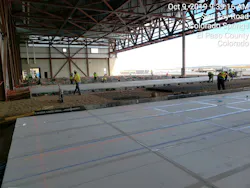
The 142,000-SF Attack Hangar is designed to hold six AH-64 Apache attack helicopters, along with modern maintenance shops that didn’t exist in the previous hangar. As the newest upgrade to the 4th Combat Aviation Brigade and Butts Airfield, the building also includes secured pre-flight planning rooms, flight operations, and support facilities. The large, open-span pre-cast concrete building will see year-round use as an aircraft maintenance facility where military personnel need to be comfortable working even with the massive hangar doors wide open in the winter.
“Radiant heating has been built into the hangar’s concrete floor to maintain thermal comfort during the colder months of the year,” Thompson says. Placed before the concrete is poured, plastic tubing circulates a hot liquid beneath the floor. The heat within the tubes radiates through the concrete and warms the surrounding air via convection. A key facet of maximizing the efficient return on investment in radiant heating is controlling the heat’s direction of dissipation. The USACE’s design specification called for rigid insulation beneath the tubes and Atlas Molded Products’ 60 PSI, high-density, rigid insulation foam was ultimately selected.
“A layer of molded polystyrene foam acts as an insulator between the earth and the concrete,” Thompson says of the need to efficiently control how the heat dissipates. Buildings lose up to 50 percent of their heat at the perimeter and slab of the foundation, making a below-grade thermal barrier vital to achieving thermal comfort efficiently in the large, high-ceiling hangar. Though it was Thompson’s first time personally using molded polystyrene as an underslab insulation, the material is well-known for its capacity to insulate roofs, walls, and foundations in pursuit of high-performance building envelopes on facilities of all sorts. Atlas’ line of architectural insulation provides owners and builders with stable R-values between 4.2 and 4.7 per inch and high compressive strengths ranging from 15 to 60 psi. Molded polystyrene’s ability to quickly dry after wetting conditions facilitates the ability of Atlas’ molded polystyrene to maintain established R-Values for the life of the building, which translates to more efficient operations.
“The molded polystyrene foam insulation was a really easy product to work with,” Thompson continues. “The soil was compacted, covered with 1-inch rock, and the rigid foam was laid flat on top of it. We were able to cut penetrations, notch around pipes, and easily fit it around every angle.”
Cost is always a driver in material selection. Savvy owners like the USACE understand the necessity of calculating both first costs and long-term operations costs into decision making. “The USACE doesn’t sole source any particular products,” says Morak of material procurement. “We do have a Buy American Act, and we use American-made materials wherever possible.”
As the finishing touches come together on the Assault Hangar, Morak and Thompson are pleased to share success.
“IHC brought the same effective, efficient, and exacting mentality from their exterior concrete projects to the interior,” Morak finishes. “We can all take pride in knowing this top-flight facility will soon be in service; a job well done.”
About the Author