SAN Replaces Legacy Terminal with Modern, Scalable Facility
Five Things You'll Learn
- How SAN replaced a legacy terminal while maintaining operations at a single-runway airport.
- Why progressive design-build helped accelerate delivery and improve coordination.
- How phased construction enabled a multiyear program without disrupting passengers.
- What role landside improvements play in overall terminal performance.
- How design can balance operational efficiency with a strong sense of place.
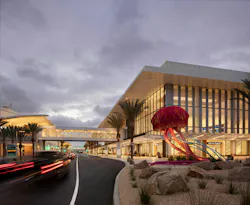
Arrivals Road to the New Terminal 1
Replacing a terminal at one of the busiest single-runway airports in the United States is not just a construction challenge. It is an operational test.
At San Diego International Airport, the New Terminal 1 program shows how large-scale redevelopment can be delivered while maintaining continuous operations and preparing for long-term growth. Completed ahead of schedule and under budget, the first phase replaces a 58-year-old facility with a modern terminal designed to improve capacity, access and passenger experience.
The scale of the project is significant. The program includes approximately 1.1 million square feet of new terminal space, 30 aircraft gates, a 5,200-stall parking plaza and a fully reconfigured network of roadways and bridges. Phase 1, which opened in September 2025, delivered the majority of the landside network and 19 gates, with additional phases continuing through 2027.
Winning Category: Terminal Program – Large Airport
- Project Name: San Diego International Airport New Terminal 1
- Airport: San Diego International Airport
- Cost: $2.9B
- Completion Date: September 2025 (Phase 1)
- Key Players: Turner Construction; FlatironDragados; Gensler
“The project was designed to replace a terminal that no longer met operational, capacity or passenger experience needs,” said Nicole Lucas of the Turner-Flatiron joint venture. “At the same time, it expands capacity and improves access while integrating seamlessly with ongoing airport operations.”
Delivering a Major Program on a Constrained Site
Executing the program required navigating one of the most complex environments in U.S. aviation.
San Diego International operates on a single runway, limiting flexibility for construction activities and requiring uninterrupted operations throughout the build. The project also progressed through the COVID-19 pandemic and periods of market volatility, adding further complexity to an already demanding schedule.
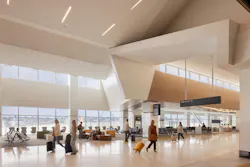
The team addressed these challenges through a progressive design-build delivery model and a highly coordinated phasing strategy. Design and construction advanced in parallel, allowing teams to respond to changing conditions in real time while maintaining alignment with operational priorities.
“The most complex challenge was delivering a large, multiyear redevelopment on a constrained site while maintaining uninterrupted operations,” Lucas said. “The team overcame this through deep collaboration, disciplined execution and a shared commitment to the owner’s vision.”
Close coordination across airport leadership, designers and builders ensured that construction activities were sequenced to minimize disruption while maintaining safety and reliability.
Designing for Growth, Access and Identity
Beyond execution, the project reflects a broader shift in how airports approach terminal design.
New Terminal 1 is three times larger than the facility it replaces and is designed to support future growth while improving the passenger journey from curb to gate. The reconfigured roadway network and expanded parking capacity improve access, while additional gates and improved circulation enhance operational efficiency.
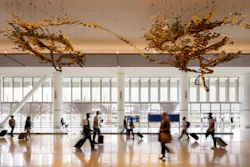
Inside the terminal, the design emphasizes a strong sense of place. Natural light, intuitive wayfinding, locally inspired concessions and public art reflect the character of the San Diego region. An outdoor dining terrace with harbor views creates a distinct passenger experience that connects the terminal to its surroundings.
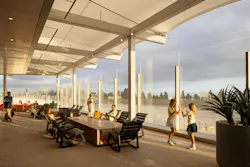
Since opening, the terminal has been widely praised for its functionality, aesthetics and ease of use. Operational improvements are already visible, including better passenger flow, increased gate capacity and improved landside circulation.
Looking ahead, the program positions the airport to meet long-term demand while maintaining flexibility for future growth. It also reinforces a key takeaway for airport leaders. Delivering complex capital programs depends as much on alignment and collaboration as it does on design and construction.
“At NT1, an integrated, people-first culture was as important as technical expertise,” Lucas said. “That approach allowed the team to navigate constraints and deliver a transformative facility.”
About the Author

Joe Petrie
Editor & Chief
Joe Petrie is the Editorial Director for the Endeavor Aviation Group.
Joe has spent the past 20 years writing about the most cutting-edge topics related to transportation and policy in a variety of sectors with an emphasis on transportation issues for the past 15 years.
Contact: Joe Petrie
Editor & Chief | Airport Business
+1-920-568-8399
>> To download the AviationPros media kits, visit: Marketing Resource Center
>>Check out our aviation magazines: Ground Support Worldwide | Airport Business | Aircraft Maintenance Technology