PHL Delivers Purpose-Driven Space with USO Lounge Relocation
Five Things You'll Learn
- How relocating a USO lounge can improve passenger flow and reduce congestion in high-traffic terminals.
- What it takes to deliver a project inside a post-security environment without disrupting operations.
- How a design-build approach supports faster decision-making in constrained airport spaces.
- Why mission-driven spaces are becoming an important part of the passenger experience.
- How integrating technical systems with human-centered design creates more effective terminal spaces.
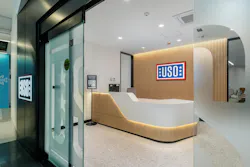
Not every airport project is designed to generate revenue or increase capacity. Some are built to serve a deeper purpose.
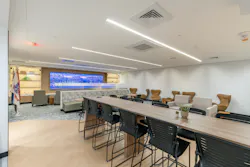
At Philadelphia International Airport, the relocation and fit-out of the USO Lounge demonstrates how airports can deliver meaningful, mission-driven spaces while navigating the operational realities of a busy terminal. Completed in March 2026, the project transformed an outdated facility into a modern, 2,830-square-foot lounge designed to support active-duty service members, veterans and their families.
Winning Category: Lounge
- Project Name: USO Lounge Relocation Fit-Out
- Airport: Philadelphia International Airport
- Cost: $2.6M
- Completion Date: March 2026
- Key Players: Arora Engineers; Corgan; D&R Construction; Arora Systems Group
Located in the Terminal D–E Connector, the new lounge addresses both a passenger experience gap and an operational need. The previous facility no longer met demand, while the new space provides a dedicated environment that reduces congestion in surrounding gate areas and improves overall circulation.
“The project was designed to address both a passenger experience gap and operational inefficiency by relocating and modernizing an outdated USO facility,” said Nicholas Selvaggi of Arora Engineers.
Building in a Constrained, Post-Security Environment
Delivering the project required executing a full relocation and build-out inside an active, post-security terminal environment with limited access and no tolerance for disruption.
Construction was carefully coordinated with the City of Philadelphia Division of Aviation, TSA, airport operations and adjacent tenants. All work was performed under strict security protocols, with sequencing aligned to minimize impacts on passengers and daily operations.
The team used a design-build delivery model to enable real-time coordination between design, construction and field conditions. This approach allowed for faster decision-making and greater flexibility as challenges emerged in a constrained space.
“The most complex challenge was delivering a full relocation and fit-out within an active, post-security terminal environment with limited access and tight space constraints,” Selvaggi said. “Continuous collaboration allowed the team to proactively resolve conflicts and maintain schedule integrity.”
This level of integration extended across all disciplines, ensuring that construction activities remained aligned with operational priorities while maintaining safety and compliance.
Designing for Purpose and Performance
Beyond execution, the project stands out for how it balances technical performance with human-centered design.
The lounge integrates modern mechanical, electrical and life-safety systems designed to meet current standards while supporting comfort, acoustics and accessibility. A comprehensive systems network includes AV, CCTV, access control and wireless infrastructure, ensuring the space functions seamlessly within the airport environment.
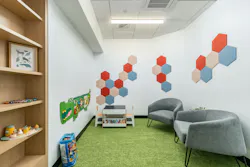
Inside, the design focuses on creating a calm and supportive environment. Quiet zones, family seating, a children’s play area and access to power and connectivity are designed to meet a wide range of needs. For some travelers, the space offers a place to rest during long journeys. For others, it serves as a private setting during more sensitive moments, including dignified transfers tied to nearby Dover Air Force Base.
The impact is already visible in both operations and passenger experience. By providing a dedicated lounge for military travelers, the project has reduced pressure on shared seating areas while offering a welcoming and functional environment tailored to its users.
More broadly, the project highlights a key takeaway for airport leaders. Even in highly constrained environments, it is possible to deliver spaces that meet operational needs while serving passengers with purpose and dignity.
About the Author

Joe Petrie
Editor & Chief
Joe Petrie is the Editorial Director for the Endeavor Aviation Group.
Joe has spent the past 20 years writing about the most cutting-edge topics related to transportation and policy in a variety of sectors with an emphasis on transportation issues for the past 15 years.
Contact: Joe Petrie
Editor & Chief | Airport Business
+1-920-568-8399
>> To download the AviationPros media kits, visit: Marketing Resource Center
>>Check out our aviation magazines: Ground Support Worldwide | Airport Business | Aircraft Maintenance Technology