DFW Rebuilds Critical Runway While Maintaining Operational Continuity
Five Things You'll Learn
- How DFW rehabilitated a runway handling 50% of departures without major operational disruption.
- Why reducing construction phasing from three stages to two accelerated delivery and minimized downtime.
- How reopening a shortened runway allowed 90% of aircraft to operate during peak travel periods.
- What an integrated project delivery model looks like in a high-activity airfield environment.
- How communication, coordination and stakeholder alignment drive success on complex runway projects.
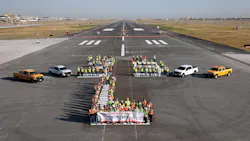 Finished project: Runway 35L team
Finished project: Runway 35L team
At one of the world’s busiest airports, taking a primary runway offline is not an option—it’s a risk that must be carefully managed. Dallas Fort Worth International Airport’s Runway 17R/35L Rehabilitation Project shows how strategic phasing and coordination can deliver major airfield improvements without compromising operations.
Serving as the primary departure runway on the east side of the airfield, Runway 17R/35L handles approximately 50% of DFW’s annual departures and plays a critical role in both regional and global aviation activity.
Category: Runway/Ramp-Large Airport
- Project Name: Runway 17R/35L Rehabilitation Project
- Airport: Dallas Fort Worth International Airport
- Completion Date: March 2025
- Key Players: AECOM; H.J. Russell; AtkinsRealis; Austin Bridge and Road; EAS Contracting
After decades of use and multiple temporary closures, airport leadership opted for a keel replacement approach rather than a full reconstruction, allowing the team to restore the runway to a state of good repair while minimizing long-term disruption.
Rethinking Phasing to Reduce Impact
The defining feature of the project was its approach to phasing.
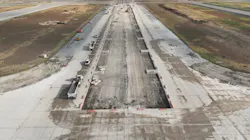
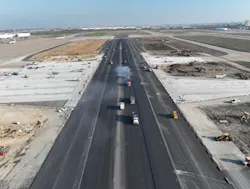
Initially planned as a three-phase effort, the team reworked the strategy into two phases, anchored by a full runway closure following the peak summer travel season in 2023. In just nine months, crews completed a full asphalt overlay on roughly two-thirds of the runway and reopened it one week ahead of schedule.
That early reopening—at a shortened length of 9,275 feet—proved critical. It allowed approximately 90% of DFW’s fleet mix to continue using the runway during the following summer peak, while construction continued on the remaining portion.
“As on any project—but especially at one of the busiest airports in the world—time is money,” the project team noted. “There are real operational costs associated with each day an asset is unavailable, which drove the focus on minimizing downtime.”
Delivering in a High-Activity Environment
Executing the project required maintaining continuous access to critical airfield functions, including taxiway crossings and terminal connectivity, while construction progressed.
To achieve this, the team developed detailed phasing plans in close coordination with airlines, the FAA and airport operations. Construction activities were carefully sequenced to support safe aircraft movement and maintain regulatory compliance, even as major work occurred on a key inboard runway.
The project also adopted an integrated delivery model that emphasized constant communication. Leadership maintained 24/7 availability to field teams, while coordination ramped up significantly as key milestones approached.
Weekly leadership meetings began months ahead of reopening, followed by daily check-ins and stakeholder coordination sessions in the final weeks. This structure enabled rapid decision-making, reduced miscommunication and helped resolve issues before they could impact the schedule.
“Decisions were made together, not in silos,” the team said, pointing to collaboration as a key factor in the project’s success.
Restoring Reliability and Extending Asset Life
Beyond the runway surface itself, the project delivered a broader set of airfield improvements, including upgraded drainage systems, LED lighting, signage, de-icing infrastructure and rehabilitation of nearby holdpads.
The result is a more reliable asset that reduces the likelihood of unplanned closures and lowers long-term maintenance demands—an outcome that directly supports airline operations and system efficiency.
At a network level, the improvements reinforce DFW’s role as a major hub, helping maintain operational performance and confidence among both airlines and the FAA.
The project also demonstrated a strong commitment to safety and sustainability, completing approximately 350,000 work hours with zero reportable safety incidents and reusing 330,000 cubic yards of crushed concrete on-site.
A Model for Future Airfield Projects
For airport leaders planning similar work, the project offers a clear lesson: success depends on early alignment and disciplined execution.
Engaging stakeholders early, developing flexible phasing strategies and maintaining consistent communication across all teams allowed DFW to deliver a complex rehabilitation project on an accelerated timeline—without sacrificing operational continuity.
In an environment where even minor disruptions can ripple across the system, that balance between construction and operations is what ultimately defines success.
About the Author
 Joe Petrie
Joe Petrie
Editor & Chief
Joe Petrie is the Editorial Director for the Endeavor Aviation Group.
Joe has spent the past 20 years writing about the most cutting-edge topics related to transportation and policy in a variety of sectors with an emphasis on transportation issues for the past 15 years.
Contact: Joe Petrie
Editor & Chief | Airport Business
+1-920-568-8399
>> To download the AviationPros media kits, visit: Marketing Resource Center
>>Check out our aviation magazines: Ground Support Worldwide | Airport Business | Aircraft Maintenance Technology