Five Things To Know About Tony Tyler’s Speech
We’re close to marking the 100th anniversary of an aviation milestone: On Jan. 1, 1914, Tony Jannus took a single passenger on the world’s first scheduled commercial airline service.
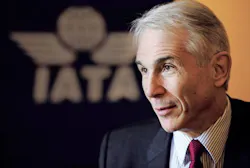
It was a short 23-minute flight, but Tony Tyler, the head of the International Air Transport Association used it to open his speech at New York City’s Wings Club last week.
Some highlights:
We’re the world’s transit system: This year, the world’s airlines will carry more than 3 billion passengers – equivalent to around 44 percent of the Earth’s population. “By value, over 35 percent of the goods traded internationally are transported by air,” Tyler said. “Within the United States, aviation contributes some $670 billion of gross value added annually, equivalent to 4.9 percent of GDP, and supports 9.3 million jobs.”
We’re the safest transportation system around: There’s more reasons than one why the industry’s first scheduled air service attracted all of one passenger. In less than a lifetime, air transport went from being a high risk activity to a routine part of daily life. For example, last year the Western-built jet hull loss rate was just 0.20 per million flights, or an average of one major accident for every 5 million flights. “At that rate, if you took a flight every day, odds are you could go 13,500 years without an accident,” Tyler added.
Despite those accomplishments, we’re broke: Aviation remains an enormously capital and labor intensive business that is extremely challenging across the business cycle and highly vulnerable to external events. Last year, the industry delivered earnings of $7.6 billion, but that only sounds like a lot. “On revenues of $680 billion, that equates to a net profit margin of just 1.1 percentt, or around $2.50 per passenger.”
The U.S. airline industry is showing how to stay in the black: Earnings last year, excluding special items, were around $2.1 billion for U.S. carriers with top line dollars being a veritable bargain. “In constant dollars, the average domestic round trip ticket, including bag and reservation change fees, has fallen by 10.4 percent since 2000,” Tyler said. “Meantime, the average price of Gulf Coast jet fuel has risen 260 percent since 2000.”
In other words, airlines are making money, with lower fares in real terms than a decade ago, in the face of much higher cost inputs.
Don’t worry about market forces, worry about the return of regulation: “Regulators have and are continuing to pursue policies that are preventing airlines from partaking fully of the global economic revolution they themselves have done so much to facilitate,” Tyler added. "The net result is not just bad for airlines, but for air travelers and the economy."
Tyler went into much further detail on government interference. For more details here’s the full speech.