Airhub Aviation Announces Boeing 737 MAX and Airbus A320neo Base Maintenance Expansions
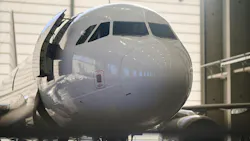
Airhub Aviation has increased its base maintenance capacity to include Airbus A320neo aircraft that are powered by Pratt & Whitney GTF engines or CFM LEAP engines, along with Boeing 737 MAX aircraft.
Airhub Aviation provides technical services at every stage of the aircraft’s lifecycle, operating out of an MRO facility with five maintenance bays and significant aircraft parking capacity.
The services expansion comes after a successful regulatory audit by Lithuania’s Transport Competence Agency (TKA), with the goal of responding to increased market demand for next-generation aircraft maintenance.
Airhub Aviation also plans to add technical services for the Airbus A220 aircraft to its offerings, currently completing the approval process and developing capabilities like:
- Line maintenance
- Aircraft transitions
- End-of-life asset management
Managing Director of Airhub Aviation Oleg Novak said, “The aviation market is evolving rapidly, and technical capabilities must evolve with it.”
He continued, “Expanding our Airbus A320neo and Boeing 737MAX maintenance scope responds directly to growing demand from lessors, operators and aftermarket players for specialized support across new-generation aircraft platforms.”
“It also strengthens our capabilities across the broader aircraft lifecycle, with a continued focus on technical asset management and residual value preservation,” noted Novak.
Novak explained, “We are seeing growing demand not only for regular 24-month checks but also for the first 12-year checks on new-generation aircraft.”
He elaborated, “A wave of A320neo aircraft is now approaching this milestone, bringing additional challenges for operators, including potentially longer ground times, as these checks are being performed for the first time in the aircraft's operational lifecycle.”
“Managing these complex maintenance events in the most cost-effective manner requires extensive technical expertise and strong MRO capabilities,” added Novak.
Novak said, “Additionally, over the past 12 months, we have seen the first Boeing 737 MAX 8 undergo an end-of-life management process, while A320neo part-outs are also gaining momentum following several airline insolvencies in 2025–2026.”
He continued, “Despite ongoing fleet modernization, the industry continues to face supply chain constraints, limited engine shop capacity and delays in new aircraft deliveries.”
“These pressures are increasing the need for solutions that keep aircraft operational while preserving long-term asset value, and are also driving demand for flexible technical slot availability across the aircraft lifecycle,” stressed Novak.
He noted, “Demand for specialized technical support is growing across NEO, MAX and A220 fleets, particularly where expertise in complex maintenance, aircraft transitions and asset management is required."