Technician at McConnell AFB Uses 3D-Printed Funnel to Solve Engine Servicing Problem
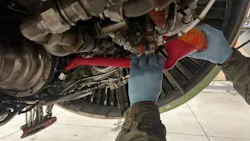
At the McConnell Air Force Base Innovation Lab, a new innovation is allowing technicians to service KC-46A Pegasus engines with less oil spillage and contamination.
2nd Aircraft Maintenance Squadron Crew Chief Tech. Sgt. Brandon Branstetter said, “They were essentially using a turkey baster to service the KC-46 engine starter.”
Branstetter continued, “It was dripping oil onto the ground, and I knew there had to be a better way to solve the problem.”
To address the issue, Branstetter developed a 3D-printed funnel to service the engine starter, which can be produced in-house for less than $3 using a 3D printer.
Branstetter’s invention is important because there was no product commercially available that could offer the right fit and maneuverability for servicing the KC-46 aircraft engine starter.
He created the initial design and prototype for the funnel using CAD software and a Bamu Lab H2D printer, using thermoplastic polyurethane to ensure durability and oil/fuel resistance.
Branstetter explained, “Once I got the dimensions of it, I modeled it up in CAD and then decided to print it out of TPU after finding out the dimensions were correct.”
He added, “We made it out of TPU because it is oil and fuel resistant, so it won't break down after continuous use.”
“For the test ones, I printed them out of polylactic acid, which costs about 30 cents each test print, but for the final product we used TPU, which costs about $2 to $3 max,” noted Branstetter.
He said, “It was a real specific design because of how the funnel needed to go across but still be angled to where it could reach. It just had real specific and challenging dimensions.”
Branstetter’s invention highlights the potential for 3D printing in aerospace, showcasing applications in various departments at McConnell AFB. This includes being able to create items like:
- Prototypes
- Custom tools
- Replacement parts
- Specialized items
As organizations can use 3D printing in-house, the process helps maintain low costs and reduce material waste.
“Almost any job can benefit from 3D printing. It's a cheap and convenient way to make readily available items to improve productivity,” Branstetter stressed.