Duncan Aviation Supports High School Aviation Maintenance Program with TFE731 Engine Loan
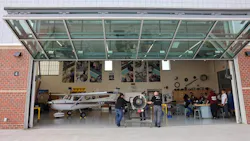
Duncan Aviation has permanently loaned a Honeywell TFE731 engine to Lincoln North Star High School’s Aviation Program to help support students who want to build careers in aircraft maintenance and engineering.
The engine is currently mounted on a stand donated by Discount Tire, ready to be used in the classroom to provide hands-on learning opportunities to engineering AMT students.
Initially meant to be used as a training aid within Duncan Aviation’s Apprentice Program, the engine was loaned to the high school after it was going unused due to priority changes.
The Aviation Program at Lincoln North Star High School can now use the engine for hands-on training, like performing borescope inspections and getting familiar with engine components.
Executive Vice President and Chief Operating Officer at Duncan Aviation Kasey Harwick said, “Darwin Godemann really initiated the conversation.”
Harwick noted, “We’ve always believed in using real-world equipment to build confidence and competence in our technicians. When this engine no longer had a home internally, it made perfect sense to extend that same opportunity to students at Lincoln North Star.”
Godemann is Team Leader of the Technical Training Center, and he coordinated the engine loan and placement at Lincoln North Star to offer similar experience that apprentices receive when training at Duncan Aviation.
“When we delivered the engine, students were working on small engines in class,” said Godemann, “I mentioned that the TFE731 is also a four-cycle internal combustion engine—just like what they were studying.”
Godemann added, “You could see the gears turning as they connected those foundational principles to a turbine engine.”
Lincoln North Star’s Aviation Program has received support from Duncan Aviation for many years, through actions like:
- Mentorship opportunities
- Facility tours
- Educational partnerships
Lincoln North Star Aviation & Technical Education Teacher Amanda Woodward said, “I plan to use the TFE731 to show how the four-cycle events in a small gas engine relate to the same processes in a turbofan engine.”
Woodward continued, “For more advanced students who have learned safety wire, it will be a great option to have students practice safety wire on application. For my most advanced students, I plan to use oscilloscopes to expand what we're already doing with airframe inspections to include powerplants.”
“Having an actual aircraft powerplant, on a stand in the hangar, transforms learning from theoretical to hands-on,” added Woodward, “It’s no longer just a photo on a slideshow, it’s tangible.”
Woodward said, “Students won’t forget the experience of inspecting a turbofan engine in a high school classroom. This gives them further opportunity to use real tools and truly explore whether a career in aviation maintenance is the right fit.”
Harwick added that this is about investing in the future workforce.
“By giving students access to the same types of equipment our technicians use, we’re helping them build skills earlier and understand what a career in aviation can look like,” he said.
“We are so lucky,” Woodward noted, “I thought having the Cessna 150 was cool, but this is on another level.”
“Our program is the only public school in the country with this type of equipment and opportunity,” said Woodward, “I’m excited to keep building and see how much excellence we can bring out in high school students.”
“Kids can’t pursue careers they don’t know about,” Woodward commented.
She continued, “Having this incredible partnership between Duncan Aviation, including all of these incredible hands-on learning opportunities—not to mention our students who are actually out at Duncan Aviation working on aircraft—is going to have an incredibly positive effect in the Lincoln community.”
Woodward concluded, “I hope everybody who reads this is as excited as I am and tells everyone they know about the unlimited opportunities in the aviation maintenance and aviation industries.”