How Aircraft Interiors Maintenance is Emerging as a Critical MRO Discipline
Key Highlights
- Interior components like seats, IFEC, and cabin fittings require frequent maintenance, especially in high-utilization narrowbody aircraft.
- The interior MRO market is fragmented, with major players and numerous regional firms competing on pricing, turnaround time and customization.
- Passenger experience and turnaround time are primary drivers for cabin retrofits, with airlines prioritizing quick, high-quality refurbishments to minimize downtime.
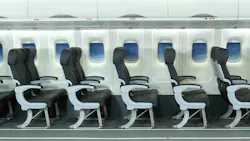
Airlines increasingly view interior Maintenance, Repair and Overhaul (MRO) as a strategic yield-management lever capable of extending aircraft competitiveness without triggering the capital intensity associated with fleet replacement.
As aircraft interior components live on a faster clock than airframes, a well-maintained cabin converts the aircraft into a highly competitive asset that commands top dollar.
The International Air Transport Association (IATA) notes that airlines typically upgrade cabin components every five-to-seven years, including:
- Seats
- IFEC systems
- Cabin fitting
However, studies show that aircraft with well-maintained interiors often sell 30-40% faster than comparable aircraft featuring outdated cabins. Due to this and similar economics, airlines are shifting focus to three critical areas that put more focus on interiors, which are:
- Improving passenger experience
- Maintaining cabin appeal
- Extending the useful life of aging fleets
The opportunity is particularly concentrated in narrowbody aircraft, where the massive installed base of Airbus A320 family and Boeing 737 family platforms together accounts for nearly 60% of the global commercial fleet.
A major driver behind this trend is operational frequency, as narrowbody aircraft average significantly more flight legs per day than widebodies.
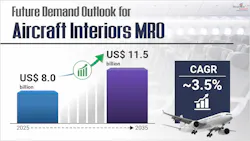
As of 2025, the market for aircraft interiors MRO was worth more than $8 billion.
The bigger question now is which operational and commercial factors will sustain this momentum over the coming years.
Why seating shows the highest demand in the interiors MRO market
Frequent daily cycles of an aircraft accelerate cabin wear, driving a continuous demand for the repair and refurbishment of components like:
- Seats
- IFEC hardware
- Galleys
- Structural parts
However, not all components follow the same maintenance cycle. For example, some high-touch, passenger-facing interior parts take on higher levels of daily wear and tear, requiring a refresh every six to 12 months. These include:
- Seat covers
- Seat cushions
- Curtains
- Class dividers
In contrast, other interior components only need routine maintenance inspections annually, such as:
- Cabin branding elements
- Electrochromic windows
- Cockpit interiors
The table below summarizes the typical MRO frequency across major components:
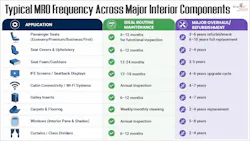
Seats and carpets experience the highest wear intensity within an aircraft cabin, due to:
- Continuous passenger load
- Frequent usage across multiple daily flight cycles
- Repeated recline and tray-table movements
- Constant contact with armrests, cushions and seat covers
How the interiors MRO ecosystem is competitive but fragmented
While overall aircraft MRO remains relatively consolidated, interior MRO is still moderately fragmented, with only about a quarter of total business being held by the top three players:
That leaves 75% of the market for a wide network of smaller FAA/EASA-certified regional firms specializing in maintenance like seat repairs, carpets and panel refurbishment, keeping competition intense across:
- Pricing
- Turnaround time
- Customization capability
- Service quality
This larger portion of the aircraft interiors MRO market also features prominent providers, such as:
- Lufthansa Technik
- Air France Industries KLM E&M
- SR Technics
- Delta TechOps
- AAR Corp.
- Etihad Engineering
- HAECO
- ST Engineering Aerospace
- SIA Engineering
Stratview Research’s insights highlight MRO in India as a critical standout. The nation is shifting from an outsourced MRO dependency—where up to 80-85% of maintenance was done overseas—to an expanding domestic hub—aiming to localize about 90% of heavy maintenance and engine overhauls by 2040.
India is currently the world's fastest-growing aviation MRO hub, with global aerospace giants establishing domestic facilities, making India central to long-term cabin supply chain strategies. This is largely driven by:
- Lower labor costs
- Maturing aviation ecosystem
- Strong government support
- Prime geographic location
Why airlines are investing more in cabin retrofits
Most passengers rarely notice the manufacturing year of the aircraft they are flying on. They judge the cabin experience, including:
- Comfortable seats
- High-quality screens
- Convenient charging points
- Overall cabin feel
From an airline’s perspective, Turnaround Time (TAT) can be more important than the price of MRO because aircraft downtime is extremely expensive. Unplanned emergency MRO costs typically skyrocket by 30% to 50% compared to scheduled maintenance due to urgent logistical demands.
The most immediate cost of an Aircraft on Ground (AOG) is lost revenue, with downtime being the largest cost driver in these scenarios.
The underlying macroeconomic reality of the aviation industry reinforces this reliance on interior refurbishments.
As per IATA, the global commercial in-service aircraft fleet as of mid-2025 totalled about 30,300 aircraft, and the average age of that fleet has reached 15 years. MRO frequency and intensity increase with aircraft age, though not always in a perfectly linear way.
Adding to this aging trend is intensive utilization, with IATA data showing that total demand in Jan 2026 was up 3.8% compared to January 2025.
Airlines are flying aircraft more intensively and filling more seats per flight, which drastically accelerates wear-and-tear on cabin interiors.
Supply chain constraints and certification bottlenecks at premium seat manufacturers such as Safran and Collins Aerospace are further disrupting the aircraft deliveries.
This makes extending legacy fleet lifespans the ideal option for many operators, shown in aging fleets of aircraft like:
- Boeing 777-300ER
- Airbus A330-300
- Airbus A380
- Boeing 777
- Boeing 787
These airlines’ retrofitting activities show how interior upgrades are bridging the gap created by delayed aircraft deliveries.
Which trends cause rising demand for interior MRO?
Though aircraft interiors MRO accounts for roughly 7% of the total civil MRO market, the segment is expanding at a notably faster pace than the broader sector.
Crossing $8 billion in 2025, the interiors’ MRO market is expected to expand at a 3.5% CAGR during 2026–2035, compared with 2.0% CAGR for the civil MRO industry.
Airlines are consolidating vendor relationships around providers who can own the full cabin scope, from seats and IFE to certification. Meanwhile, the commercial model itself is evolving from break-fix transactions to long-term Cabin Lifecycle Management (CLM) contracts anchored by:
- Predictive maintenance
- Spare pooling
- Digital tracking
Moving forward, adopting CLM will become unequivocally vital for every aircraft. It will act as a crucial strategy to help MROs with efforts like:
- Optimizing operational efficiency
- Saving labor hours
- Cutting unnecessary engineering costs
AI-powered platforms are already cutting unplanned downtime by up to 70% and reducing maintenance costs by 25–30%. For MRO players willing to invest in capability breadth and data-driven service delivery, the interiors segment offers a fundamentally stronger business.
In a market where every flight hour matters, interior MRO is the ultimate differentiator. It transforms a cabin into a high-yield asset, keeping the fleet flying, passengers loyal and margins high.
About the Author
 Vaibhav Prashant Pandit
Vaibhav Prashant Pandit
Vaibhav Prashant Pandit is a Market Research Consultant with 7+ years of experience specializing in Aircraft, Aircraft MRO, Datacenter, and Nonwovens industries, delivering strategic insights, market intelligence, competitive analysis and growth-focused consulting solutions.
He currently serves as Senior Research Analyst with Stratview Research.
Chandana Patnaik
Chandana Patnaik is Senior Strategist (Content) at Stratview Research.