Why In-Service Monitoring and Predictive Maintenance are Key for Aircraft Life Extensions
Key Highlights
- In-service monitoring captures real-world operational loads, environmental exposure and structural health, providing data beyond fixed inspection schedules.
- Combining monitoring with scheduled inspections allows targeted maintenance, especially for high-stress components like spars and corrosion-prone areas.
- Predictive maintenance uses operational data trends to identify potential issues early, enabling proactive repairs and extending aircraft service life.
Once a life extension is approved, continued airworthiness depends on how effectively the aircraft is monitored in real-world operation.
Building on a 2025 article series on aircraft service life extensions, this article shifts focus from assessment to ongoing operational management. It presents an in-service monitoring and predictive maintenance framework, using the Piper PA-44-180 Seminole fleet in Jordan as an example.
Why is in-service monitoring crucial?
Manufacturer service limits are based on assumptions about load, usage and environmental exposure.
In reality, these factors often differ based on an operator’s location. For example, flight schools in Jordan typically operate Seminoles in dry, predictable conditions.
Additionally, fixed inspection schedules alone may not fully capture an aircraft’s structural condition after life extension.
In-service monitoring helps operators to:
- Track actual operational loads versus design assumptions
- Detect early signs of structural wear or abnormal behavior
- Adjust inspection intervals based on real-world usage and environment
In-service monitoring also aids compliance with civil aviation regulations.
Monitoring doesn’t replace traditional inspections, rather it complements them by providing data-driven insight into aircraft health.
Why collecting operational data is key
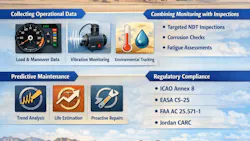
Practical monitoring focuses on parameters affecting fatigue and aging, such as:
- Load and Maneuver Data: G-meters or flight monitoring systems record peak and average load factors.
- Vibration Trends: Onboard sensors detect changes in stiffness or joint condition.
- Environmental Exposure: Monitoring systems rack temperature extremes, humidity and corrosion risk.
Even in arid conditions, such monitoring ensures structural awareness. Data can often be collected using existing instruments, with minimal cost or operational disruption.
How to combine monitoring with inspections
Operational data works best alongside scheduled NDT inspections.
Aircraft experiencing higher loads may need more frequent checks of components like:
- Wings
- Spars
- Primary load-bearing structures
For corrosion-prone areas, it’s best to inspect these periodically, even if the aircraft operates in primarily dry climates.
This integrated strategy aligns with the conditional life-extension philosophy, reviewing aircraft condition incrementally to maintain safety.
Why implement predictive maintenance?
Predictive maintenance identifies potential issues before they become critical such as:
- Tracking trends in loads, vibrations and minor damage over time.
- Estimating remaining life for key components based on real usage.
- Planning inspections and repairs proactively.
For example, stiffness degradation in a wing carry-through joint can trigger additional inspections or minor reinforcements, preventing fatigue-related failure.
What regulatory programs to consider
Programs must comply with civil aviation regulations like:
- ICAO Annex 8: Airworthiness requirements for continued operation
- EASA CS-25: Certification specifications for fatigue and damage tolerance
- FAA AC 25.571-1: Damage tolerance and fatigue evaluation guidance
Jordanian Civil Aviation Regulatory Commission (CARC): Local requirements for inspection and approval of life-extended aircraft
Well-documented monitoring facilitates regulatory approval and continued safe operation. Operators must document:
- Data collection
- Criteria for adjusting inspections
- Proof that safety margins remain acceptable
What operators can do
Flight schools and training organizations operating aging Seminoles can engage in predictive maintenance and proactive in-service monitoring by:
- Keeping monitoring systems simple and minimally intrusive
- Integrating data review into routine maintenance schedules
- Using collected data to guide inspections, not replace them
- Basing life-extension decisions on documented evidence of structural integrity
This approach balances safety, operational readiness and cost management.
For the PA-44-180 Seminole fleet in Jordan, this strategy ensures that life extensions comply with regulatory bodies and remain:
- Safe
- Reliable
- Cost-effective
Applied responsibly, in-service monitoring and predictive maintenance form the backbone of sustainable, long-term operation for aging aircraft fleets.
About the Author