How Reducing Paper Use in the Hangar Saved KLM Engineering Thousands
Key Highlights
- Optimizing printer placement and workflows reduceds unnecessary walking, saving time and costs for aircraft maintenance technicians.
- Mobile printing support enables engineers to print from devices at their convenience, increasing flexibility and efficiency.
- Regular workflow audits help identify low-cost, high-impact improvements that deliver quick returns.

By rethinking how printing worked in the hangar, KLM UK Engineering recently captured immediate cost savings and unlocked several workflow, compliance and ESG benefits. Their experience offered a powerful lesson for MRO leaders everywhere.
In a company-wide happiness survey, printing came out as the second biggest problem in the entire business. Staff hated it. And when PaperCut started digging into the reasons, the problem soon became apparent.
In aviation maintenance, where margins are already razor-thin and regulatory scrutiny is relentless, even small inefficiencies can erode profitability. However, the survey uncovered that KLM engineers were walking 273 yards (each way) to collect printed items like:
- Job cards
- Manuals
- Compliance paperwork
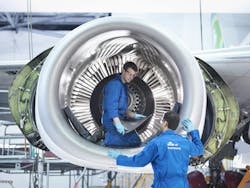
Sometimes this involved up to 20,000 pages for each individual aircraft check. That’s a half-kilometer round trip per engineer, per print job. As the engineers worked, moving from bay to bay, they needed their print jobs to essentially follow them. And this wasn’t happening.
What were the hidden costs of paper in the maintenance hangar?
Assuming it took each KLM engineer 10 minutes—twice daily—to walk to and from the printer. That represented about $240,000 in lost productivity and time for 100 technicians working at roughly $60/hour loaded cost.
KLM also didn’t have any functional print analytics or tracking, so it was challenging to know exactly how efficient their actual printing was or what new systems or processes would provide the best impact.
We worked out that if we could cut unnecessary printing by just 5% across 1,000 aircraft checks a year, that could save KLM up to 1 million sheets of paper. This would mean a significant decrease in annual cost and carbon output.
How an MRO workflow audit helped
One solution PaperCut recommended to help address KLM Engineering’s problem was adding a print-focused check to their regular workflow audit, including steps like:
Print Volume Analysis
- Estimate how many sheets of paper are printed per check (routine and non-routine).
- Quantify how many of those prints go uncollected, are cancelled or get reprinted.
Engineer Movement Mapping
- Physically walk with your engineers and map how far they travel to collect printed materials.
- Log typical walking time per print retrieval.

Queue and Printer Placement Review
- Evaluate whether print queues are mapped logically to physical printers.
- Find the printers in warehouses, terminals or offices that are underutilized or poorly located.
Reprint & Error Tracking
- Track how often print jobs are redone due to missing, misplaced or misrouted pages.
- Calculate wasted toner, paper and time due to misprints.
Security & Compliance Risk Assessment
- Review how secure signature and release of sensitive compliance documents gets handled to ensure the process is watertight and identify any gaps.
- Determine whether printed documentation is always available when auditors or regulators need it.
Common Sustainability Metrics
- Measure paper and toner usage (weekly, if possible) to get a feel for overall environmental footprint.
- Map how much print waste could be reduced via smarter workflows or cloud release.
This form of audit helped identify the optimization sweet spots, which are low-cost and simple MRO changes that can deliver high-impact, fast returns, showcasing how any MRO leader can use this process to find ways to improve printing procedures and reduce paper use.
How PaperCut measured operational impact at KLM
After capturing the data, the next step was to model its business impact. With KLM, PaperCut did this by quantifying the cost of walking distance, uncollected print jobs and reprint rates, so they could translate operational inefficiencies into actual dollars.
Observations included:
- Walking distance: Traveling 273 yards each way meant engineers spent significant time walking to get their paperwork. Multiply that by the number of engineers and the frequency of print jobs, and the labor costs added up.
- Waiting and reprints: Print delays and missing pages often triggered costly reprints, which meant wasted toner, paper and engineer time.
- Turnaround time drag: With KLM, delayed access to non-routine job cards meant signoffs got delayed, which slowed down aircraft release and reduced their overall throughput.
KLM’s own internal tally showed that within just a few months of optimizing their print system, they’d saved between $4,000 and $5,000 just in recovered print costs.
How to modernize printing at the point of work
Fixing the system during the KLM project didn’t require ripping out core MRO systems or embarking on a multi-year digital transformation. All the pieces were there, just not well-optimized.
Instead, we looked for the quick wins and targeted things we could change at the point of work, such as:
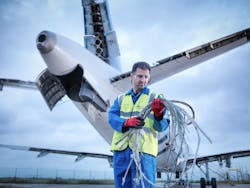
- Find-Me Printing: By implementing a “follow-me” or “find-me” print queue, engineers could print to whichever physical printer was closest or most convenient for them.
- Secure Print Release: This allowed engineers to walk up to any printer and authenticate and release their documents securely. This cut down uncollected printing and boosted security, as users can authenticate via swipe cards, biometric scans or a PIN.
- BYOD & Mobile Printing: KLM’s solution supports mobile and BYOD (Bring Your Own Device) printing, which means engineers can send print jobs from laptops or tablets, then release them at the hangar when they arrive.
- Transparent Reporting: The new print-management software platform also increased visibility, as IT team can now monitor uncollected jobs, track usage by user and generate reports to continuously optimize printer placement.
- Strengthening ESG performance: Reducing print waste was also a useful lever for ESG performance. Using less paper, ink and toner, and by eliminating unnecessary print jobs, can reduce consumable use and overall footprint.
These changes were relatively quick to deploy, and they didn’t require overhauling legacy MRO systems, but they unlocked huge productivity gains.
Over time, PaperCut also noticed behavioral changes at KLM. Since they had to be physically present to release each job, engineers slowly became more conscious of what and when they were printing, which helped shrink print usage over time.
Since KLM was aiming to reduce environmental impact across its entire operation, the print-management gains fed into broader sustainability goals.
Why this matters now for MRO leaders
In the aviation MRO world, documentation is non-negotiable. Regulatory bodies, auditors and safety teams demand that every maintenance action, checklist and non-routine task be clearly documented, signed off and traceable.
But if you’re going to print, you may as well harness the power of incremental innovation: small efficiency gains that can add up to significant savings. This could result in benefits like:
- Improved workplace safety
- Enhanced compliance
- More economical use of funds
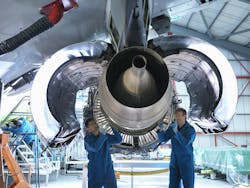
This also doesn’t always require a complete overhaul of legacy systems. IT could be as simple as taking a walk (and timing it) or shortening the distance between aircraft and print tray.
By fixing one annoyance—the long walk to the printer—KLM delivered real, measurable value.
The company achieved:
- Happier engineers
- Lower costs
- Stronger ESG performance
PaperCut offers MRO leaders looking for high-leverage improvements in a tight-margin world a simple piece of advice: Don’t overlook the basics.
About the Author
 Mat Buttrey
Mat Buttrey
Mat Buttrey is Senior Product Manager at PaperCut Software