JuliaHub Launches Agentic AI Applications for Industrial Digital Twins
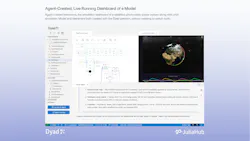
JuliaHub is celebrating the launch of a new solution for applying agentic AI to digital twins for industrial uses, including in industries like aerospace, government and utilities.
The company is also launching a $65M series B funding round led by Dorilton Capital, with other participants including:
- AE Ventures
- General Catalyst
- Bob Muglia
Dyad 3.0 enables autonomous AI agents to support digital design and testing processes for industrial machines during the development process.
Taking a process that historically has taken months to complete and allowing it to be completed in minutes, this solution reduces the time needed to design, test and build machinery like:
- Components
- Heat pumps
- Semiconductors
- Satellites
Dyad gives engineering teams an AI-first environment to model, test and validate industrial systems. The recently launched Dyad 3.0 integrates autonomous AI agents with:
- Scalable physics simulations
- Rigorous controls
- Safety analysis
- Code generation for embedded systems
This helps with processes like:
- Developing digital twins
- Adjusting controllers for specialized deployments
- Optimizing hardware designs from the start
Dyad works by using a modelling language that’s designed for AI agents to understand and respond to easily. As its logic is based in the laws of physics, Dyad’s AI agents can evaluate questions like:
- How temperature and wind speed impact components
- How fluids move through machines
- How forces like gravity affect design choices
“It’s not about helping engineers complete one small task at a time,” says Viral Shah, CEO of JuliaHub.
Shah adds, “It’s agentic engineering at scale, where teams can feed a full specification to Dyad and have it design the complete system. Spec in. Design out.”
Dyad’s AI agents are cloud-based, so they can scan through scientific data and information continuously to learn and improve its models. JuliaHub is also developing AI-automated lab testing so models respond in the same way as real-world scenarios.
This process is informed by streaming data and Scientific Machine Learning (SciML).
Dyad then relays all the relevant learned information back to engineers on a design project, allowing the engineers to:
- Review the processes
- Determine which assumptions align with customer needs
- Maintain a human element in the loop to ensure safety and compliance
Commenting on the partnership with JuliaHub, Synopsys Senior Vice President of Innovation Prith Banerjee says, “Dyad is transforming system-level engineering by combining scientific AI, agentic modeling, and a powerful compilation pipeline into a unified workflow.”
Banerjee continues, “Integrated with Synopsys simulation software Ansys TwinAI, it enables high fidelity hybrid digital twins by integrating physics-based simulation with data-driven models.”
“What once required extensive manual effort can now be done far more efficiently, accelerating the entire digital engineering lifecycle and redefining how intelligent, software-defined systems are designed and validated,” adds Banerjee.
Daniel Freeman—leader of the Series B round for Dorilton Capital—comments, “Systems modeling is one of the most strategically important layers of the AI-native engineering stack, because it is where physics, control logic and AI converge.”
Freeman continues, “JuliaHub has built something extraordinary with Dyad: a platform that doesn’t just model systems, but compiles them, taking engineers from concept to production control code in a single environment.”
“We believe JuliaHub has the potential to become one of the defining companies in Physical AI, and we’re proud to back the team as they accelerate Dyad’s path to market,” notes Freeman.
Former CEO of GE Aviation and Vice Chair of GE David Joyce says, "There is a disruptive transition occurring in engineering system design software, and Dyad is on the cutting edge.”
Joyce proceeds, “Previous generations of tools do not provide the promised productivity, or integration to unlock the value of AI.”
“With Dyad, you can model the physics, develop controls algorithms with auto code generation, and create accurate digital twins and surrogates for rapid development of deep learning inference models, all enabled by AI,” adds Joyce, “Dyad operates where physics meets analytics, and customers and shareholders win.”
JuliaHub plans to host an official launch event for Dyad 3.0 on May 19, 2026. Interested parties can join to learn about how customers are using Dyad and to observe live product demonstrations.