This St. Paul Company Equips Seaplanes to Fight Minnesota Wildfires
Bill Lukitsch
Star Tribune
(TNS)
From an airplane hangar in St. Paul, an aviation engineering business is working to put out wildfires in a quintessential Minnesota way: using lakes.
Fighting wildfires requires getting lots of water into places that can be slow to reach by land. Pilots have been using airplanes to scoop up lake water to fight fires for decades — but it’s always been risky. Several crash each year, often on the water, where pilots can hit a wave and sink or take off too early and stall out.
“This is a dangerous thing to be doing,” said Dan Garrett, founder and president of Momentum Aeronautics. “Our design thesis was: How do we make this as safe as possible for a pilot?”
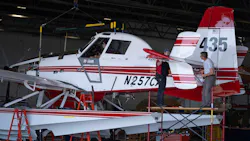
The St. Paul-based engineering firm’s solution is a new system that attaches to firefighting planes that pilots skim along the surfaces of bodies of water to fill an 800-gallon tank.
During wildfire season, a fleet of aerial firefighting planes is activated, especially in the dense forests of the North Woods.
After starting at the chalkboard more than five years ago, Momentum Aeronautics got clearance late last year from the Federal Aviation Administration for its newly engineered product, Heatwave. The system’s specialized pair of floats pull water into the storage tank to help pilots deal with treacherous flying conditions and keep better control of the plane on the water.
Momentum designs its float system to fit on a single-engine model airplane made by Air Tractor, a Texas-based manufacturer and a leading producer of aircraft used in crop dusting, firefighting and fuel transportation.
Wildfires pose a greater risk to lives and property as the world contends with a changing climate. In Minnesota, where fire season starts in spring, two large wildfires — the Stewart Trail and Flanders fires — collectively consumed roughly 2,000 acres and destroyed several homes in mid-May.
State officials predict warm and dry conditions this summer, some elevated fire risk and up to 16 days of poor air quality because of wildfire smoke.
Every spring when the lakes thaw, aircraft such as the small water-scooping airplanes become a valuable part of firefighting response, said Leanne Langeberg, a spokeswoman for the Minnesota Interagency Fire Center, which coordinates operations across the U.S. Forest Service, Bureau of Indian Affairs and the state’s Department of Natural Resources (DNR).
“They’re pretty nimble, and we’ve frequently used them throughout Minnesota when we’re in that initial attack stage,” she said.
Langeberg said other aircraft include bucket-carrying helicopters, the DNR’s flame spotter planes and the Canadair CL-415, a larger aircraft known as the “super scooper.” In wildfires, she said, all work together to help with containment and keep firefighters on the ground safer.
Officials cite a growing need for firefighting aircraft and people to operate them, driven partly by climate change. In 2023, a report from a commission of the U.S. Agriculture Department recommended agencies enter longer-term contracts with aerial firefighting operators and increase public funding for specialized aviation training.
Garrett said the demand for his aerial firefighting system comes from government agencies’ appetite for contracts with private operators. The business is delivering five systems this year, and he expects to hit 12 or more annually by 2028.
Although the technology fits some regions better than others, Garrett said the method of scooping water rather than landing back at base to fill up the water tanks saves time and fuel during a period when a wildfire battle requires rapid initial attack. Water-scooping aircraft, he said, can do up to 25 runs in an hour compared to two runs an hour for a land-based plane.
“It doesn’t do much good in the middle of the desert,” Garrett said. ”But here in Minnesota it makes a lot of sense.”
A client using the new floats this year is Florida-based Coastal Air Strike, a contracted aerial firefighting operator with planes and pilots stationed in Hibbing and Brainerd.
Colby Smith, one of its pilots and the primary trainer of new pilots, described the challenge of flying down to scoop up water.
“You’re kind of fighting this airplane, kind of bouncing off its nose and off the tail,” Smith said, adding that the new design removes a lot of those tendencies. He said five pilots were trained on the new system this year.
Though dangerous, Smith’s job offers changes in scenery and a feeling of appreciation from the public that he never got as a crop duster, he said.
“That’s kind of a nice change of pace for me,” said Smith, who began aerial firefighting in 2018. “You get to be a part of a bigger group and a mission when you’re putting these fires out.”
©2026 The Minnesota Star Tribune. Visit startribune.com. Distributed by Tribune Content Agency, LLC