GA-ASI and U.S. Air Force Demonstrate Autonomy Start Kit for Collaborative Combat Aircraft
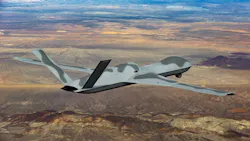
General Atomics Aeronautical Systems, Inc. (GA-ASI) and the U.S. Air Force recently performed a demonstration using the newest government Autonomy Start Kit (ASK) and an uncrewed MQ-20 Avenger jet to showcase developments in Collaborative Combat Aircraft (CCA).
The MQ-20 Avenger functioned as a testbed CCA, and the demonstration showed how the aircraft can coordinate with autonomy behaviors with complex infrared sensing using a tactical proliferated low-earth orbit data link.
The MQ-20 performed Infrared (IR) sensing with Single Ship Ranging (SSR) and engagement using GA-ASI’s TacPad Pilot Vehicle Interface (PVI).
GA-ASI’s TacACE (Tactical Autonomy Ecosystem) was built with the ASK and used SSR with an Infrared Search and Track (IRST) sensor to localize a passive target. This allowed the jet to track airborne threats and estimate the target’s range autonomously and without radar emissions.
This newly proven capability enables GA-ASI aircraft to remain completely passive, even in typically inaccessible electromagnetic environments, while:
- Detecting targets
- Classifying targets
- Localizing targets
Vice President of Advanced Programs for GA-ASI Mike Atwood said, “Integrated within the TacACE’s modular skills library, SSR supports autonomous mission execution, cooperative targeting and distributed kill chains, advancing the role of autonomous aircraft in future air combat and CCA operations.”
Atwood added, “This flight was part of a large forces exercise and allowed internal investment to showcase GA-ASI’s capabilities.”