In the Cockpit Scanning Seas for Environmental Criminals, Oil Spills
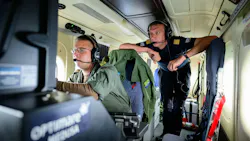
Emden, Germany — The crew of a twin-engine propeller aircraft spot a cargo ship off the coast of Denmark, out in the North Sea and decide to zoom in for a closer look.
The Dornier 228 LM descends towards the grey waves. The "LM" designation stands for Luftgestützte Meeresüberwachung - German for aerial surveillance of marine pollution.
Three members of Germany's navy are on board: two pilots and an operator from Naval Air Wing 3 Graf Zeppelin, based at Nordholz in northern Germany.
They are scanning the seas for potential environmental offenders, gazing down at the waves in the shallow bay in the German Bight, the area of the North Sea bordered by the Netherlands, Germany and Denmark.
"Kevin, take a look at two o'clock," pilot Benjamin radios from the cockpit to the operator at the rear of the aircraft and points to the freighter they suspect may be committing an environmental crime. "Let's fly over there."
As the aircraft approaches the freighter, operator Kevin looks at two large screens. One shows the live feed from a camera mounted beneath the aircraft. He zooms in on the spot where water is flowing from the deck into the sea.
"That looks like a cleaning operation," he says, giving the all-clear. "That will be seawater."
Cleaning the ship's deck with seawater and then discharging it into the North Sea is permitted, he says. No breach of regulations detected.
As the aircraft continues its patrol, fishing boats, sailing vessels, freighters and cruise ships pass below.
More than 120,000 ships move through the German Bight every year, making this part of the North Sea one of the world's busiest shipping areas, according to Germany's federal Waterways and Shipping Administration.
The job of an 'oil hunter'
Under international regulations, Germany is required to monitor its waters for marine pollution, including oil spills.
For 40 years, two propeller-driven aircraft - known as "oil hunters" - have patrolled the North Sea and Baltic Sea every day.
They are operated by the German Navy, while any suspected pollution is reported to the Maritime Emergency Response Centre in Cuxhaven, a joint operation of Germany's federal government and the coastal states responsible for coordinating responses to maritime accidents and pollution.
"We don't have to catch everyone red-handed," operator Kevin says as the aircraft flies just 600 metres above the sea.
Pollution can sometimes remain on the surface for longer depending on the wind and swell.
When it comes to detecting contamination such as oil slicks, even when no potential source is nearby, operators have a wide range of technology available.
A camera and sensors complement the plane's side-looking radar which, in ideal conditions, scans the sea surface up to 40 kilometres to either side of the aircraft.
The technician tracks the radar readings along the flight path on the monitor. "If there were an oil slick on the sea, it would deflect the radar beams upwards rather than reflect them. We see this on the radar image as a black spot," he says.
The oil hunters fly a series of routes across the North Sea and the Baltic Sea, including during the night. "There have even been ships that have counted on the fact that if they discharge at night, we won't see them," says Kevin. "But radar works at night too."
Aerial surveillance: 'Like a speed camera on the motorway'
The patrol flights carried out by the oil hunters – whose blue-and-white hulls bear the words Pollution Control in large letters on both sides – have a deterrent effect.
"We can see that the number of pollution incidents has simply been falling steadily for 40 years," says Benedikt Spangardt, Central Command for Maritime Emergencies spokesman who joined the team for the day.
While in the early 1980s, pollution was detected every 3 to 4 flying hours – effectively an average of one per surveillance flight – these days, the oil hunters only detect pollution roughly every 11 to 12 flying hours.
"We attribute this to the surveillance programme," says Spangardt, comparing it to a motorway speed camera.
"People know there are checks taking place and that there may be consequences. So I might think twice about whether or not to do something illegal."
The technology has also improved. In the past, photographs had to be developed after a flight and sent for analysis. "Today we’re much, much further ahead. We have data transmission. We can now even stream live video," says Spangardt.
The surveillance flights operate under the 1973 MARPOL Convention, the main international agreement governing pollution from ships.
"Monitoring shipping traffic in the North Sea and Baltic Sea from the air is certainly one of the most effective measures," says Finn Viehberg, head of the WWF conservation organisation's Baltic Sea office.
Germany and other coastal states handle this key task though when it comes to international shipping, the question remains as to whether the problem of marine pollution is being tackled in this way as a matter of principle.
"On international routes, it is questionable whether ships are not discharging their waste or sewage into the sea on the high seas – simply because there is not as much scrutiny there," says Viehberg.
The MARPOL Convention has not been signed by all seafaring nations and is based on voluntary participation, Viehberg says.
Alongside more binding rules, better collection facilities in ports could also help prevent ship waste from being discharged into the sea.
"It must not be worthwhile for seafarers to carry out waste disposal at sea," he says.
Securing evidence against marine pollution
In 2025, according to the German Maritime Rescue Coordination Centre, 130 incidents of environmental pollution were detected during surveillance flights over the North Sea and the Baltic Sea. In 37% of cases, the possible perpetrators were also identified.
To do this, the oil hunters must secure evidence that will stand up in court. Operator Kevin explains that there is a standardized procedure for this.
If the crew identifies a potential polluter, the aircraft performs several loops around the vessel while flying at low altitude – up to 100 feet (about 30 metres) above the sea – to take photographs; viewed from above, this flight path would resemble a cloverleaf.
During this manoeuvre, Kevin also takes photos with a handheld camera. The crew and the Marine Accident Command then pass on their findings to the investigating authorities. The oil patrol pilots often never find out what becomes of the cases.
"Just the fact that the ships know they're not unmonitored – that's a good feeling," says Kevin.
On this particular patrol, there is no need for the "photo pattern." After more than three hours in the air, the aircraft heads back towards the military airfield at Nordholz.
"No [water pollution] detected," Kevin radios after landing.
They will be back tomorrow, up in the air to track down any hazards in this patch of the North and Baltic Seas.
©2026 dpa GmbH. Distributed by Tribune Content Agency, LLC.