25 Years: Then & Now Systems Integration Drives Last 25 Years of Avionics
Say so-long to specialization. If the arc of avionics has taught us anything in the past quarter century it’s that. Systems integration rules today – a sometimes-frustrating frontier the industry has yet fully figure out.
When you look at radios 25 years ago, installation was comparatively straightforward. It was a matter of, “basic integration, not a lot of digital interface,” says Ric Peri, vice president of government and industry affairs for the Aircraft Electronics Association. “Fast-forward [to] today, where you’re talking about a fully-integrated cockpit with software controls. That skill-set is just fundamentally different.” While digitally intermeshed systems can be elegant to behold, “when you get into integration it’s much more complicated,” he says.
In circa-1989 avionics’ technicians would specialize in the repair and installation of analog radios, radar, or navigation systems. “Today we’re going to ask the same technician … to be able to repair multiple products,” says Thierry Tosi, vice president and general manager of Rockwell Collins Service Solutions business. Interwoven in that maintenance and installation must be an intimate understanding of how it all fits together.
AD 2014 technicians “have to deal with no-fault-found far more than before,” asserts Tosi. That’s because of the interconnectedness of it all. The entire integrated system may fail, when “it’s only one component that needs to be repaired. [That’s where] no-fault-found will come up. You remove the unit from the aircraft and go test it.” If the suspect box doesn’t squawk, you keep searching until you unravel the root cause.
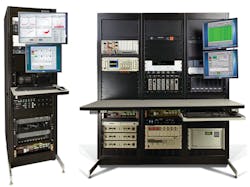
And here lies the irony of digital integration. Tosi and others believe that while it’s harder these days to quickly troubleshoot the problem, “It’s easier [once you’ve isolated the specific sub-system] to repair … You have an automatic test bench that tells you what to do.”
Often, visits to today’s automated benches are less frequent than to their forefathers. Reliability is just better. Many of 1989’s components remained rooted in “round-dial” mechanics. “They were mechanical, single-functional systems,” says Jim Rymarcsuk, Honeywell Aerospace’s vice president of strategic marketing. “From the maintenance side, they had many more demands … They were very fragmented separate instruments.”
“What you see is a fundamental shift,” says AEA’s Peri. “The reliability of the equipment is much greater than what it used to be.” It’s his contention aircraft electronics lag consumer electronics by about a decade in terms of adoption. Consumer electronics introduced today “would take roughly five years” to find their way into cockpits, “to go through the testing, the evaluation, the laboratory work … required.” Aside from the fewer moving parts entailed in digital systems compared to their analog ancestors, the robustness of today’s avionics is rooted in regulatory rigor.
AEA President Paula Derks says the switch from “essentially printed circuit board technology, and relatively simple systems, to more complex digital systems” means – for the most part – “these new boxes are sent back to the manufacturer” for fixes. The result is a reduction in actual “hands-on maintaining and repairing by the avionics’ technician or the A&P.”
Peri prefers the glass half-full perspective. “What [the OEM shift] does is create opportunities,” especially in-shop software updating. On your home computer you get software updates from Microsoft via Wi-Fi. “In an aircraft [shop], we’re not connected [via Wi-Fi] to the OEM,” he says. “All that has to be done by a shop. So it’s a shifting of technical skills."
The devil is very much in the details. It’s no mere matter of plug-n’-play. Absent an in-depth knowledge of how components fit together Peri says, “You can do a simple software update and [bring down] other systems, or … affect the reliability of other systems.”
That’s the integration piece of the puzzle. As opposed to their 1989 counterpart, Peri says today’s avionics’ technician “has got to understand integration mapping, and [have] the ability to validate the integration.”
Integration doesn’t end at the hangar door. Twenty-five years ago Tosi says the OEM performed ‘time and material’ repairs, in which a customer sent in a unit, asked them how much it would cost to fix and how much time it would take. Now, it’s a matter of inking an “integrated maintenance contract,” a power by the hour arrangement meant to ensure the aircraft operator “always … [has] a working unit on his aircraft.”
Repair management integrates spares and logistics, leveraging increased component reliability to keep operator parts stores sufficiently stocked.
The last quarter of a century has wrought real change. While airframe and engine evolution have been measured – arithmetic and measured – the introduction of digital cockpits rendered avionics change geometric and downright revolutionary.
There’s no way to fight it. All you can do – body and soul – is buy into the maintainer’s mantra of ‘education, training, qualification’ to make it through the next quarter century. Hope to see you on the other side.
About the Author

Jerome Greer Chandler
Jerome Greer Chandler is a two-time winner in the Aerospace Journalist of the Year competition's Best Maintenance Submission category; he won in 2000 and 2008. He received the Lifetime Achievement Award at the 2017 Aerospace Media Awards in Paris, France. His best-seller 'Fire and Rain' chronicles the wind shear crash of Delta Flight 191 at DFW.