Southwest Airlines CEO Talks About Fares, Fees And New Routes
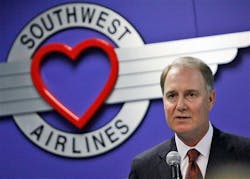
Southwest Airlines is, by far, the busiest commercial air carrier at McCarran International Airport. And, McCarran is Southwest's second-largest station of the 98 airports it serves.
With more than 2,700 Southwest employees in Las Vegas, the company is a major economic force in Southern Nevada, and the airline views the city as a key corporate partner.
Chairman and CEO Gary Kelly recently sat down with VEGAS INC to discuss the airline's future at McCarran, Southwest's "bags fly free" program and the strategies the company is taking to stay profitable:
You're in Las Vegas for a "message to the field." What happens at that event, and what will you be telling employees?
It's a celebration, a way to kick off the year. Last year, we did six locations and had an attendance of around 11,000.
At Southwest Airlines, we like to have fun, so this is another opportunity for us to get together. It's really basic things like sharing recent accomplishments, near-term goals, challenges we face and just being available for questions. It's a town-hall format, so I have some prepared remarks. We also give away prizes.
It's roughly a 2.5-hour event, very well-attended, very enthusiastic. It has a typical Southwest family feel to it. It has been awhile since we've held one in Las Vegas, where we have pilot and flight attendant domiciles. So we're back. We're glad to be back.
You've alluded in the past to Southwest's desire to fly to Mexico, the Caribbean and Hawaii. We've also heard a new rumor that Southwest is looking at Anchorage, Alaska. What's the status of international routes, and are there any plans for Hawaii or Alaska?
Our plans are pretty well known and set for the near term. Buying AirTran and closing on that transaction in May 2011 really set a significant amount of our work in concrete. That's a 3.5-year integration period.
The main deliverable in 2013 is to connect our networks, and that will set the stage so that we can begin to optimize the two airlines on a combined basis. Since '11, they've operated completely independently, and it's very inefficient.
In the meantime, we've been profitable. We bought a very solid business, and they've done a very nice job of running their business independently. Now, we begin to gradually integrate them into Southwest. That's the main objective for 2013.
For 2014, it will be to bring up the international capabilities within Southwest. That work was begun last year, so it's roughly a two-year effort. At that point, we'll have an international reservation system capability that will set the stage for us to complete our reservation system replacement on the domestic side.
We have all the multifleet work in place. We have a deal with Delta to retire the (Boeing) 717s so that by 2015, we'll be all 737s again. There are 88 of those aircraft.
In the meantime, both airlines have been operating well with very strong on-time performance. Southwest, by itself, had the best baggage-handling record in its history in 2012. So the wheels are still on, even while we have all this construction under way.
The stage is set to begin thinking about international after 2014. AirTran has a small international presence right now. The idea would be to move most, if not all, of that into Southwest when Southwest is ready, and then we'll be at a point where we can contemplate where we want to grow.
What we've been saying for a long time is the return on investment is like Las Vegas. Las Vegas isn't building new resorts. Likewise, we're not adding aircraft right now because we're not hitting our profit target that generates a sufficient return on investment.
That's a 15 percent goal, right?
That's the metric we use. Every company has one.
Why 15 percent?
That is sufficient to cover the cost of capital and to generate a sufficient return for investors. It's very, very basic.
Investors can argue whether that should be 18 percent or 12 percent. It's set based on alternative investments that are safer, then adding a risk premium. Airlines are considered to be pretty risky, and therefore you have to have a pretty good business plan to generate a sufficient return to accommodate that risk that you take.
It has been a positional number Southwest has used for 30 years. All these things we've been working on will contribute to us hitting that goal. We have a very good plan for 2013, and our plan does contemplate us hitting that target.
Of course, it assumes that jet fuel prices will stay at current levels and that the economy doesn't take a turn for the worse.
Will Las Vegas be a part of Southwest's international network?
We have a lot of work under way to prepare ourselves for expansion beyond the 48 states. You can lump Hawaii and Alaska into that.
We brought on the 737-800; we revamped our frequent flier program. All of this is in preparation for addressing the question you asked earlier, which is when. Logically, I think that would be 2015 and beyond.
Las Vegas, of course, vies for our top city all the time. Right now, it's second to Chicago, but in many years -- most years -- it's the largest city in terms of the number of customers who board, the number of seats that we offer. It is a very attractive destination. We're the No. 1 carrier here, and we're very proud of our long-term association with Las Vegas and the community.
When we bought AirTran, Southwest had 72 service points. When we complete the AirTran integration at the end of next year, we'll have 97. In a very short period of time, we're adding 25 service points. One-hundred percent of those won't get nonstops to Las Vegas, but they're all under consideration.
Of course, Las Vegas would be interested in international service and nonstops to Hawaii, and a whole host of opportunities will be available for the city and for Southwest. We're just not ready to undertake all that yet.
Is Southwest still seeking extended operations (ETOPS) certification to fly over water?
We're pretty much ready for ETOPS in the sense that we have the airplane. Of the 34 -800s we have, two-thirds of those are ETOPS-enabled.
The final step with the certification we wouldn't do until we're ready to announce Hawaii service. So there's no more preparation we need to do.
Once we decide, then we would have to undertake that and have enough time between the announcement and the certification to make sure we're prepared to launch, but there's no reason to do that until we're ready to go.
Rates climbed for Southwest in Las Vegas when McCarran's Terminal 3 opened. How much more does Southwest pay, and what benefits does the airline get from having T3 open?
It's not double, but it's significantly more than we were paying. We also got more space, and our unit costs are up.
The all-in cost per passenger in Las Vegas is very competitive. Las Vegas has an outstanding airport, and it has outstanding airport leadership.
And by the way, Southwest, along with all the other carriers, agreed to this. They full-well understood that this was going to be an investment for the future. The timing, of course, isn't the greatest because the market isn't growing right now in sufficient numbers to help drive down that unit cost. We just need more volume.
Our challenge is to try to manage our costs overall so that we maintain our low-cost leadership position. Admittedly, when our airport costs across the country are going up, it's one more thing we have to pay attention to. So we'll continue to work with the county and the airport to do what we can to mitigate those cost increases.
The nice thing today is that there is a recovery of the traffic that is taking place in Las Vegas. Our traffic was up in 2012, and we've got a good outlook for 2013, so hopefully this will be a short-lived issue.
You scared customers across the country recently with your "never say never" response when asked whether Southwest would abandon its "bags fly free" policy. Have there been discussions about modifying the policy?
That comment was intentional. It wasn't a slip, it wasn't a mistake. It was the truth. But it was under cross-examination by CNBC.
We have no plans to charge for bags. None. The question was along the lines of, "Will you ever do that?" Of course, I can't promise that into infinity we won't.
When we look at our performance to date, we are either in line with the industry over the last five years or well above. Our judgment was that we would win more customers than we would gain in fees. So not only do the gross revenue results support that -- our revenues are up $5 billion a year on an apples-to-apples basis since 2007 -- but we've done some pretty sophisticated research into what defection rate we could expect. It shows, remarkably, that we would lose about the same number we have estimated we'd gain looking at market-share shifts.
Can you explain that research?
What we've done is equalize everything: take into account seat changes that carriers have made and what has happened to market shares in the country. We're up at least a point, and at times, we're up 2 points. That's taking every other factor out.
What I can't prove is that it's all attributable to bag fees. We admit that. But that's one of the main variables that have occurred.
Then, we follow that up, talking to customers, saying, "This is what we do today. What would you do if we offered this?" And the number comes back almost exactly the same.
We think it has helped us by about a billion dollars a year. The research we did shows that if we started charging for bags, we would lose about $800 million.
The other thing is that we have a great plan for 2013. We have a laser-like focus on completing five major initiatives in a five-year time period. I think it would be foolish to throw anything else into the mix. I don't think it would help from a common-sense perspective.
In the future, are there opportunities perhaps to offer something different and include a bag fee? I think customers will tell us that. Maybe there is a scenario in which customers prefer to have the pieces and parts unbundled. That's not what we sense today.
We'll continue to be mindful of how the market changes and how customer preferences might change.
I went back and found a Southwest leadership memo from the early 1980s. There was great pride in the fact that we offered no tickets that required advanced purchase. The world has changed. Now, 80 percent of our tickets are bought that way, and customers have no problem with that. We just need to be open-minded.
Southwest recently began to offer a same-day line upgrade fee that allows customers to pay to board earlier. How that's working for the company?
It's pretty much in line with what we thought. I don't think we'll see a large percentage of our customers wanting to do that, but it fills a hole in our product offering.
We updated our boarding process in 2007 and offered folks who want a Business Select-type product to purchase that. Roughly 6 to 7 percent of our customers consistently buy that, they like it. It's our highest fare and has some bundling features in it.
We offered Early Bird in 2009. I think for us, that was an innovation. For those customers who don't want to buy Business Select and simply want to move themselves up with the automated check-in and an earlier position in line, that product fills that need. About 10 to 15 percent of our customers buy Early Bird. It's a very popular product.
So this is a feature that needs to fit within those other two products. When you're at the airport and you decide, "I don't like my boarding position, I've had a hard day and I want to move up in line," you can, if we have those open boarding positions. It costs $40.
Ten to 15 percent? No wonder I always get a B boarding pass.
About 99 percent of the Early Birds are in A groups. I travel all the time, and A is a good boarding spot in terms of getting the good aisle or window seat that you want.
But I don't think we'll see anything near that number of customers buy day-of upgrades. It'll be a fraction of Early Bird in my opinion. It's just a product offering. It's a choice.
It doesn't really impact others in line because I don't think that many people are going to buy it. Besides, they spent $40.
That's the trick here -- to try to find ways to generate more revenue in a way that is customer friendly. If we do that, then it will help keep the rest of our fare structure down, and that's the goal. And not to do it with hidden fees that people just totally despise.
It's not a fee. It's a version of a fare that gives a few more amenities; i.e., you get to board earlier.
If we can generate $40 million a year with it, that would be great.
Southwest also plans to generate additional revenue by using a new seat design and adding a row of seats. What's the status of that change?
There are 417 airplanes that will have that seating configuration. That's all of our 737-700 jets. There are eight AirTran 700s that are being converted to Southwest, so they'll have it. That leaves 33 that we will convert next year.
So far, it has gone very well. The customers seem to like it. We always look at the customer feedback about our seats, the old seats versus the new seats. As usual, you've got winners and losers.
We've got people who like the new ones better. We've got people who like the old ones better. But I think on balance, it's an improvement. It's a way for us to get six more revenue passengers on the aircraft and another technique for us to keep our fares down.
Las Vegas was one of the first cities to use the larger -800 series 737 jets. How does that change operations at McCarran?
I think it's wonderful from McCarran's perspective. The airport and Southwest are focused on local traffic, bringing people to Las Vegas, not using Las Vegas as a connecting point and utilizing scarce resources here as efficiently as possible.
So we have more seats per departure in Las Vegas than ever before. The airplane takes a little longer to turn at the gate so that has to be factored in, but the net effect is still a more efficient use of the gate. Our average turn time for an -800 is probably 10 minutes longer than a -700, and that's all the deplaning and boarding process for the most part.
As you would expect for an operator like us, it's a pretty material change, to go from 143 passengers to 175, with four flight attendants instead of three. So we've had some breaking in to do, but the on-time performance is very good and the load factors are higher than the system average. So for the scheduling of the aircraft, our guys are doing a great job.
How many -800s do you have now?
We had 34 at the end of the year, and I think we've added one or two. We'll get 20 this year, so we'll end this year with 54. We're firmly committed to 78 in 2014. We'll decide on the 79th delivery whether that will be a -700 or an -800.
What routes do you use those on from Las Vegas?
It's mostly the long routes to the East Coast. That's what it was designed for.
Has the use of the 737-800 planes created any unexpected operational problems?
Like any airplane, it has its limits and its drawbacks. Those are not hard issues to identify, and all of those factors were known.
It's a very cost-effective airplane as long as you have a solid load factor. It's much more profitable, much more cost-effective than the -700 in the right circumstances.
Occasionally with headwinds, with weather, it is a little bit more of a challenge. But we have those challenges with all of our airplanes.
Any reaction to the merger between US Airways and American Airlines?
As somebody on the sidelines, it's interesting to watch, and it has been long predicted that the industry would consolidate. So it's really not surprising to see this. US Airways has made no secret for years that they were interested in doing something like this.
We'll face vigorous competition whether it's one airline or two. We've already witnessed how airlines have successfully gone through bankruptcy and dramatically lowered their labor costs and made themselves more cost-competitive. They're still not at our cost levels, but they're certainly more cost-effective than they were, and some of them are turning out very handsome profits right now. There are a lot of labor cost increases that are occurring with our competitors because they were cut so low.
In any event, we're going to face a competitive landscape from the legacy perspective, and we're more than prepared for that.
How do you feel about restrained capacity? Do you think it will be adopted by the aviation industry?
I think it already has happened. It has been an imperative. Unfortunately -- and it's been especially true since 2006 -- the operating cost per unit has just gone straight up because of fuel prices. The industry was forced to react or go out of business.
It's basic: Get the occupancy rate up or get the fare up. So we're constantly pushing those two levers.
If you look at Southwest, our load factors today are significantly higher than they were a decade ago and even five years ago. We've been forced that way.
What is helpful, though, is if you think about it in reverse. Let's just say that we didn't fill the airplanes up more, and we relied more on fares. What would happen is that fewer people would fly, and you'd actually end up with less seats. So I approach the answer to your question in reverse. It's not squeezing fewer flights. It's actually enabling more flights because you found a way to boost the revenue on that flight.
So what's going on with total traffic? The short-haul market over 20 years is down. The medium-haul market is sort of flat. The growth has been in the long-haul market. If you squeeze all that together, compared to 2000, traffic is up 2 percent and the economy has grown 20 percent, so it's not keeping pace.
And the reason, I would argue, is that the fares are higher because of increased fuel costs. So that's the enemy, and that's why the focus on the airport here and the airport costs are what they are. It's an acknowledgment that we've got to find some way to make fares affordable or people won't fly. If the demand is here, you're going to have seats.
There is nothing more Southwest would like to see than increased demand where we can add more seats and more flights in Las Vegas. If another airline chooses to pull out, it's another opportunity for us to pull in. And we're not the only airline thinking that way.
Las Vegas is going to do great. You are the last market that ought to worry. There are some marginal cities that I do feel for because they just can't generate the traffic at today's higher fares because of higher costs to sustain much flight activity. You're always going to be a primo destination and a great business community. You're always going to have really good air service.
Copyright 2013 Las Vegas SunAll Rights Reserved
