World-Class, Without The Pricing
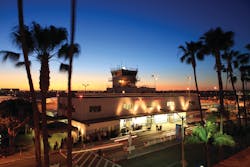
“Ahead of schedule and under budget.” “Southern California resort look and feel.” “Twenty minutes from the parking lot to the gate.” That’s Long Beach, California’s new passenger concourse, which opened for operations on December 12. Though there is still plenty of work to do, the function is obvious, and the style, including some surprises, is also obvious.
Long Beach Municipal Airport (Daugherty Field; KLGB) welcomes over three million commercial passengers a year through its 41 daily operations, plus a healthy amount of corporate and private traffic. Additionally, as the assembly site for Boeing’s C-17 Globemaster III, the 10,003-foot main runway stays busy. In recent decades, though, LGB’s considerable charm was becoming an increasingly-solitary draw.
Located just down the coast from Los Angeles and with neighboring harbor facilities (the largest in the U.S.), Long Beach was a city in decline, as the once-considerable defense businesses (including such significant entities as the U.S. Navy) pulled out starting in the 1980s. By the mid-90s, Long Beach looked like just another abandoned, run-down, stagnant American city.
Now six and a half years in office, Mayor Bob Foster comments, “Fifty thousand jobs left Long Beach in the 1980s; then the Navy pulled out. The city was at ‘depression level’ in the mid '90s.”
"Except for the Riviera-like weather and incredible nearby scenery, it was running on empty."
"We have a great tourist destination here, and we know that the airport is a big part of that. We had an airport that went from cute, iconic, and comfortable ... to cute, iconic, and congested. One of our goals was to go from parking lot to gate in 20 minutes. We wanted the improved airport to be ‘big, but manageable.’ The airport is the face of the city. This was a very important project, and it turned out better than expected.”
The city was well-positioned to exploit the downturn, as Foster relates, "We don’t carry a lot of debt. One-time revenue is hardly ever used for ongoing expenses.”
The significant hub for JetBlue (JetBlue uses the term 'Focus City') and a destination for Delta, US Airways, and Alaska, soldiered on, its excellent military infrastructure supporting giant airplanes as well as the 737s, A320s, and 757s that make up the daily faire.
Unfortunately, LGB looked and felt old. A traveler’s review in 2010 describes the airport as "Rinky-dink, decrepit, and old; a local airport that should have been either upgraded or torn down DECADES ago."
Could Have Gone Either Way
The do-over could have been a disaster; it nearly became one, but those in charge didn’t give up and worked on the common goal, knowing that a vibrant, convenient airport can transform a city. Long Beach, though, did not want to concentrate on only airline traffic.
First, its NIMBY-limited 41 daily ops constrained airline expansion; second, its huge capacity and long runways invited corporate use. With an in-the-fence area of 1,166 acres and easy transport over short distances to the Los Angeles area, LGB had, in addition to capacity, an ideal location.
The project needed to expand airplane-handling capacity, and early on, the decision to forego jetways was made. This was not to preserve the 1930s feel of Long Beach, but rather to allow flexibility in aircraft docking. Since the climate is dry and mild, passengers will typically have a pleasant walk to/from their planes. Stairs also allow, should airlines desire, loading through fore and aft doors, simultaneously.
Passenger convenience was paramount. Not only is LGB one of the few airports with free Wi-Fi, the airport’s planned convenience extends all the way from terminal signage to mobile apps that tell what’s going on, so that ground transportation can be updated in real time.
Early in planning, the decision was made that the original terminal could be retained and repurposed, and the new concourse would be built between the historic terminal and the runways. This not only preserved history, it meant that construction costs could be minimized as new facilities would not have to duplicate existing ones.
Airport director Mario Rodriguez arrived here in early 2009 after turning around and improving a couple other regional airports. He had a different vision. “All airports look exactly the same,” he remarks. “Why? We can break that mold. We can make it simple, pleasant, and convenient. We don’t need to scale down O’Hare.” Over the airport’s design life (30 years), the airport’s flexible design allows “the ability to change on the fly, at 1/10 the price of building new.”
However, the things that could derail the cost savings were the unplanned, such as the original general contractor’s default. Work effectively stopped. Rodriguez explains, “We [airport management] in essence took on the role of general contractor during the interim period,” maintaining key subs, listening to those subs and revising the plan on the fly to make best use of completed work and avoid costly pitfalls that were yet to come. The city and airport management’s reaction to this possible tragedy was key to the project’s ultimate success and its being both early and under budget.
The airport’s new construction meets and exceeds LEED-Silver standards (the airport believes it can earn Gold certification), employing everything from lo-flow toilets to getting an eighth of its electrical power through solar technology.
Still, Costs Matter
Rodriguez notes that typically airport facilities are financed through bonds. This debt, much like a mortgage, is paid by the airlines. The airlines, in turn, pass this cost on to their customers. "We opted to be more businesslike and prudent," he says. "Our new improvements are self-funding, which means that the cost should not be passed on to our airlines and, by default, our customers.”
Airlines got involved from the beginning, knowing they were not obligated to fund the project. “When they heard ‘free,’ they got very interested,” and were themselves free with their ideas and help, adds Rodriguez.
"LGB stands out not because we spent hundreds of millions to accomplish this task, but because we did not. We designed the building in such a way that it is easy to modify, and we have the money to do it.”
On the side of comfort, Rodriguez has only local businesses as concessions, run through The Paradies Shops. “With every [other] airport the same, we wanted to do it differently," comments Rodriguez. "This is not a ‘big box’ airport. Over here, it looks, feels, tastes like a high-end resort. You won’t see Starbuck’s, Burger King — and no upticks. Everything is street-priced here. It elevates your experience without gouging — we’re world-class, without the pricing.”
Rodriguez, whose annual airport budget is just under $40 million, aims to make the airport at least a break-even proposition rather than a cost center for the city. He addresses areas where the airport was doing things that looked good on paper, but that weren’t working. A case in point comes from the City Auditor’s report, issued in early 2012.
With more than three million passenger operations, one would expect a thriving taxi and limo business. There are 26 shuttle van operators and approximately 460 luxury sedan/limousine operators authorized to access the airport, and per their contracts, such services self-report, and pay a fee of $1.75 per passenger. At the time of the report, Underlying support for these payments, such as sales receipts or gasoline meter readings is currently not being required.” Further, the underlying basis for these payments — the number of airport pickups during the preceding month … is not independently verified.
Checking further into the revenue stream from livery, the auditor found that in a single month, “Of the 18 operators listed in the log, one accurately reported the number of passenger pick-ups. The remaining 17 operators either under-reported pick-up activity or did not submit a report.”
The auditor’s report contained several suggestions, which the airport investigated. “One option we contemplated is working with the Los Angeles International and John Wayne Airports to implement a program where all three airports use a single electronic transponder system that will record each visit to the airport and allow for electronic reconciliation and possibly billing," explains Rodriguez. "Conversations have been promising … but [under current conditions] it does not make any business sense. The preferred option in this circumstance is to opt for a yearly permit fee in lieu of a per pick-up fee to reduce administrative overhead."
Rodriguez thinks the interim solution is a lot better than maintaining the status quo. “Currently, LGB spends about $80,000 to collect almost $45,000," he adds. "The annual fee option will lower costs to near revenue levels.”
Mayor Foster remarks, “[Rodriguez] wanted to make this a social airport and a ‘Long Beach’ airport, using local vendors. He wanted an airport where you could afford to buy a sandwich without the fear of actually eating it.”
Long Beach has largely achieved its goals. Though there remains some six more months of work ahead, the passenger experience has improved; the food is good; the Wi-Fi remains free; the integrated information system works; and passengers can still get from the parking lot to the gate in under 20 minutes.
As the mayor says, “In Long Beach, we’re not LA.”
There’s An App For That. All Of That.
Arpit Malaviya, VP for business development at ProDIGIQ, points to one of the forty 65” HD screens that will communicate to everyone in the new terminal. Everything from arrivals and departures, to commercial flight tracking, to ADA-compliant visual paging, to emergency warnings and instructions. Two walls of six ganged-display screens can also welcome guests or “act like a digital billboard,” says Malaviya. Each screen is also supports an advertising delivery function. “Mario Rodriguez [airport director] wants this facility to support itself, and he is open to unconventional funding streams.”
Airport signage isn’t new. What is new at LGB, though, is the seamless integration of information. “We support the passengers with information all the way from their homes to their cars, through the terminal, and through baggage claim on their way back,” says Malaviya, “And all in real time.” With an iPhone, iPad or Android app, a traveler can see the arrival and departure information anywhere, any time. Better yet, all the apps and all the screens draw from one data set. “The customer sees the information as soon as the airport; and it all agrees internally.”
Everything comes from the cloud. “I personally believe this is one of the largest all-cloud installations in the world,” Malaviya continues. “Regional airports are leading the way. They have limited in-house [IT] resources, so they need outside help with their solutions. That they don’t have these resources is really a blessing, though, because this way, they can lead the industry in technology.”
Everything is off site, and everything is run by ProDIGIQ (its largest installation is Indianapolis International Airport). “It’s not the airport’s responsibility; it’s ours," remarks Malaviya. "Where this kind of advanced information system might take as many as a dozen people to run locally (and with the local obstacles of finding and expanding IT training and people), the airport needs no one."
Instead of spending money up-front on equipment and technology, and paying attention to maintaining and upgrading it, the airport management passes those tasks to ProDIGIQ. This takes a certain level of trust, and the airport’s due diligence was satisfied with examination of ProDIGIQ’s 50 existing installations. (Five more airport installations are currently underway.)
Still, it is convenient that ProDIGIQ is located nearby, in Calabasas. “This also allows us to bring new ideas to LGB, first,” says Malaviya. “Today’s passenger comes from beyond the terminal. We think beyond the terminal.”
About the Author

Tim Kern
Tim Kern is an aviation writer, aircraft builder, and private pilot. He is based in Anderson, IN, and can be reached at [email protected].
Tim Kern, CAM, MBA, has written for over 50 aviation publications, and is a consultant for a variety of companies; www.timkern.com.