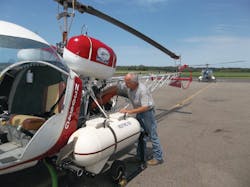
Designed by mathematician, philosopher, and inventor Arthur Young working for the Bell Aircraft Corp. in New York, the Model 47 was the first helicopter to be issued a civilian Type Certificate by the FAA. This Franklin piston engine powered helicopter received its Type Certificate in March of 1946.
Later used during the Korean War with the U.S. Army designation H-13 Sioux, the most common model, the 47G series, came along in 1953 with a Lycoming VO-435 piston engine. The exposed welded tubular tail-boom, dual saddle-tank fuel tanks, skid landing gear, and of course the large round “bubble” canopy made the Model 47 very recognizable.
Some quick research revealed figures of more than 5,600 Model 47s built, including those produced under license from Bell by other companies around the world, with nearly 1,100 on the FAA registry today and I’m sure more in other countries. Today most operators use this tried and true light-helicopter for aerial application and helicopter flight training.
Scott’s Helicopter Services
One long time operator of the Model 47 is Scott’s Helicopter Services located in Le Sueur, MN. In 1981 Scott Churchill began operating one Model 47 for agricultural application in southern Minnesota. Over the years the business grew and today operates 20 Model 47s, 8 Bell Jet Rangers, and one B model Huey in a variety of missions: agricultural application, insect control, helicopter flight training, television news, aerial photography, and heavy lifting.
Holder of an FAA repair station certificate it performs routine maintenance and inspections on its own fleet of aircraft as well as for customers worldwide, and has a dedicated shop capable of repair and overhaul for many components, several models of the Allison turbine engines, and the Lycoming VO engines. In 1994 it became a Bell authorized service center for the Model 47.
When I visited the facility it was full of helicopters undergoing a variety of maintenance. I visited with Ben Hammer and Eric Lane as they worked on one of the helicopters used for aerial application. Both are pilots and mechanics and explained how they primarily fly aerial application or insect control in the summer months and perform maintenance in the off-season. Lane explains, “I began working here over two years ago as an aspiring helicopter pilot. The bonus for me is I also get to work on them.” One of many projects I was shown was a 1947 Bell Model B1 being readied for complete restoration.
Texas Helicopter Corp.
In an effort to ensure availability of spare parts for both his fleet and for the industry, Churchill purchased Texas Helicopter Company (THC) in 2001. THC provides numerous Model 47 replacement parts certificated under an FAA parts manufacturing approval (PMA) such as cooling fan belt sets, main-rotor grips, engine mounts, typical fluid hoses, and more. THC also supplies supplemental type certificate (STC) kits such as an exhaust muffler kit which significantly reduces noise with only minor performance losses, the “No-Bar” kit which removes the stabilizer bar from the main rotor system reducing the aircraft’s weight by more than 30 pounds and provides the pilot a more responsive feel. Additional STC kits include the Sprag Kit and Lycoming VO-435 series engine modification kits.
Realizing that availability of spare parts would continue to be a future concern for all Model 47 operators, in 2002 Churchill approached Bell Helicopter to discuss the possibility of a licensing agreement which would allow his companies to build more parts. Churchill explains these discussions were on and off for five years and eventually in 2007 the discussions went cold. Then in February 2009 Churchill received a telephone call from Bell and recalls, “I remember it well. Basically I was told they decided not to enter into a licensing agreement with my companies to build parts. Instead I was told they would sell me the Type Certificate of the Model 47.”
Scott’s – Bell 47, Inc.
Churchill laughs and says after recovering from the shock he traveled to Texas where he signed a letter of intent to purchase the Bell Model 47 type certificate (TC). After six months of negotiations he became the owner of the Model 47 TC.
There are three type certificates for the different groups of models and with a smile Churchill goes on to explain he actually owns five TCs and 50 STCs altogether. The TCs are the three for the Model 47, the M74 Wasp from THC, and the Mark 5 & 6 Tomcat from Continental Copters. Both the Wasp and the Tomcat are single-place agricultural use aircraft derived from the Model 47 airframe.
I asked the question, “What do you get when you purchase the rights and TC for a 60-plus-year-old helicopter?” The answer was thousands of engineering drawings dating back to the 1940s, and a warehouse full of tooling, forgings, castings, templates, and more.
Supporting the industry
Churchill says the first priority is to support the industry with spare parts and great service, and feels if they successfully do this the industry will support them. Richard Jants, the quality assurance manager for SB47, says, “The Model 47 in total has approximately 3,500 parts. Granted many are standard parts and hardware, but now we are able to supply approximately 125 of these as PMA parts, and we are one of the only suppliers left for certain critical and life-limited parts. Our goal is to become the exclusive place for Model 47 operators worldwide to come to for spare parts.”
I was shown a new engine mount for the Lycoming powered Model 47 soon to be certified and available. Jants says, “The new engine mount is an upgrade over the original Bell and THC produced engine mounts.” There has been a history of cracking on these mounts in the past when subjected to repeated landings which is common in the aerial application operations. SB47 investigated the cracks and related design and process changes made over the years, and after agreement with the FAA on process changes, they are confident these new mounts will address the issue.
Also in the works is a new avionics system including an entirely new instrument panel. Jants says, “We are in final testing for a new instrument panel which we feel will serve Model 47 operators well. The new panel will be customizable for avionics options and designed to be both maintenance and pilot friendly.”
The new panel will replace the old electro-mechanical gauges with modern solid-state gauges with much improved quality and reliability. Regarding rotor blades, SB47 currently has no plans for new metal blade production because the old design offered no opportunities for cost reductions or increased life limits. But they are working on new composite blades which should be available next year. The use of composite materials enables SB47 to tailor the airfoil to produce a more efficient blade, and it is also expected to have a longer life limit, maybe as much as 10,000 hours.
SB47 has many other parts currently in the FAA approval cycle and Jants explains they recently went through an FAA audit by the Minneapolis Manufacturing Inspection District Office. Jants says, “More than 90 percent of our suppliers hold either ISO 9001 or AS 9100 quality program certification. We realize the definite advantages of working with suppliers that meet these high-quality standards.”
What’s next?
SB47 has a small dedicated staff to support the fledgling company. Included are draftsmen to convert all of the original Bell drawings to a digital format including 3-D modeling. Jants says, “We have a long way to go. So far we have approximately 10 percent of the original drawings converted.” As part of the TC purchase agreement Bell provides some level of technical engineering support to SB47 for a period of time.
As for engines, that’s a whole new discussion. Churchill explains, “Lycoming discontinued the vertical-mounted engine for the Model 47 after the military program ended decades ago. Over the years we’ve purchased loads of engines, engine parts, gearboxes, and rotorheads but eventually we need to face the engine issue. There is no longer tooling available for building these engine case halves.”
There are STCs available for a turbine engine upgrade to the Model 47, but Churchill is taking this a step or two further. SB47 recently entered into a memorandum of understanding (MOU) with Rolls-Royce to discuss opportunities for using the RR300 turbine engine in the SB47. Churchill says, “The RR300 is a great engine with a 2,000-hour time before overhaul.”
Both Scott’s Helicopter Services and THC have enjoyed a long relationship with Bell Helicopters and they see no reason for this to change. Being an expert on the Model 47 they have provided Model 47 operators and maintenance organizations with educational sessions for many years.
Churchill feels there is a market for the light-helicopter, albeit small; he feels the Model 47 is one of the primary light-helicopters available. He concludes by explaining the ultimate goal: to build a new production SB47 with all the enhanced features powered by the RR300 turbine engine. He feels using this turbine engine will also allow them to explore increasing the overhaul period on the airframe. There’s lots of excitement brewing in the cornfields of Southern Minnesota.
The Scott Churchill Group consists of three separate entities, Scott’s – Bell 47, Scott’s Helicopter Services, and Texas Helicopter Corp.. For more information visit www.ScottsBell47.com, www.scottshelicopter.com, and www.texashelico.com.
Ronald (Ron) Donner has spent his entire life devoted to aviation and he holds FAA certificates as an A&P/IA, and a Commercial Pilot with Single and Multi Engine Land, Instrument Airplane and Glider ratings. He has worked in a variety of maintenance related roles, both technical and management in general aviation as well as with a major airline.
Scott Churchill - Not your typical aviation executive
Dressed in work clothes sitting in what appeared like any other small airport FBO office with aircraft pictures on the walls, magazines about, and stacks of paperwork, Scott Churchill smiled as he proudly showed me the framed type certificates on display and says, “Who would have thought the rights for the world’s first commercial certificated helicopter would eventually reside at a small country airport in the cornfields of Southern Minnesota? It certainly has been an adventure.”
Scott Churchill, a fixed wing and rotary wing pilot and holder of an A&P certificate, became attracted to the Model 47 at an early age. Today he has approximately 15,000 hours of Model 47 flying time and recently purchased the same Model 47 that he originally learned to fly in. He remarks, “I just love to fly them.” Passion is what I call it!
About the Author

Ronald Donner
Aviation Consultant | AMT
Ronald (Ron) Donner has spent his entire life devoted to aviation and he holds FAA certificates as an A&P/IA, and a Commercial Pilot with Single and Multi Engine Land, Instrument Airplane and Glider ratings. Ron has worked in a variety of maintenance related roles, both technical and management in general aviation as well as with a major airline. Ron was the recipient of the 2012 National Air Transportation Association (NATA) Aviation Journalism award.
Contact: Ron Donner
Chief Editor | Aircraft Maintenance Technology
+1-612-670-6048
>> To download the AviationPros media kits, visit: Marketing Resource Center
>>Check out our aviation magazines: Ground Support Worldwide | Airport Business | Aircraft Maintenance Technology