Evaluating Your NDI Services
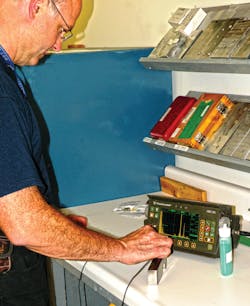
The use of nondestructive inspection (NDI) has ballooned in the last few decades as new materials have evolved for use in today’s aircraft. As we explore the frontiers of materials development, NDI has kept apace not only by allowing inspection of advanced materials but allowing continued inspection of older aircraft. NDI has benefited greatly by miniaturization and computer technology. However, the basics of NDI services evaluation remain; determination of the ability of the service organization to meet the aircraft’s maintenance program requirements.
Every audit or evaluation begins with preparation. It includes the logistics of the visit to include dates and contacts. If an audit checklist is going to be used the auditor may provide the standard he intends to use. In certain cases a customized checklist may be developed internally for focused evaluations. This may be necessary to assure that the provider has the necessary tooling and expertise to meet specific maintenance program requirements covered in an approved aircraft NDI manual. This is useful if key Airworthiness Directive (AD) work is anticipated.
The audit of an NDI organization focuses on five standard elements:
- Facility or environmental conditions
- Tooling
- Personnel certification
- Tech data or work instructions
- Training
Facility requirements
NDI organizations may have minimal need for structured facilities. There may only be sufficient brick and mortar to house equipment, administration, and records. Equipment storage in the facility should demonstrate good housekeeping and organizational layout. Poor housekeeping in any audit is an indicator that environmental disciplines are wanting and warrants a closer look around. Well-organized work spaces and tooling are positive indicators of a well-managed and disciplined workplace. Tooling and training records, areas requiring good organization should be carefully scrutinized.
Tooling
Tooling is the point of NDI. Depending on the techniques used and the repair station's authorizations the equipment may be extensive. Much of it is subject to calibration standards and should be listed in the calibrated tooling program. Annual calibration is normal but in some cases tooling may be self-calibrating. Ultrasonic inspection, for example, is checked against a physical calibration standard prior to use in an inspection. A calibration program will describe these details – the auditor should compare the repair station's program to the tooling in review. In cases where the owner/operator's maintenance program requires more conservative tooling calibration controls, he should inform the service provider of the requirements. In discussing tooling we focus on the most common NDI methods.
Eddy current (ED)
- Probes – Should be the right design and frequency. In preparing for the audit the auditor should have a list of tooling that would be required for use on their aircraft. Probes should be on that list. If the service is using equivalent probes be sure they have the records to determine equivalency and that technical data allows the probe.
- Cables – Be sure they are properly labeled, that they are in good condition. (No fraying, exposed shielding or loose connections.)
- ED test box – The unit should be free of damage and in good condition. Calibration should be current. The test box should be a model that is applicable to maintenance program inspection. If it has been determined to be equivalent the means of determining equivalency should be evaluated.
Ultrasonic (UT)
- Transducers – They come in two types single or double. Singles serve as receiver and transmitter. They are small and subject to wear and tear of frequent use. Transducers must be used with a couplant that allows a high frequency signal to travel to the test piece. Couplants as a rule are generic but certain applications may call for a specific formulation.
- Double type transducers are a separate receiver and transmitter. The generating probes are placed on one side of the test piece with the receiver probe on the other side. The signal passes through the piece and shows any flaws. UT systems using double probes are often used by manufacturers for large regular shaped pieces that can be submerged in a liquid medium that acts as a couplant.
- Cables – Check for condition (fraying, broken or loose connections).
- Test box – The test box generates and displays the signal from the test piece. Check the unit for condition; if not out of line have a technician demonstrate use on a test standard.
Magnetic particle (MP)
Inspection of ferrous materials is often accomplished using magnetic particle inspection methods. Methods of inspection include the use of fluorescent and nonfluorescent types of fluid. Dry methods of flaw indication using fine powder are also used and are effective. Parts are placed in the magnetic particle bench unit where a current creates an indication of any flaws as metal particulate aligns with the flaw in the surface of the test piece. Mag particle inspection can be accomplished on the work site using a portable yoke. It can inspect small local areas.
Key areas to check:
- Fluid must be checked for particulate concentration. The manufacturer sets the minimum particulate levels required. A small glass container called a centrifuge tube is used and the tube graduations identify the level particle concentration.
- Tooling and procedures for de-magnetizing parts.
- Fluorescent fluid requires the use of a black light. A test for light intensity must be periodically accomplished and recorded.
- An area for cleaning or removal of paint and other coatings.
- If dry powder is used, it must be periodically cleaned of any accumulated contamination, such as oils, paint chips, and dirt.
- Verify that the testing bench is functional and that no parts are missing.
- If possible have a test standard placed on the bench so that the test flaw can be observed. Observe the use of the preparation procedures, cleaning, and unit operation.
Liquid penetrant (LP)
Liquid dye penetrant is probably the most common NDI method used after visual inspection. Penetrant methods are an easy and cheap method for inspection of nonporous type metals. Personnel can be easily trained to accomplish this type of inspection and its use is very common in the field.
Penetrant inspection involves a series of steps beginning with cleaning the part or inspection area, application of the penetrant liquid with a waiting period that allows the penetrant to soak in (dwell time). The part is then cleaned and a developer powder is applied to draw any remaining penetrant from a flaw that can be seen under a bright light (dye penetrant) or black light (fluorescent penetrant). The remaining penetrant reveals the crack or flaw as it is drawn out by the developer.
- The auditor should check that penetrant and developers are controlled by a shelf life and they are properly stored.
- If fluorescent penetrant is used, check that the black light is periodically checked for intensity. It should be on a schedule. There are meters that can be used to check intensity and they should be on the calibrated tooling system as well.
- Large penetrant tanks for large articles will be clean and protected from local contaminants such as dust, paint, etc. There should be a location for preparation, application of penetrant, dwell time, and final inspection. Parts segregation should be maintained with unserviceable parts separated from serviceable or parts awaiting inspection.
- Compare the repair station internal processes and controls for accomplishing penetrant inspections with observed activity. Identify and observed deviations.
Radiological inspections (RI)
Check X-ray equipment for condition and type. X-ray methods may be electronically generated by a cathode ray tube – others use an isotope source. Darkroom facilities are required to develop the film although some NDI services are moving to digital imaging. X-ray exposures and methods are described in the inspection information for each aircraft. The NDI provider should be able to demonstrate their capabilities to meet those requirements. Safety is paramount as well. Check exposure meter records and tracking. Film storage procedures are necessary to preserve film quality. Developer and fixing solutions should be properly stored and, if manufacturer requires, under a shelf life control.
Internal standards
While most NDI services are Part 145 repair stations with a repair station manual they may also perform their work to an FAA approved process specification. These should be noted by the auditor in the preparation phase of the evaluation. Work instruction and internal procedures for management of the various inspection techniques must be reviewed. Personnel who perform NDI inspections should be at least a level 2 and certified using one of the following standards:
- The American Society for Nondestructive Testing (ASNT) Standard SNT-TC-1A Recommended Practice No. SNT-TC-1A: Personnel Qualification and Certification in Nondestructive Testing.
- AIA-NAS-410, Aerospace Industries Association, National Aerospace Standard, NAS Certification and Qualification of Nondestructive Test Personnel.
- ISO 9712, International Organization for Standards, Nondestructive Testing -- Qualification and certification of personnel.
- Air Transport Association (ATA) Specification 105, Guidelines for Training and Qualifying Personnel in Non-Destructive Testing.
The standards establish minimum requirements for certifying NDI personnel. The NDI provider’s internal maintenance procedures will identify the standard that personnel are certified to. The training program will describe the classroom and experience requirements for technicians at each level. There are three flavors:
Level 1: Can accomplish equipment calibration and may perform inspection under supervision of a Level 2 or 3 technician.
Level 2: These are journeymen technicians able to perform the inspection, interpret result, and document the results of the inspection.
Level 3: In the NDI world Level 3 technicians may design inspection techniques and processes. However in aviation, where much of the work is related to ADs or other approved data, the ability to design a deviation is of little use unless an alternate means of compliance is needed. The Level 3 will likely be the prime mover in the training and certification program as well as the supervisor of much of the work.
Each technician must have a current eye exam. The Jaeger eye chart is commonly used to test near vision of NDI technicians and can be administered by an optometrist, or someone designated by the repair station through its internal procedures.
Technical data
Inspections are conducted using manufacturers’ instructions. Repair station quality manuals describe the means of assuring that technical data is current. The audit should review technical data for currency to those standards.
Need some help?
Feeling a little lost? NDI is a major form of inspection. Entire books have been written on its processes. But we are just trying to decide if the NDI provider is the right choice for our airplane. In the time it takes to accomplish an audit you can make a reasonable determination of an NDI provider’s suitability to work on your aircraft. There is plenty of help on the Internet to get you started. A very reasonable checklist developed for FAA safety inspectors and can be downloaded at: www.faa.gov/aircraft/repair/become/media/NDTCKLIST.doc.