Recip Technology: What About Those Diesels? Part 2
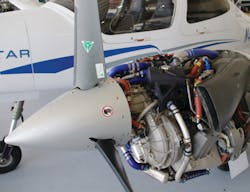
Diesels (compression-ignition piston engines) have a long history in aviation, but their numbers have never been impressive. After my first article on this topic appeared in the May 2012 issue of AMT, I was bombarded by diesel historians, and I promised to mention some of what they told me.
Dr. Hugo Junkers built successful aero-diesels as early as 1913; by 1916, these oil-injected (for fuel) beasts were making 500 hp. They powered Lufthansa airliners by 1935, and by WWII, they were making one horse for every 1.4 pounds of weight – better than most modern private-aviation gasoline engines. BMW made a water-cooled radial (with radiators between the cylinders); Daimler-Benz’s diesels powered the Hindenburg. The first USA-built Packard diesel-powered airplane flew in 1929. A Ford Tri-motor so equipped famously flew for a fuel cost of three cents a mile. Guiberson took up the mantle in the U.S., equipping prototype Navy airplanes (and then battle tanks).
In Britain, the Bristol Phoenix, the unsuccessful and heavy Beardmore Tornado, and the Jumo-designed Napier Culverin also flew, some with better-than-gas-engine performance. Even Rolls-Royce tried converting a Condor to diesel power. The Czech ZOD, Italian Fiat, Russian Charomski, and French diesels (Clerget, Salmson, Jalbert-Loire, and Jumo-licensed C.L.M.) also flew in the pre-war period, with varying degrees of success.
Thielert, Centurion, and Austro
Recent history recalls the Thielert 1.7-liter unit, originally (2002) used in the Diamond DA42. This breakthrough powerplant, based on the Mercedes OM640 car engine but with an aluminum block, became notorious for its maintenance requirements: its 600-hour (later 1,000 hour) TBR (time before replacement) was interrupted every 300 hours by a mandatory clutch and gearbox rebuild. But local mechanics could do nothing but the swap-outs; only the factory was authorized to perform the overhauls and repairs.
The second generation (135 hp, 2.0 liter) had a longer TBR and longer-lived gearbox, but the company hit hard times and emerged under new ownership and management to build the Centurion, whose engineers looked at every weak point to improve it; it now has a 1,500-hour TBR (1,200 for the more-powerful 155 hp 2.0s version) and gearbox improvements that have also doubled that unit’s TBR to 600 hours. All the 1.7-liter engines have either been replaced by the 2.0, or are set to be replaced at their next service. The Thielert Mercedes-based 4-liter V-8 shown in 2007 received a TC (Type Certificate) and STCs for the Cirrus SR22 and Cessna 206, but has not been heard from since the reorganization.
While Diamond was sweating out the Thielert situation, another aircraft engine (using the original iron Mercedes block) came to life, closely allied with the Diamond company’s ownership. The four-cylinder, 180-hp 2-liter Austro AE300 comes into the Austro Engine Factory and is stripped practically bare; and rebuilt with new components – electric controls, alternator and starter, a proprietary turbocharger, wastegate, sump, torsional damper (Thielert/Centurion uses a clutch in its gearbox), and countless other details have brought the Austro into volume production. Today, all heavy MRO work is done at the factory.
Austro Engine has offered EASA Part 147 maintenance training for the AE300 (E4-series) in cooperation with Diamond Aircraft Industries since 2009. All maintenance procedures are specified in the maintenance and overhaul manuals. Austro Engine recently received its first extension of the TBO to 1,200 hours; the target is 2,000 hours. The formerly limited TBO on the alternator and torsional damper were also extended to “on condition,” and the TBO on the high pressure fuel pump went up to 600 hours. In 2011, Austro and Steyr Motors entered an agreement to develop the Steyr M-1 Monobolc, a 280-hp six-cylinder design, for aviation use, but little has been heard since the announcement.
SMA and Continental
In contrast to the auto-based Centurion and Austro, the French company SMA has designed a traditional four-cylinder opposed, four-stroke, air-cooled, direct-drive diesel, which has garnered several STCs on various Cessna and other aircraft. The newest version, the 305e, features more power at altitude and several detail improvements. Any opposed four-cylinder, big-bore diesel will have sharp power pulses, which are tough on the props, but SMA is working on that with its four, and… a six-cylinder version was long in the rumor mill.
Continental acquired technology and engines from SMA; its TD300 displayed at Oshkosh 2011 was a lightly reconfigured SMA 305a. Teledyne Continental (TCM) had recently worked on two iterations of a two-stroke diesel (a six-cylinder radial from the General Products Division and the “NASA GAP” engine, an opposed four, from the Aircraft Products Division), but came around to the idea that the SMA four-stroke approach would be a better direction to take, particularly regarding cooling. Where Continental now plans to go with this project is anyone’s guess, but the idea of a Continental diesel will not go away.
And there’s more
There are two Wisconsin diesels on the horizon. Most-recently is the Engineered Propulsion Systems’ flat-8, 4.4-liter, 350-hp (at 3500 crank rpm), geared Vision 350-A44-POC, a turbocharged, common-rail injection, four-stroke design; it has been running since late 2011. This water-cooled cast-iron (very special) alloy block engine invokes many innovative features and is designed to fit in the space currently occupied by popular six-cylinder air-cooled gasoline engines. Its controls are designed to be “pilot-resistant,” as well.
Engineer Steve Weinzierl notes, “We also have some interesting technology in our electronic systems; we have already applied for several patents. We can use these to make the engine immune to cetane changes, for instance.” As for the diesel’s sharp power pulses, “Electronics can shape the pressure rise in a diesel, and shape the pressure, gradually and non-linearly, and affect the internal gas-pressure rise. This can yield a quieter, more-efficient fuel burn. Our telemetry monitors how much fuel gets through each injector, mechanically.”
From the other side of the state comes the DeltaHawk, a 160/180/200-hp (at 2,700-rpm) direct-drive V-4, water-cooled two-stroke, loop-scavenged, turbo-supercharged diesel that has been flying for nearly a decade but has yet to reach certification. Its configuration as a two-stroke also allows mounting in V, inverted V, and vertical positions in a pusher, tractor, or upright-shaft position, with rotation in either direction – 18 models in all. With a 4-inch square bore and stroke (202 cubic inches) and 19:1 static compression ratio, the DH200V4 DeltaHawk’s power/weight ratio is similar to legacy gasoline aero-engine performance at roughly 2 pounds per horsepower. The projected TBO is 2,000 hours.
The DeltaHawk design pushed for overall simplicity, and it’s easy to work on. If you don’t open the block, you won’t need to be a specially trained diesel or DeltaHawk-trained mechanic. Inside the block, there are only the crank, rods, and pistons; outside are all pumps, cooling, intake and fuel, controls, and so on. Some externals – the water pump belt, for instance – are 500-hour items. (DeltaHawk’s Rip Edmundson notes, “We have run them ragged, for dozens and dozens of hours after they were way past their obvious useful life.”)
Neither Wisconsin-based engine maker has the volume to announce plans for training non-factory mechanics or to establish non-captive rebuild facilities, though some well-known STC developers have approached DeltaHawk about becoming authorized service centers.
In Germany, limited flight tests in a Yak-52 have been made by Raikhlin Aircraft Engine Developments (RED), with its A03, a 500-hp (at takeoff) 6.1-liter double common-rail injected V-12. This purpose-built aero engine (that looks like it's auto-derived) has a dry sump, and is configured as a pair of straight-6 engines, each DOHC bank having its own monitoring, induction and fuel system, liquid cooling system, and turbo/exhaust. A single starter and twin alternators complete the configuration. All this runs through a 1.88:1 gearbox, yielding a maximum propeller rpm of 2,127 (4,000 engine rpm).
The Gemini, a promising three-cylinder, six-piston, two-crankshaft two stroke of 100 hp was shown for a few years by Powerplant Developments, a UK company that produced a working prototype/dyno test engine, but ran short of funding for development toward certification. Several LSA (Light Sport Aircraft) manufacturers have expressed strong interest. Opposed piston engines like the Gemini have a built-in obstacle: with ports in the cylinder walls, they have either relatively low power or short lives. The project still exists on hold.
Some other diesel engines have shown promise in experimental in recent years. WAM (Wilksch), of Gloucestershire, England, has flown since 1997 and has freely offered its three-cylinder, two-stroke 120-hp diesels to willing experimental airframers. This direct-drive engine is inverted and has a wet sump; and though it is a two-stroke, it uses a valve for exhaust. In the late 1980s and early 1990s, the Zoche family (of Munich) developed three (70-, 150-, and 300-hp), two-stroke turbocharged diesel engines, but I was told their major funding ceased, and the designs languished.
Certified and experimental
Many companies are planning to stay in the certified marketplace, though some have released power to particular experimentals. DeltaHawk, especially, has several engines flying in many designs, and also has test engines deployed among both experimental designers and certified airframers.
Experimenters (as opposed to volume developers) have flown just about everything, from Citroën to Pugeot to Opel to Subaru and beyond, but these are more projects for the hobbyists themselves, and MRO activities are often as not performed in private hangars and garages. Most companies offer some level of factory training on their engines.
Tim Kern is an aviation writer, aircraft builder, and private pilot. He is based in Anderson, IN, and can be reached at [email protected]
DeltaHawk: www.deltahawkengines.com
Centurion: www.centurion-engines.com
Austro: www.austroengine.at
SMA: www.smaengines.com
Continental: www.genuinecontinental.aero
Raikhlin Aircraft Engine Developments (RED): www.red-aircraft.com
Wilksch/WAM: www.wilksch.net
Zoche: www.zoche.de
About the Author

Tim Kern
Tim Kern is an aviation writer, aircraft builder, and private pilot. He is based in Anderson, IN, and can be reached at [email protected].
Tim Kern, CAM, MBA, has written for over 50 aviation publications, and is a consultant for a variety of companies; www.timkern.com.