The first words our Ground Support Team Leader wants to say is that the award is for the team not him.
“I just got the credit,” says Greg McDermott, chief warrant officer, United States Coast Guard.
For the past 12 years McDermott has served as chief of the USCG’s support equipment assigned to the Aviation Logistics Center, Elizabeth City, NC.
McDermott manages a staff of seven, oversees GSE inventory worth more than $500 million with an annual operating budget of $6 million that supports 26 USCG air stations and more than 200 aircraft throughout the United States and Puerto Rico.
“That is everything from fuel trucks to test kits,” McDermott explains.
His role fits into the center’s Engineering Services division – one of 12 divisions at the center, but one that is a “catch-all for us and crosses all platforms,” McDermott adds. That generally includes maintenance, engineering, procurement, supply and information.
The center’s motto says it best: “We Keep ‘Em Flying.” USCG aviation is renowned for its high level of readiness. At any given time, more than 50 USCG aircraft must also read to fly.
While aircraft may take the lead, we ran across an armed forces newsletter that referred to military GSE as “the forgotten enabler.” Without it, nothing is likely to move even an inch.
McDermott’s got more than a few things on his plate. His nomination for our Team Leader Award says he “ … purchased equipment in support of those air stations to include SATS tractors, fuel trucks, C-130 engine cranes and helicopter maintenance stands. He conducted a Coast Guard-wide electrical assessment of all air stations, Logistics Compliance Inspections, managed all ground support training (fuel trucks, GPUs, tow tractors) and is the CG representative to the Joint Panel for Aviation Support Equipment (JPAVSE).”
That’s a lot to unpack so let’s focus on standardization of GSE. That factor is important for two reasons:
- • Training: It’s a key role for McDermott. In many cases, he’s training teenagers fresh out of high school for big responsibilities. “One of our challenges is that we are very good at what we call ‘pipeline’ training to service aircraft,” he says. “But that still leaves a lot of training for all the ground equipment that goes into servicing aircraft.”
- • Money: “These are lean budget years,” McDermott explains, “so we need to know what we are going to do with what we get and make it work and make it last.” Standardizing new GSE also saves money through the equipment’s life cycle since all the spare parts needed throughout the years are also standardized, too.
SATS
We talked with McDermott shortly before a rep from NMC-Wollard Inc. would spend a week at the center to offer training on some of the newest pieces of GSE for the USCG.
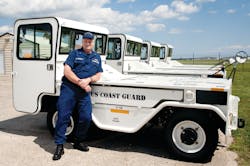
This past February, the United States Army teamed up with the USCG on the Standard Aircraft Towing System joint venture. The first of five SATS rolled off the NMC Wollard’s production line that month and were delivered to the USCG.
Standardization is one of the keys to today’s military procurement. As we mentioned, McDermott serves as the USCG’s rep to the JPAVSE, which emphasizes standardization of Aviation Ground Support Equipment (AGSE) for the Department of Defense and other uniformed services such as the USCG.
“Everyone in the armed services needs to do more with less financial resources,” McDermott says. “The SATS is a great example of this.”
The SATS is a tow tractor by any other name that the Army’s already relied on for the past two years to reposition rotary and fixed-wing aircraft for its aviation missions. To date the Army has bought nearly 500 of the tow tractors and the USCG will begin using 100 tractors this year.
McDermott joined Steven Ansley, a lieutenant colonel in the Army and product manager for the Army’s AGSE, during the roll out ceremony at NMC-Woollard’s Wisconsin plant.
"SATS represents the mutually beneficial scenario to both government and business that occurs when a system that one service is using can be incorporated for use by another, with little or no modifications, and our industry partners are flexible and responsive enough to accommodate the increased production requirements," Ansley said at the event.
McDermott says the SATS is a little different to service than the towing equipment the USCG had been using. But thanks to the “train the trainer” education NMC-Wollard was about to present, USCG personnel would be able to service the vehicles no matter where they happened to be stationed. The training will part-class room and part-hands on. The center has five SATS so everyone will get the opportunity to turn a wrench.
“Standardized equipment just makes training that much easier,” he explains. “We still have some oddities that require specialized maintenance skills, but for the most part, we are moving away from that.” “We’ve have five tractors here so that everyone can get a chance to turn a wrench.”
Standardizing equipment doesn’t just mean choosing one vehicle that will work for more than one branch of the military. It also can mean a better deal by making contracts performance-based and whittling down the manufacturers to those prepared to meet those standards.
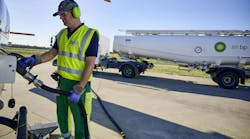
For example, McDermott says the USCG currently buys three different fuel trucks, down from 12 when he first arrived at the center more than a decade ago.
“Some of our bases have just one unit, so eliminating downtime is important,” he says. “When the truck is down so is the aircraft, or we’re forced to purchase fuel at full cost.”
McDermott singled out fuel trucks from Westmor as a prime example of high standards right down to the paint job.
“Paint quality is probably an overlooked feature, but it is the best paint job I have ever seen on a truck,” McDermott says. “If you don’t put paint on a metal edge or over welding there will be corrosion. In a sense, it seals our investment from corrosion.”
As for training, the USCG typically sends crews directly to the Westmor’s Minnesota facility.
ELECTRIC GSE
Standardization also means buying more electric GSE.
“I have a letter from my commandant that says we should go green whenever possible,” he says. Just a decade ago, the USCG had no electric GSE. None. Now it operates more than 60 electric tractors, mostly from Tug Technologies, but also from LEKTRO.
With lean budgets in mind, McDermott also talks a lot about “cost avoidance.” For example, take servicing electric equipment vs. the traditional fossil fuel models.
“A diesel tractor takes about 50 man-hours annually to maintain,” he explains. “With an electric tractor that time is cut to 16.” With less moving parts, that also means stocking less spare parts.
Cleaner power also makes it easier to station the electric equipment around the country. McDermott mentioned Southern California and New Jersey for tough environmental standards for traditional equipment.
“Local or state regulations make it tougher for gas and diesel equipment since you may lose time and money to prepare and pass different tests before you’re even allowed to place the equipment,” he explains. “We can avoid that extra cost in terms of money and time spent on testing and the related paperwork with electric equipment.”
By the way, electric ground equipment isn’t just reserved for the ramp. Service personnel at the center also travel around the center’s 55 acres with a fleet of 24 battery-powered Global Electric Motorcars that replaced about 20 gasoline-powered light utility trucks. Each of those trucks consumed about 200 gallons of gas a year.
In a matter of speaking, the center’s also standardized its own procedures to recognized standards. To ensure the center’s business management system are effective and continually improving, the center uses International Organization for Standardization (ISO) 9001-2000 (Quality) and ISO 14001:2004 (Environmental) standards.
In June 2006, the center reached a significant milestone in USCG history by being the first Coast Guard unit to achieve a fully integrated ISO 9001 and 14001 business system.
Additionally, the center has been actively engaged in Lean/Six Sigma process improvement initiatives that have resulted in more than $12.8 million in projected cost avoidances as well as significant increases in process efficiencies.
The center’s commitment to excellence is nothing new. In 2006, the center was the winner of the White House Closing the Circle (CTC) award for demonstrating exemplary environmental stewardship. In 2004, the center was a Gold Level Recipient of the Commandant’s Quality Award. The Commandant’s Quality Award is based on Malcolm Baldrige performance excellence criteria. In addition, ALC was the 2001 and 2003 Silver Level Recipient of the Commandant’s Quality Award.
McDermott will be retiring this year capping off nearly three decades of service to the USCG.
“I typically have 20 different projects to manage, but it makes the day go faster,” he adds.
To keep the work flowing smoothly, McDermott says the key is to not to micromanage his team.
“I empower my crew – get them involved in the budget process and provide them the information they need to make decisions,” he explains.
McDermott will leave behind a 20-year roadmap on what to do with GSE. A standardized deicing vehicle that, like the SATS, can be used by more than one branch of the military is currently on the agenda. McDermott’s also keen on considering hydrogen fuel cell power, too.
“I’m fascinated by how the industry is evolving,” McDermott says, adding that our recent Cygnus Aviation Expo – where he officially picked up his Team Leader Award – offered a great opportunity to see equipment and meet product managers.
“I’m usually in uniform so I’m an easy target,” he says. But he made a point to stop at practically every booth to see what was on the market. “Something as small as casters can be made better and at a lower cost. There were also manufacturers that honestly we haven’t bought anything from in 20 years, but it’s still good to see the equipment and talk with the managers.”