PSIM: Ready for Takeoff
Large airports are like miniature cities, with tens of thousands of people passing through them on any given day. Dynamic and expansive, airport environments are anything but simple — and that makes securing them evermore complex. Toward this end, airports collectively spend billions on aviation security annually. While this technology has automated and greatly improved many functions, it has also created some challenges.
For example, with so much information from so many different sensors and systems flowing into the security operations center, it can be difficult to discern false alarms from real threats. Simply put, the overwhelming flood of data can obscure the big picture. This is precisely the problem PSIM addresses.
What is PSIM
In its simplest form, PSIM (Physical Security Information Management) integrates, synthesizes, and analyzes information and alerts from different security and safety systems. PSIM is an open architecture, interoperable software solution with generic gateways that enable any number of security, communication, safety, alerting, and sensing systems to be integrated to form a unified platform.
Examples include Video Management Systems (and accompanying video analytics applications like perimeter protection and counter flow detection), access control, alarm panels, fire and safety sensors, radars, radio and telephony communications systems, video walls, CAD (computer aided dispatch), GIS (geographic information systems), emergency/mass notification, real-time mobile video, Web/RSS feeds, fence sensors, weather systems, and just about any other security, operational, or communications system imaginable.
Using pre-defined rules, PSIM also analyzes and correlates information and alerts across these different subsystems in real time, providing rich situational awareness. Because it correlates data, PSIM connects the dots between seemingly unrelated events to form a Common Operating Picture.
Finally, PSIM guides appropriate responses to situations based on all of the different indicators of what’s happening. Adaptive, pre-defined response plans ensure standard operating procedures are followed. The PSIM solution thoroughly documents the incident as it’s happening, so it can be reviewed later on: When did the incident start; what specific actions were taken and by whom; and how and when was it resolved?
PSIM doesn’t just bring data together, it helps operations manage incidents from start to finish.
Situational Awareness
“PSIM provides three main benefits,” explains Moti Shabtai, VP Security for NICE Americas. “Airports have many islands of information, essentially security systems that are silos. So the first benefit of PSIM is its ability to tie these sub-systems together in a cohesive common operating picture (COP).
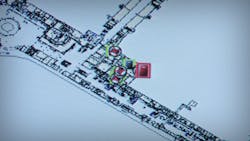
The second benefit relates to visualization. Once the dots are connected between these complex sets of information and incidents are revealed, they’re overlaid on a map-based interface — making it easy to get a real time visual representation of an event and the associated assets and people involved.
"You can literally view the different 'plots' of an incident, whether it involves aircraft on a runway, vehicles on an airfield, or other tracked assets in terminals or on airport roadways. Everyone involved in the incident share a common understanding of what’s going on. Finally, PSIM ensures consistent responses, in keeping with the airport’s pre-defined standard operating procedures.”
Since PSIM creates a unified, cohesive platform, multiple control centers are no longer needed. We’ve seen airports consolidate all their control room operations into a single expanded location with internal and external agencies and first responders all sitting side by side with the same view. This significantly improves communication and coordination, as well as saving money and resources.
PSIM at MSY
One of the first North American airports to deploy PSIM was the Louis Armstrong New Orleans International Airport (MSY). Spanning over 1,900 acres, with four concourses and two terminals, the airport serves some 8.5 million passengers each year, and is the primary commercial airport for the New Orleans metropolitan area and southeast Louisiana.
Managed by communications manager John M. Lyon, the Aviation Communications Center, also known as AVCOM, is the coordination hub for safety and security at MSY. In 2011, the Center handled more than 20,000 incidents that required life safety or security personnel to be dispatched.
The airport employs a variety of security and life safety systems, including video surveillance, access control, fire alarms, CAD, Voice over IP (VoIP), and automated external defibrillator (AED) alarms. Through the use of the NICE Situator PSIM solution, the airport was able to integrate all of these systems into a COP, so dispatchers get all of the real time information they need, in a relevant context, on just two PSIM screens.
Comments Lyon “Before, we had silos of information, so different dispatchers would be responsible for monitoring video, access control, etc. If something happened, the dispatchers would need to verbally relay information to each other to put the pieces together, and that took time.
"Now the different pieces are automatically assembled through the PSIM so dispatchers instantly get the big picture," he adds. Dispatchers can also visualize geographically where incidents are happening and drill down into layers of rich information, including building plans and video.
Lyon says the PSIM solution helps dispatchers know how to respond as well. Prior to implementing the PSIM solution, dispatchers relied on 'flat' electronic forms. Now, when an incident occurs, the PSIM system guides them through a step-by-step response plan. In all, over 90 standard operating procedures are embedded in the PSIM system.
Additionally, the processes are interactive and adaptive. For example, in the case of a fuel spill, the specific response would depend on the magnitude, size, and type of spill. Escalation procedures can also be built in as a safeguard.
Not Just For Security
While PSIM evolved out of security, airports can also leverage it to enhance safety, operations, and overall ROI.
“We’ve already seen airports taking it to the next step — starting with security, and then broadening the scope to safety and even operations," says Moti Shabtai, VP Security for NICE Americas. "If you think about all of the things that PSIM can do — connecting the dots between different systems, creating the common picture, providing a consistent way to manage incidents and documenting their resolution — then you can begin to envision other applications.
"For example, using PSIM to coordinate all of the complex processes and resources involved in managing an emergency landing, or to manage other operational scenarios involving gate closures, or maintenance issues, which all contribute to the smooth operation of the airport.”
Case in point — say a water pipe bursts at the airport. As soon as the call comes into the operations center, the operator hits a quick launch button on his PSIM screen to open an incident. This in turn sets other procedures into motion. The operator marks the location of the burst pipe on a map. The PSIM system automatically creates a work order as maintenance personnel are dispatched to the scene. Similarly, reports of other types of incidents, such as “slip and falls,” lost items, etc., can be tracked, reviewed, and documented in the system.
Finally, PSIM helps airports comply with regulations such as FAA Part 139 by giving them a mechanism to document and follow up on safety hazards discovered during Part 139 field inspections.
PSIM ensures business continuity by providing complete situational awareness of the location and severity of incidents and operational issues, and by helping airport personnel respond quickly with contingency plans to minimize disruptions to operations.
Response plans for hurricanes and other weather events are also embedded in MSY's PSIM system. Lyon says the PSIM solution would extend critical technology to the airport’s emergency operations center should airport managers and representatives from outside agencies need access to it.
Another aspect that facilitates disaster preparedness is PSIM’s ability to leverage external real-time information sources. NICE recently completed an integration between its PSIM solution and the NC4 Risk Center service. The integration enhances the situational awareness picture in the PSIM solution by leveraging NC4’s early incident warning capabilities to alert command and control centers to relevant threats, such as extreme weather events or terror threats.
One final technological note — since PSIM systems are open and connect to security, safety, and operational systems through the use of gateways, they offer future adaptability, and seamless technology migration.
Airports can migrate to new technologies without having replace existing sub-systems. PSIM brings everything together under one cohesive umbrella.