New Aircraft Materials Require New Ground Support Procedures
Despite the rollercoaster ride in air traffic numbers in recent years, the historical trend of 5 percent growth per annum still holds true. That equates to plenty of new aircraft – some 33,500 over the next 20 years, according to the Boeing market outlook.
Many of the airplanes now taking to the skies are not merely the latest generation of long-established workhorses. Increasingly, there are brand-new designs made of new materials.
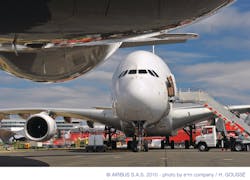
So far, Airbus has delivered 68 A380s with another 185 on order. December 2011 was a record month for the double-decker Leviathan, with four deliveries in a single month. The European manufacturer is also moving forward with its A350 project with 500 orders for the various derivatives. Over 70 percent of the A350 is made from advanced materials that combine composites (53 percent), titanium and advanced aluminum alloys.
Boeing has the 787 and the revamped 747-8 coming fresh to the market. Some 870 787s (comprising both 787-8 and 787-9) are on order and there are around 36 orders to date for the 747-8. The 787 is 50 percent composite by weight. A majority of the primary structure is made of composite materials, most notably the fuselage.
It is not only a paradigm shift for the airlines. For ground handlers, too, the market and the working systems are changing. There is a big learning curve as aviation enters this new era and new-found knowledge could have a fundamental affect on the ground service business model of the future.
GOOD TEACHERS
Airplane manufacturers are well aware of the ground handling issue. New aircraft design takes into account the increasingly important role of ground operations as airlines look to increase utilization rates and improve turnaround times. Where there are significant differences to established practices, manufacturers look to help ground handlers understand the new requirements.
The A380, for example, was something completely different. It required new equipment – a 70-ton tow tractor and an upper-deck catering vehicle, for example. Billions of dollars were spent modifying airports, and ground handlers are still learning about best practice, especially in servicing multiple aircraft.
The A350 won't demand so much. Airbus says the A350 "provides easy and cost-effective ground handling, minimizing aircraft turnaround time."
Boeing is likewise leaving nothing to chance on the 787.
"Boeing offers our customers robust training programs to ensure they are equipped with the necessary information and procedures," says Mike Fleming, vice president, 787 services and support.
As with all airplane models, ground crews must be familiar with the airplane to service it appropriately.
"Although the 787 Dreamliner brings a wide range of new state-of-the-art technologies and features to the market, such as extensive use of lightweight composite materials and distributed electrical systems," Fleming adds, "we have worked very hard with our customers to ensure a seamless transition for ground handlers more use to conventional-technology airplanes. This means that a ground handler's transition to the 787 will be no more onerous than to any other new airplane type."
This is good news for ground handlers because it is vital that they do know their way around the new aircraft. Ground damage costs the industry some $4 billion every year.
The concern voiced in some corners, however, is that composite material, which is very different from aluminum, may hinder current safety efforts rather than help them.
DETECTING DAMAGE
While major repairs, where the aircraft can be extensively tested, are not expected to be an issue, unscheduled work could be a cause for concern. The topic gained momentum in 2011 following a minor collision between an All Nippon Airways 787 and a boarding bridge. Also, last November, nearly 500 passengers missed a flight to Frankfurt when an aerobridge struck the wing of a Lufthansa A380 at Singapore’s Changi Airport.
In an October 2011 report, the U.S. Government Accountability Office noted several challenges relating to composite materials. It worried that damage to composites "may not be visible or may be barely visible, making it more difficult for a repair technician or aviation worker to detect than damage to metallic structures."
The GAO also noted repairs could be more troublesome, in part, because of the lack of standardization. This comes down to some old-fashioned corporate secrecy and the relative novelty of the material.
As yet, solid data on damage to composites is lacking.
"A repair technician could confuse materials or processes, which may result in improper repairs," noted the GAO report.
Others in the industry have also commented on the provision – or lack of it – of tools and training across the industry. The relevant equipment and skill set for composite repair may not be available at all outstations for some time to come, delaying aircraft repairs.
The manufacturers refute such arguments. Boeing cites the 787, designed from the outset to be especially robust in damage-prone areas, such as passenger and cargo doors.
Fleming insists it can be repaired in exactly the same way as older models.
"The ability to perform bolted repairs in composite structure is service-proven on the 777 and offers comparable repair times and skills as employed on metallic airplanes," he says. "By design, bolted repairs in composite structure can be permanent and damage-tolerant, just as they can be on a metal structure."
There is also the option to perform bonded composite repairs, which offer improved aerodynamic and aesthetic finish.
Although a typical bonded repair may require 24 or more hours of airplane downtime, Boeing has developed a new line of maintenance repair that requires less than an hour to apply.
"This rapid composite repair technique offers temporary repair capability to get an airplane flying again quickly, despite minor damage that might ground an aluminum airplane," Fleming says.
Improvements in nondestructive testing methods, such as using x-rays and ultrasonic scanning, will also pave the way forward. Lufthansa Technik is one of a number of companies looking at providing a comprehensive, mobile service for repairing composite material.
TRAINING TIME
The debate is unlikely to go quiet any time soon. The GAO found the science lacking when it comes to a long-term assessment of composite material. The report questioned how damage would show itself – even whether it would show itself – and how composites would respond as they age.
Plenty of research is being done. The Commercial Aircraft Composite Repair Committee is an industry-wide effort to fine-tune work on composite materials. Both Boeing and Airbus are involved. But the best knowledge will come when composites have a flying history comparable to metals.
Until then, some robust training schedules for inspectors, technicians and engineers are the industry's best solution.
At Boeing, during training for inspectors, the students learn how to perform an inspection and analysis to make a "fix or fly" judgment on 787 composite damage. Technician students learn how to carry out repairs in accordance with the Structural Repair Manual and engineers learn how to design repairs using approved Boeing design data.
There is no doubt that composite-laden aircraft are safe and correctly certified to fly. But for ground handlers, the jury is still out as to how they will react to the minor bumps of daily ground operations. The service level agreements of the future could look very different indeed.
Graham Newton is a professional writer and editor with more than 10 years of experience contributing to international aviation publications, including Airlines International, the official Magazine of the International Air Transport Association.