Cultural Tradition Dictates Design
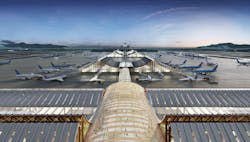
Airports have become national landmarks, great civic buildings serving as pivotal service and business centers, and gateways to the nation and the continent. But airports must also be perfect instruments, tuned to passenger comfort and operational efficiency.
In the recent design competition for Terminal 2 at Incheon International Airport, the aim was to design a quintessentially Korean airport, echoing Korea’s architectural heritage and culture, deploying warm, natural materials, celebrating the region's nature and garden tradition.
The most significant decision in designing the new terminal for Incheon was the selection of the appropriate organizational diagram for the building. In recent decades, a number of organizational diagrams for airports have evolved. The single-building terminal, with extended piers and hammerheads, such as at the Hong Kong International Airport, Pearson Terminal 1 in Toronto, or any one of the terminals at Changi International in Singapore.
In these buildings landside and airside operations are integrated and connected, but at such large airports, extremely long piers, excessive walking distances, and supplementary conveyance such as power walks and trains are required to support the building.
At the opposite end of the organizational spectrum are airports where a dedicated processor serves landside operations, complemented by one or more concourses providing airside services, including the holding gates, retail operations, support services, and aircraft bridges.
In the United States, Atlanta and Denver are the quintessential models — employing a series of elongated piers parallel to the processor connected by an internal rapid rail system.
Selecting A Building Model
We initiated the design process by favoring the single-building model as supported in the documents prepared by the Incheon Airport Corportaion. This indicated a preference for an organizational diagram where all 72 gates of the two phases of Terminal 2 and all airside operations would be accommodated in a single structure continuously connected for pedestrian traffic and supported by an associated means of passenger conveyance.
In our studies we simplified and improved the orientation of the diagram provided by the authority. We developed a processor with attached gates, connected to a long pier terminating in a long linear concourse. This diagram was similar in some respects to Hong Kong International Airport.
While the architecture of such an airport might vary greatly depending on the particular interpretation, the organizational diagram nevertheless depends on extremely long walking distances for most passengers supported by power-walks. For additional flexibility and convenience, we studied the possibility of introducing an IAT (Intra-Airport Transit) system that would serve the long pier and connect to Terminal 1 through a transfer point.
While this diagram initially promised to provide advantages to retail operations by providing for a major concentrated retail center abutting security and passport control and exposed to passengers of all planes, complemented by a secondary node at the distant pier, deeper analysis showed major disadvantages to this arrangement: The distance from the gate to the retail minimizes passenger interactive time, which was detrimental to retail revenues.
The walking distances from processing to many gates was excessive, and the utility of the supporting train was limited to only serving the passengers at the extended pier. Future flexibility, convenience of transfer passengers, and aircraft maneuverability and taxiing all registered negatively, compared with other alternatives. Inspired by these challenges, we turned to an alternate model, which was surprisingly similar to that originally embraced for Incheon Terminal 1, but superior to it in many significant aspects.
The Alternate Hybrid Model
For Incheon’s Terminal 1, a hybrid between the two models had been adopted. The main terminal building accommodates 44 gates and related airside services. In addition, one satellite concourse and ultimately a second and third were to provide for future growth and expansion. But after opening the terminal and the first satellite pier in the first and second development phases, the Incheon authority decided to abandon the original master-plan model.
It was deemed too difficult to expand the landside sector to support additional satellites, and there were doubts about the viability of the model as a whole. As an alternative to expansion at Terminal 1, the decision was to proceed with Terminal 2 as an independent terminal accessed from the north end of the airport.
In selecting the appropriate model for Terminal 2 at Incheon, many considerations were wieghed — the experience of the authority with Terminal 1 as well as the fundamental considerations of airport comfort, efficiency, and economy. Central to our thinking was, above all, passenger convenience.
This included a clear sense of orientation, speed of access to the departure gates, walking distances and efficiency of other forms of conveyance, ease and speed of transfer passengers, passenger amenities and retail opportunities, and a pleasant and comfortable public environment.
Efficiency; Flexibility
On the operational side, flexibility, ease of maneuvering aircraft, gate access, baggage handling, and many other facets of apron and terminal operations had to be considered. Economic viability depended on an efficient building where the number of square meters constructed per passenger was minimized, and sustainability and energy consumption was managed.
On the opposite side of the coin, income-generating operations, particularly retail, needed to be maximized to enhance the airport’s income. Finally, the building needed to possess flexibility to accommodate change in the structure of airlines and other operational adjustments, change to aircraft types, security requirements, and other technological changes that would affect operations in the future.
Our proposal was for a dedicated processor connected by an efficient and flexible IAT to three pods, square-ish in proportion (rather than elongated piers), each supporting between 21 and 26 gates. In addition to the underground transit system linking the three pods to the processor, there was a pedestrian link accommodating a high-speed moving walkway (moving at 117 meters per minute) connecting incoming and outgoing passengers to the first pod.
Thus, by concentrating many of the larger planes at Pod 1, the pressure on the train system was minimized and passengers are given a high speed option for transportation to and from the processor. The resulting terminal provides both train and pedestrian access to more than 30 percent of the passengers in the ultimate build-out, and more than 50 percent of the passengers in the first phase.
One of the primary considerations, and an important objective of the airport authority, was to increase retail performance and maximize retail revenues within Terminal 2. To achieve the highest level of retail performance within the design, we worked carefully with an international team of airport retail consultants.
Maximizing Direct Passenger Access
Based on the experience with other terminals, one of the key objectives of our organizational concept for Terminal 2 was to maximize direct passenger access to the retail amenities, and to increase the amount of time available for relaxed browsing of the shops.
Reducing the time and energy required for passengers to check in, pass security, and make their way to the gates would increase the time at the gates and the comfort of the passengers. Relaxed passengers, with more time to shop near their departure gates, would equal increased retail revenues. Therefore, we proposed to center the bulk of the retail operations within the airside departure pods and in close proximity to every departure gate.
Supporting between 21 and 26 departure gates, each pod would handle more than 15 million passengers per year. Our team of airport retail consultants calculated that this passenger load would provide the critical mass for diverse retail offerings.
Incorporating A Regional Tradition
Incheon International Airport is the gateway to Korea and as such it must be designed to celebrate the ritual of arrival and departure from the country. Arriving by bus or car on axis along the central line of the terminal affords a welcoming view of a great public garden, beyond which was visible from the terminal and its transportation hub within the Central Garden.
Way-finding throughout the terminal was obvious and punctuated by pleasant architectural events.
While the terminal would be a modern building, deploying the latest construction and operational technology, it would echo the great building tradition of the Korean peninsula in its form and materials — with sloping roofs, compositional axial symmetry, traditional patterns of Korean retail street life, and displays of Korean artifacts and art, and employing steel, wood, and concrete.
Drawing on a vocabulary of forms and spaces in the tradition of Korean architecture, the airport would be endowed with generous daylight throughout, and would be a significant, contemporary design, capturing the spirit of Korea.