Display Solutions Get Dynamic
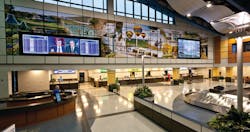
As digital signage becomes cheaper as the technology advances, airports have a real opportunity to make an impact statement with dynamic visual communcations systems. A digital display strategy has become a key part of the customer service imperative airports face today.
With the use of large format display technology, digital signage can be an important solution for airports with regard to keeping travelers well-informed and entertained while also promoting its own services, as well as those of its tenants and local stakeholders.
Says Barbie Peek, Huntsville International Airport director of marketing, "We want to stay on the cutting-edge of technology and provide the best customer service experience for everyone."
To that end, the airport has recently expanded its LCD video wall technology as a part of its capital improvement program. The 'jumbotrons' display everything from flight information and local cable television to advertisements.
"Going digital enables with signage enables the airport to be much more flexible with its display offerings … you can change things fast and in a more efficent way," explains Peek.
"New applications for display technology are being developed all the time, and the need to keep the traveling public informed and provide up-to-the-second information is key," says Daktronics aviation and parking market manager, Todd Lambert.
"Dynamic display technology is giving ultimate flexibility in message and branding control to airports; and technology is advancing to the point where it is becoming cheaper to implement large format display solutions."
Serving the customer
"There has been an increased emphasis by airports in communicating with passengers in a customer service context," relates Planar's John Dixon. Planar Systems, Inc. is providing the Huntsville Airport with its Clarity Matrix LCD Video Wall System.
Comments Dixon, "Multi-user functionality has become critical. The ability to send many different types of messages by way of one display screen or system of screens is a great display solution.
"Customers expect to see local and weather information alongside FIDS; there is also the advertising function, and that of entertainment, and keeping the customers interested and engaged."
Dixon says in the past, airlines were directly involved in the purchasing of display equipment. "Now, you are seeing a full press by the airport to interact and engage with their customers throughout the entire facility," he adds.
Peek, who has been with the airport for more than 22 years, remarks, "culturally, we are all driven by technology, whether it’s a mobile device or laptop computer ... that drives everything we do.
"Our objective in adding these display systems helps answer questions like: Are we reaching out and serving our customers and consumers in the best way possible? Are we delivering the best information to the right place in the quickest and most efficient way possiblee? Those are vital ingredients in communicating with and serving our customers."
Huntsville is a community that adopts cutting-edge technology; NASA is located here/Marshall Space Flight Center; Redstone Arsenal.
Peek relates that Huntsville is home to the cutting-edge of aerospace and defense technology. NASA's Marshall Space Flight Center is located in Huntsville, along with aerospace companies like Redstone Arsenal. "Those types of things are happening all around Huntsville," she adds.
"As the airport, we are the front door for our community; we also want to be on the cutting-edge in terms of technology; our passengers expect that.
"We want to provide the infrastructure, service, and facilities to make the customer experience here the best it can be for airport users."
The Huntsville Solution
Peek refers to the large format signage systems at the airport as 'jumbotrons.' The first jumbotron was installed in the public waiting area; the aiport was expanding the area for security and screening of passengers. Some 14,000 square feet of space was added to the existing area creating a total of 20,000 square feet.
The jumbotron has the capability of playing just about any type of digital media as well as local cable television. On either side of the main screen, the jumbotron is anchored by FIDS monitors.
"It is really targeted at airport use; there is not advertising, but we do use it to promote various services," explains Peek.
The aiport also uses it as a community tool, and to entertain passengers by display local sporting events.
As the airport moved into a baggage claim project, it designed two more jumbotron systems. One of the systems is a community jumbotron, with Planar screens in the center anchored on each side by airline arrival and departure information.
The second jumbotron is used primarily for advertising. "Both jumbotrons have similar technology and are very flexible in terms of displaying various types of content," adds Peek.
Planar's Dixon says he is definitely seeing a trend to ‘go large’. "We have been very successful with the Clarity Matrix product," he comments.
"Another trend we are seeing with video walls is the integration of the display solution with the architectural aspect of the facility."
Huntsville is a good example of this, he says. With its open space, the video technology is integrated into a wall mural and the architecture of the terminal interior.
Content flexibility; advertising
As more and more data becomes available, the capability to take that data and interact with it is key, says Dixon. The capability to display a wide range of different types of content exemplifies the contextual advantage of digital signage technology.
"Signage can be dynamic in that it responds to the immediate network needs of the airport, such as if the airport wants to change any particular stream of content at any particular time," explains Dixon.
"Another dynamic aspect is the content itself – the capability to display everything from gate information, updated in real-time, to full-motion video streamed live from the Internet or from local cable television."
"With the access to the different information available through the network, and the ability to instantly change or adjust content … airports have the capability to display content in an intelligent and dynamic way that captures the attention of travelers, and engages them."
Lambert agrees, stating, "Digital signage is also a space to promote internal programs and the airport brand itself, as well as the brands of airport tenants.
"The need to provide consistent branding, and to keep customers happy with services such as free Wi-Fi, and informing users of the various retail options provided by tenants - that is very key."
"Airports are seeing that the software and content being driven to these display installations is becoming very easy to implement and manage."
There is the ability for return on investment, says Lambert. With the larger boards, a certain percentage of the display is used to inform while a certain percentage is used to advertise; this can provide an economic boost to the airport by giving a concession to advertisers and retail tenants.
"Local area visitor bureaus are beginning to invest in the airport space with advertising; airports are also seeing local industries, such as area art councils, advertising or sponsoring some of the larger displays.
"Airports are recognizing that the price of the technology is coming down, and they have found more avenues for generating revenue tied to display technology."
Of the three major jumbotrons at Huntsville, only one is targeted for paid advertising, says Peek. "We have also incorporated advertising into our digital boards," she comments. "These are digital displays that can house multiple ads as opposed to having several static advertising boards; it’s a space efficiency solution."
Even for the entity selling the ad, says Peek, the customer can change the display of its ad quickly and easiliy; the airport's advertising partner is Clear Channel Airports.
Remarks Dixon, "The pressure is on airports to try and generate revenue that is non-aeronautical … airports can really take advantage of the functionality they now have with some digital signage technology in offering a space for the various vendors at the airport setting to advertise.
Maintenance/lifecycle
Generally, airports are looking at five years of usage for most of the components of a digital video display, says Dixon. Peek says five to seven years is a fair assessment.
Lambert says with an LED product, airports are looking at a seven to twelve-year plan. "One thing we have implemented is the opportunity to utilize a standard-sized module so that in seven or eight years, for customers that would like to move to the newest technology - we are able to leave the cabinet infrastructure in place and just swap out the electronics," he relates.
A key point with regard to maintenance of the Daktronics product is the capability to engineer a product that is either front or rear-servicing. "Some of our installs actually have plenty of room behind the product so that the airport can put up a catwalk behind the system, which makes the maintenance much easier to perfom," says Lambert.
Touchscreen Technology
There is some resistance in moving toward touchscreen technology, but also definitely an increased demand to want to add the capability of touch interaction with displays in airports, says Dixon. In other digital signage applications, particularly in the retail space, a different level of interaction with customers can be added.
"With smart phones and tablet devices, people are used to interacting with touch screen display technology, and so display technology is naturally moving in that direction," remarks Dixon.
"The technology has evolved to the point where it’s incumbent on the airport to figure out how to add multi-level ‘drill-down’ content to signage applications.
"People are using touch technology all the time, and users now expect that type of functionality; interactive technology is only going to become more prevalent."
Huntsville's Video Wall System Expansion
Huntsville International Airport has committed to LCD video wall technology from Planar Systems, Inc. by choosing the company's Clarity Matrix LCD Video Wall System as a key part of the airport’s $92 million capital improvement program.
Features and capabilities of the expanded system include:
- One video wall consisting of 21 Clarity Matrix LCD panels in a seven-wide-by-three-high configuration;
- One video wall with 25 panels in a five-wide-by-five-high configuration (the two video walls combined provide more than 400 square feet of digital signage space);
- 1,366 X 768 resolution, 700-nit brightness and a 3000:1 contrast ratio;
- Despite high ambient light in Huntsville’s new baggage claim area, information on the video walls is visible from as far away as 75 feet;
- 7.3 millimeters separates the displays creating a nearly seamless image;
- EasyAxis Mounting System streamlines positioning and alignment of LCD panels, saving time and money for the customer and systems integrator; also provides front and rear access to all LCD panels. Routine service and maintenance can be performed without dismantling the video wall.
- The off-board electronics design removes the electronics from behind the LCD panel, reducing heat that can cause damage and reduce the lifespan of the displays;
- The video walls can display a wide range of dynamic content — from video to photos, and graphics to text — which airport staff can change quickly and easily at any time;
- Available in 46” (1366x768) and 55” (1920x1080 with LED backlight technology).
The Clarity Matrix video walls were selected with the involvement of the airport’s systems integration partner, Norcross, Georgia-based Technical Innovation.
About the Author