MRO Operation: Finding and Fixing Fuel System Leaks
Leaks, drips, seeps, bubbles, streaks and stains make AMTs nervous. We all have read the allowable limits for these events and while that is good information, the truth is it usually doesn’t matter. These items are an affront to our quality code, our beliefs, and who we are.
To most AMTs a leaking, dripping, bubbling system or a stained and streaked fuselage, pylon, or cowling tells us that something is not quite right with our airplane. These things make us suspicious because we feel they could be indications of something coming that would be unpleasant, expensive, or affect normal aircraft operations or safety. We worry about them, we think about them when we are away from the job, and sometimes we become obsessive. We check that B-nut one more time, wipe the bottom of that valve again, look on the ramp under the cowling again, or shine our flashlight on the bottom of the wing just to be sure. Often the drip will run and drop far from the source.
Fuel leaks
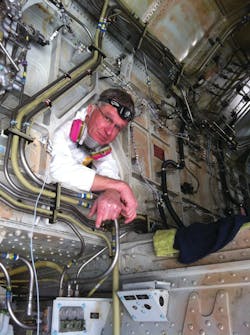
Finding and fixing aircraft fuel tank leaks has always been an arduous and time-consuming process, many times best left to a specialists. Generally, the aircraft is pulled from service and parked in a hangar or designated safe area. The general area of the leak is marked; the tank defueled, opened, vented, and allowed to dry. Next the AMT dresses in anti-static clothing, ensures that the tank environment meets safety standards, and enters the tank. The area in question is located, sealant removed, and fasteners replaced if necessary. The worked area is cleaned and prepped for the reseal. The sealant is allowed to dry and openings are closed. The tank is pressurized with shop air and the suspected area is sprayed with a soap solution. AMTs watch for telltale bubbles. If they do appear, the process is repeated and oversized fasteners are installed and or another round of sealant is applied. If no bubbles appear the tank is refueled and put on watch for leaks. If no leaks appear the aircraft can be returned to service. Fixing leaks is a big part of an AMT’s professional life. It is also big business.
NAAS and AOG
In 1985 two Dallas, TX, aviation entrepreneurs founded Aircraft On Ground Inc. (AOG) and began servicing the business and corporate market. Recently AOG and North American Aircraft Services (NAAS), both FAA certificated repair stations offering specialized services, partnered in order to better serve their customers in the commercial, MRO, defense and corporate markets.
Today their headquarters is in San Antonio and they have offices in 25 locations around the U.S., and in the U.K., Panama, Canada, and Spain. Their combined aircraft maintenance service offerings have expanded to include structural repairs and modifications, engineering, NDT, line and heavy maintenance, and training. NAAS and AOG have global repair teams that can be dispatched to all customer work locations. Aircraft fuel system maintenance is one of their core specialties. They are the experts in aircraft fuel system troubleshooting, fault isolation, and fuel tank repair. NAAS and AOG have a combine staff of more than 300 employees who are very passionate about finding and fixing fuel leaks.
Craig Rose, vice president of operations, has about 20 years with the AOG and provides some of his expertise on the subject. He explains why NAAS and AOG deserve their reputation. According to Rose, their fuel tank specialists are absolute experts at quickly finding the fuel leak path and pinpointing the exact location and root cause of the leak. When asked about their leak-finding process he said that it all begins with good analysis. "The specialists use our Work Order Management System that contains fleet trend modules, electronic wing maps, and repair histories,” he says. Next they conduct both positive and negative pressure test to find the leaks.
The negative pressure test process requires three specialists -- one inside of the tank, another outside to run the pressure test equipment, and one safety attendant. They manage their safety procedures by following the guidelines, notes, warnings, and cautions listed in ATA Chapter 28 of the specific aircraft maintenance manual.
“Before entering the fuel tank our specialists use a gas detector to test the atmospheric conditions to ensure the tank is within the safety limits,” Rose says. They also use the required safety clothing, tools, and explosive-proof lights. Once the specialist is inside the fuel tank and in position, a vacuum is pulled on the tank. Rose recommends that “a good place to start troubleshooting is to look for previous repairs that have multiple layers of sealant.” In his experience, “integral wing tanks leak most often and common root causes are loose or deteriorating sealant, worn fasteners, and cracks in the wing structure and previous repairs.”
I asked Rose to tell me about their fuel tank maintenance specialists. What motivates them to work day in and out in a confined, explosive, toxic environment, chasing and fixing problematic fuel leaks? “We usually recruit staff with former fuel tank maintenance experience. Some have A&P certificates, others don’t, but all attend in-house training programs. AOG has very low turnover and our specialists have the time and opportunities to develop their skills and personal expertise. In my opinion they are motivated to perform fuel tank maintenance because they are experts in their field. They have a lot of pride and respect for their team members because they do what others often cannot.”
Spectronics Corporation
Recently another group of leak-finding experts has given aircraft owners and operators and AMTs another product to help pinpoint aircraft fluid leaks. Spectronics Corporation has been a good friend to a variety of maintenance departments for a long time. It invented fluorescent leak detection and has provided us with ultraviolet dyes and inspection lamps for over a half a century. The 200-employee company headquartered in Westbury, NY, manufactures and distributes more than “1,000 different UV, UV/Blue and LED products that are used to find flaws and leaks in a multitude of mechanical systems.”
It produces the Aero-Brite universal fluorescent leak detection dye that can be used to locate leaks in all petroleum- and synthetic-based aviation fluid systems. Aero-Brite is “safe to use in aircraft fuel, hydraulic, and lubricating systems” and “safe to use in turbine and reciprocating engines.” Using the Aero-Brite for leak detection is about as easy as it gets. You add a prescribed amount of fluorescent dye to the leaking fluid system and let it circulate.
It can be used under all normal operating conditions and temperatures. When the mixture escapes at the leak site it glows a bright fluorescent yellow-green color when illuminated with a Spectroline high-intensity UV inspection lamp. Spectronics Corporation offers a variety of products for AMTs and operators. The Aero-Brite comes in three different quantities and the OPX- 365 VV LED flashlight with a 20-foot inspection range can be used to check for leaks in those hard-to-get-to places.
According to Daniel Cooper, sales account manager at Spectronics Aviation Division, the MAXIMA aviation leak detection kit would be a better solution for specialty shops and crews needing a more robust system. Cooper suggests that “using the fluorescent leak detection products will help decrease the number of aircraft grounded for repair work.” As a tip to AMTs using Aero-Brite, the company recommends that “wherever possible, leak sites should be scanned with the UV lamp under low ambient light conditions in order to enhance the fluorescent response of the dye.”
Most AMTs that I have worked with have a personal zero-tolerance for leaks, drips, bubbles, streaks, and stains. Finding and fixing leaks calls for excellent systems and structural knowledge, safe tools and equipment, and time to do good detective work. Success usually comes to those AMTs that have patience and persevere. Often the only tactic that works is watchful waiting. Waiting until the loose B-nut, worn rivet, or pinched O-ring finally gives up its secret location. Good hunting.
More information can be found by contacting: North American Aircraft Services Inc. at (210) 805-0049 or visiting www.naasinc.com; AOG at (214) 350-5334 or visiting www.aoginc.com; Spectronics Corporation at (800) 274-8888 or visiting www.spectroline.com.
Field Editor Charles Chandler is based in Michigan.
About the Author

Charles Chandler
Charles Chandler began his aviation career as a junior mechanic for American Airlines and retired after 27 years of service. Charles Chandler has a Master’s of Science degree in adult and occupational education with a major in human resources development.