Turbine Technology: Dynamic Fluoride Ion Cleaning
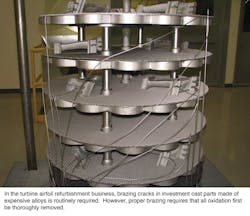
In the turbine airfoil refurbishment business, brazing cracks in investment cast parts made of expensive alloys is routinely required as hot section jet engine components are damaged due to oxidation, sulphidation, hot corrosion, fatigue, or foreign object damage.
However, proper brazing requires that all oxidation first be thoroughly removed from airfoil component surfaces, cooling passage, and cracks, which can be very narrow and deep.
Oxide scale in airfoil cracks
While a jet engine is in service, oxide scale forms on the mating faces of cracks that occur in the airfoils. These cracks become packed full of scale, all the way to the tips. It is the goal of the service shop to repair the airfoils by filling the cracks with a braze alloy, but braze alloy cannot flow into cracks that are full of oxide scale.
To complicate matters, the alloys used to make turbine airfoils are nickel (Ni) and cobalt (Co) based superalloys that usually contain aluminum (Al) and titanium (Ti) to improve strength. The presence of these elements causes the resulting scale to contain complex spinels that are extremely difficult to remove.
“At the narrow tip of a crack, scale forms during service. The scale occupies a larger volume than the metal from which it formed. This results in the narrow spaces at the tips of cracks being totally packed with scale,” says Donald Bell, chief engineer at P&WC Component Repair, a division of Pratt & Whitney Canada. “You cannot fill the crack with braze alloy if it is already filled with oxide scale.”
Traditionally, fluoride ion cleaning has been performed at atmospheric pressure to remove oxidants from components, but metallurgical studies have shown it only works well when cleaning wide cracks. Plus, it can add extra steps to the oxide cleaning process that result from chromium fluoride or chromium carbide buildup during the process.
More recently, however, an innovative dynamic fluoride ion cleaning (DFIC) process has offered turbine refurbishment professionals the ability to clean deep, narrow cracks of oxides by cycling between negative, atmospheric, and positive pressure for more ideal surface preparation prior to brazing.
Beyond fluoride ion cleaning
The DFIC process, also known as hydrogen fluoride (HF) ion cleaning, results from the reaction of fluorine with various oxides. HF gas can be toxic if it escapes into the atmosphere. However, improvements in gas monitoring sensors and digital electronics, resulting from its widespread use in the semiconductor industry, have made it safe and reliable for parts cleaning.
At temperatures greater than 1,750 F (950 C), the fluoride ion reacts with oxides that have formed on the crack faces in turbine airfoils, converting them to gaseous metal fluorides. This allows them to be easily removed. They depart through the off-gas stream of the reactor.
There are significant drawbacks to the early fluoride ion cleaning processes developed in the 1970s, which utilize fluoride compounds in powdered form and perform the work at normal atmospheric pressure. Besides having difficulty penetrating into deep, narrow cracks, the early processes were less flexible and not continuous. They relied on a single charge of powder to produce their HF gas. This often resulted in parts having to be processed through more than one cleaning cycle.
“When compounds are in powdered form, such as chromium-fluoride, aluminum-fluoride, or PTFE, there is a finite amount of reaction that can occur,” says Bell. “When they’re done, they’re done, and if the parts are not yet clean, the cleaning process often has to be repeated.”
Flexible and repeatable
Fortunately, the DFIC process has been proven to be more effective, flexible, and repeatable. What separates the DFIC process from first generation fluoride ion cleaning equipment is that the reaction temperature, fluorine concentration, pressure level, and duration are all independently controlled variables.
The sophisticated digital control systems that come with today’s equipment can be programmed with hundreds of “recipes” for cleaning specific alloy types, widths of cracks, and levels of scale and oxidation.
During the cleaning process, HF and H2 gas are introduced into the system through precision metering, so time and gas concentrations can be precisely controlled. For example, a typical cleaning cycle may begin as 94 to 96 percent hydrogen. But within that cycle, it may be changed to a 92:8 or 86:14 H2 to HF ratio, depending on the substrate material.
Some DFIC systems, such as those available from Hi-Tech Furnace Systems, are designed to perform the cleaning process at sub-atmospheric pressures from 100 to 650 Torr (133 to 867 Millibar) while at processing temperature.
By varying the pressure between positive, negative, and atmospheric levels, the DFIC system “pulses” HF in and out of cooling channels, deep cracks, and small holes to more effectively clean oxidized, hard-to-reach areas.
Current users
In recent years, the Lufthansa Technik Turbine repair facility in Shannon, Ireland, added a DFIC furnace from Hi-Tech Furnace Systems. The DFIC furnace is used to prepare hot section engine parts, such as LPT/HPT vane and combustor parts, for brazing.
One of only a few DFIC manufacturers in the world, Hi-Tech Furnace’s customers include General Electric, Pratt & Whitney, Snecma Services, Lufthansa Technik, Chromalloy, Goodrich, and others.
“The DFIC works equally well on a variety of alloys, and allows us to cycle between positive and negative pressure to get component surfaces as well as deep cracks and crevices extremely clean,” says Philip Kelly, a process engineer at Lufthansa’s Technik Turbine Shannon repair facility.
Pratt & Whitney Canada Component Repair’s Donald Bell concurs. “We use the DFIC process to modulate atmosphere from low to high to pneumatically push the fluoride ions down into the tips of the cracks and hold them there for a while,” explains Bell. “We can cycle back and forth as needed for the best cleaning results.”
Bell adds that by performing the process under vacuum, not only is surface oxidation removed, but aluminum and titanium are depleted from the substrate, creating a denuded zone approximately 0.0005 inch deep.
“This gives us a buffer. During furnace brazing, residual oxygen in the vacuum chamber can re-oxidize a clean part. The denuded zone gives us time to get the braze filler to flow and wick into the cracks before re-oxidation occurs,” explains Bell.
Added benefits
As an added benefit, the use of HF at sub-atmospheric pressure often eliminates extra steps in the brazing preparation process.
Cobalt-based alloys, used to make jet engine turbine airfoils, contain a significant amount of chromium. This can react with fluorine during the process to create a chromium fluoride film on the surface of the parts. Chromium fluoride is the most refractory (temperature-resistant) compound of all the metal fluorides. As a result, it does not volatize at the usual temperatures used in FIC.
Without the vacuum capability in the cleaning process, the part must then be moved to a vacuum furnace where the part is subjected to the higher temperature and lower pressure required until the chrome fluoride volatilizes.
However, the resulting fluorides can contaminate the brazing furnace or the vacuum pump, which should be kept very clean and are not designed to handle acidic gases.
According to Bell, at pressures of about 150 Torr absolute, chrome fluoride will remain gaseous, “so we’re able to clean without depositing a residue on the joint.” If any chrome fluoride is created during the process, the control system can be set to subject the part to the higher temperature and appropriate pressure to remove it.
“With the DFIC equipment, we are able to clean components in one shot, instead of the multiple cleanings typically required with more traditional fluoride ion cleaning,” adds Bell.
Another benefit of the dual vacuum process is that it uses significantly less HF, because oxides are volatilized at a lower temp and concentration of HF when performed sub-atmospherically. Using less HF also reduces the risk of inter granular attack (IGA), which could otherwise chemically alter the microstructure of the metal being cleaned.
For more info, call (586) 566-0600; Fax (586) 566-9253; email [email protected]; visit www.hi-techfurnace.com; or write to Hi-Tech Furnace Systems Inc. at 13179 West Star Dr., Shelby Township, MI 48315.
Del Williams is a technical writer based in Torrance, CA. He writes about health, business, technology, and educational issues and has an M.A. in English from C.S.U. Dominguez Hills.