Wireless Headsets For Team Communication Improve Ramp Safety
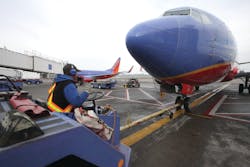
The aviation industry has made great strides to improve passenger and employee safety over the past 50 years. Ground support communication, however, is still handled the same way it was a half century ago - usually with hand signals … or shouting … or having one member of the team talk over a wired headset to the pilot while the rest of the ground crew try to figure out what the two are saying.
Relying on such traditional approaches is understandable, but dangerous. Shouting over background noise can cause dangerous misunderstandings. Hand signals are complex, convey only part of the message and require line-of-sight visibility and often failin darkness or bad weather. And neither option does anything to protect hearing. The stakes are high on the ramp with expensive equipment and people constantly in motion. Just one overlooked hand signal or misunderstood command can result in millions of dollars in damages, personal injury or even death.
Recent technological advancements, however, have made wireless headset systems for team communication the best practice for enabling communication and addressing safety challenges on the ramp. Such systems are currently deployed at more than 50 U.S. airports. And that number will increase substantially in the first quarter of this year as Southwest Airlines becomes the first major U.S. air carrier to outfit all of its gates with wireless headsets for their pushback operations.
SAFETY AND COST
Ramps are one of the most dangerous places to work. The Flight Safety Foundation, for example, estimates that nearly 250,000 people are injured in 27,000 ramp accidents around the world each year. This equates to one accident and nine injuries per 1,000 departures. A 2007 report from the U.S. Government Accountability Office identified 29 fatal ramp accidents between 2001 and 2006 that involved the death of 17 ramp workers, eight passengers and four pilots.
Beyond the human loss, ramp accidents also exact an immense financial toll. The direct costs of repair alone are estimated at $5 billion annually. The estimated price tag jumps to a staggering $10 billion when indirect costs are factored into the equation.
Moreover, airlines themselves write the checks not their insurance companies. An FSF study reviewed 274 ramp accidents and concluded only one resulted in direct costs that exceeded the airline’s deductible limits.
FSF notes human factors are the primary culprit in ramp accidents; issues such as malfunctioning equipment and inclement weather play a lesser role. And of the 12 human factors typically cited in the occupational safety literature, poor (or nonexistent) communication routinely tops the list.
The ramp also poses a threat of noise-induced hearing loss. U.S. OSHA regulations require hearing protection when the time-weighted average noise level exceeds 85 decibels (dB). During takeoff, a jet aircraft emits eardrum-rupturing noise levels of 150dB, about 40dB higher than the human pain threshold. In comparison, normal conversation is around 65dB; a motorcycle, 100dB; a jackhammer, 110 dB; and an emergency siren, 125dB.
This extreme noise likely contributes to airline employees suffering four times as many lost workdays and nearly 12 times as many injuries from hearing loss as the industrial average.
Meanwhile, ground support crews don’t have many options to protect hearing.
Earplugs and earmuffs, for example, may protect hearing, but restrict communication.
Wired headsets can offer hearing protection and clear communication, but tether the individual to the aircraft intercom. In addition to restricting mobility, wires can also wear out or become entangled with equipment. Damaged cables have long been the most frequent reason wired headsets require repair, resulting in hefty service costs and equipment downtime.
Plus, that takes us back to where we started. A wired headset on one member of the crew does nothing to help the rest of the ramp workers hear or participate in a very important conversation.
WIRELESS TEAMWORK
Viewed against a dangerous and costly backdrop, clear team communication is obviously essential to create a safe, productive and effective work environment on the ramp. Tractor operators and wing walkers need to warn each other of impending dangers. The tractor operator needs to keep the flight deck informed of ground movement. And all ground personnel should at least be able to hear the flight deck and each other during a pushback.
Ramp workers can do much more without the wire, the shouting or the hand signals. Figure 1 depicts a pushback and towing configuration in which headsets and a portable communication system continuously connect one or more wing walkers with the tractor operator during aircraft movement, enabling the operator to concentrate on correct maneuvering and allowing instant communication in the case of danger.
The tractor operator wirelessly communicates with the aircraft pilot through a portable system.also permits all team members to hear the pilot. Becasue wireless communication increases coordination and enables verbal warnings, it decreases the risk of accidents, shortens turnaround time and increases the likelihood of hitting flight slots.
In addition to pushback and towing, wireless team communication systems can also be used to improve safety and efficiency in deicing operations. As shown in Figure 2, a wireless system connects the driver and the basket, and the system itself is connected to a two-way radio by means of an interface cable, enabling communication with remote users.
Communication between the driver and the basket takes place on open microphone over a 1.9GHz (1.8GHz in the EU) encrypted frequency while also allowing radio monitoring and transmitting with a push to-talk button on the headsets. Systems can be configured to enable multiple deicing crews to communicate while working on the same aircraft - further improving efficiency. Additional configurations are available for maintenance teams and are scalable to almost any size.
Because wireless communication increases coordination and enables real-time verbal warnings, it decreases the risk of accidents, shortens turn-around times and increases the likelihood of hitting flight slots.
Wireless headset systems are available in a wide variety of configurations and price ranges. To ensure a system meets the diverse needs of ground support, consider the following factors carefully:
Is the system truly wireless? A number of so-called “wireless” systems actually require a wire from the headset to a radio or belt pack. While these systems allow freedom of movement, a belt pack or radio wire creates many of the same problems inherent in hardwire systems, particularly tangled cords. Moreover, belt packs generally have less than half the transmission range of self-contained systems worn on the head.
Does the system use DECT or Bluetooth technology? Transmission technology can dramatically affect how well wireless systems perform in the field. Systems that employ Bluetooth technology generally have a limited range and are subject to radio frequency interference from nearby devices.
Look for systems that use Digital Enhanced Cordless Telecommunications technology. DECT units generally offer up to 30 times more coverage and are less subject to interference than Bluetooth. DECT transmissions also have multipath capability, meaning the signal will bounce up, over and around objects in order to establish the best possible connection. DECT signals are also digitally encoded to ensure privacy.
Is the system full-duplex or half-duplex? Half-duplex systems allow communication in both directions, but only one direction at a time. That’s a walkie-talkie. On the other hand, full-duplex systems allow communication in both directions simultaneously. Full-duplex capabilities are an important safety consideration because they allow the parties to speak and hear others at the same time.
Is the system compatible with a radio? While communication during pushback and towing are generally confined to the flight deck, wing walkers and tug operator, other ground support functions may benefit from the ability to communicate with remote users over a two-way radio. Given the large number of two-way radio models in use, look for a system with maximum radio-interface flexibility.
Can the duplex capabilities be configured to your specific needs? The system should allow you to establish a hierarchy of who can talk to whom — especially who is allowed to talk to the flight deck or broadcast over the radio.
Is the system comfortable to wear and easy to use? Before purchasing, physically try on a headset. It should be lightweight and fit snugly, but still feel comfortable over the ears. The controls should be readily accessible and easy to operate.
What is the system’s Ingress Protection Rating? The Ingress Protection Rating or IP Code rates the degree of protection against the intrusion of solids and liquids into an electrical unit. A wireless headset should have a minimum rating of IP 65 when worn.
What is the range of the system? The greater the range, the more effective the system will be since obstacles and vehicles may reduce range. Look for a minimum 1,500-foot line-of-sight transmission capability, bearing in mind that system performance may deteriorate at the outer limits of the range.
What is the Noise Reduction Rating? Noise Reduction Rating or NRR is the decibel measurement indicating how well a hearing protector reduces noise. Look for an NRR of at least 24.
What is the operational temperature range? To be effective on the ramp, a system should operate within a temperature range of minus 40 degrees F to 130 degrees F.
What about warranty and service? Not all wireless headset systems are equally reliable and durable over the long run. Make sure the system is designed for use in your operating environment. Ask about warranty, repair and replacement policies, and try out the manufacturer’s technical support prior to making a decision. A limited warranty of one or two years is standard in the aviation industry; some manufacturers provide extended plans of up to five years.
Full-duplex wireless headsets leave the wearer’s hands free, provide freedom of movement and eliminate the wires that previously tethered ground personnel to an aircraft or belt pack.
Wireless communication systems are affordable. A single ramp accident can cost hundreds or even thousands of times more than deployment of numerous wireless communication systems. A wireless communication system could easily pay for itself in less than a few weeks; the safety benefits are virtually incalculable. As these systems become more widely deployed, they will likely reduce injuries and save lives every year.
About the Author: Michael Walsh is the director of business development for Sonetics Corporation and oversees Flightcom’s wireless ground support communication systems worldwide. He is a pioneer and acknowledged expert in wireless communication solutions for ground support and works closely with major airlines, ground handlers and airports to provide customized solutions.