Composites In Aerospace: A Maintenance Primer
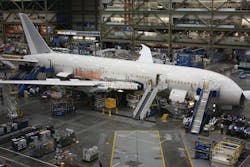
National Institute of Aviation Research (NIAR): “The use of composites in modern aircraft designs is accelerating and will underpin a quadrupling of the aerospace composites market over the next 20 years.”
While the many benefits of composite aircraft construction continue to be extolled in the press, it is human nature which makes it difficult for us to accept the unfamiliar or unknown. Despite the incredible advancement and growth of composites in aerospace over the past 20 years, many people within and outside the industry remain skeptical of the technology. It’s time we all learn about this extremely durable and versatile class of materials and what makes them so invaluable to aerospace.
First of all, what is a composite? A composite is a macroscopic (visible to the naked eye) combination of two or more materials which results in a material possessing structural properties none of the constituent materials possess individually. Because the materials are not soluble in one another, they retain their identity. Chemical compounds such as alloys therefore are not composites. The fact is we are surrounded by products meeting this description; automobile bumpers, bathtubs, cardboard boxes, diving boards, exercise equipment, fuel tanks, golf clubs, etc. Why not airplanes?
Like their metal counterparts, composite aircraft utilize a variety of materials and construction methods. The most basic unit of composite construction is the laminate. The laminate is analogous to sheet metal and consists of one or more plies or lamina as they are called. A lamina combines a fiber component usually of fiberglass, carbon fiber, or aramid (Kevlar is DuPont’s aramid product) and a surrounding matrix material, epoxy resin being the most common in aerospace. The fibers in the laminate may be chopped (short fibers with random orientation), woven cloths (long fibers in specific directions), or tapes (long fibers in a single direction) but in all cases must be saturated by the matrix material.
Boeing, on the 787 Dreamliner: “Engineers are discovering that their composites are tougher than they initially imagined … maintenance costs will be about 30 percent lower than for aluminum airplanes … corrosion and fatigue benefits are going to be astounding.”
Laminates vs. sandwich construction
More laminas result in stronger, thicker but heavier laminates. The principle advantages of laminates over sheet metals of equivalent strength are: less weight, high fatigue and corrosion resistance, and that they are formed in mold tools resulting in fewer, larger aerodynamically smooth parts designed and built to handle specific loading. The advantages of sheet metals over laminates are that metals are isotropic in nature (they are uniformly strong in all directions), less expensive, and generally have better part stiffness characteristics than laminates of equal strength.
|
Material |
Specific Gravity g/cm³* |
Ultimate strength in psi** |
|
2014 T6 Aluminum |
2.8 |
70,000 |
|
Carbon steel |
7.6 |
122,000 |
|
E glass |
2.6 |
217,500 |
|
Kevlar |
1.4 |
400,000 |
|
Carbon fiber |
1.75 |
600,000 |
|
* H²O = 1.00 |
|
|
|
** The force required to cause failure or permanent deformation |
||
|
assuming a hypothetical cross sectional area of 1 in² |
||
To increase their isotropic characteristics, laminates are usually made with the long fibers of multiple laminas running in two or more directions within the laminate. To overcome laminate stiffness limitations, a second type of composite construction is used, sandwich structure.
Sandwich structure introduces a core material bonded between two laminates or basesheets. The loading mechanics of sandwich structure act similarly to truss or beam construction. The core material carries and transfers the imposed loads to the basesheets perpendicular to the applied load just as stringers and frames do. Typical core materials include high density polymer foams, honeycombs (a hexagonal cell material usually made of aluminum or aramid oriented perpendicular to the basesheets), and cross cut balsa woods. Large composite parts frequently utilize both laminates and sandwich structures in their lay-ups.
When a core material is sandwiched between two basesheets, the part may become as much as 40 times stronger than the combined strength of the basesheets. It is the core’s material and thickness which determine its ultimate strength. Because of the thin basesheets, sandwich structures have low impact tolerance, and once punctured are highly susceptible to moisture ingress.
The perfect composite airframe would consist of a one piece lay-up using laminate and sandwich constructions. Because of tooling and material limitations, this is not yet possible and so like their metal counterparts, composite aircraft are an assembly of parts. Where metal airframes use mechanical fasteners to join parts, composite airframes use structural adhesive (or in some applications, combinations of mechanical fasteners and adhesives).
Remember building plastic model airplanes as a kid? This is approximately how composite aircraft are built except for the part about using advanced composite materials instead of polystyrene plastic and glue. Because of their excellent adhesion and strength properties, epoxies are the most commonly used adhesives in aerospace. The bond mechanism created between adhesive and composite parts is referred to as a secondary bond. It is a complex molecular union which is nearly as strong as the composite material itself. When applied within allowable bond thickness limits, epoxy adhesives have very high shear strengths (shear is parallel but opposing loads applied to the joint).
Damage assessment
Whenever one is faced with the prospect of assessing damage to composite airframes, it is important to be familiar with the unique strengths and weaknesses of these constructions. Due to composite’s very high strength, one must be cognizant of “point of impact damage” as well as “load path damage”. It is not uncommon to have minor point of impact damage while sustaining major load path damage.
Damage assessment nearly always begins with a thorough visual inspection either as part of a scheduled inspection or as a special condition inspection which may arise from a reported (known) incident or event. It is important to discriminate between these two types of inspections. The amount of energy associated with damage from a known event may be used to determine the extent of the inspection(s), e.g., a fuel truck hitting a wing will have much more energy than a golf club hitting the wing. Ironically, both may result in similar point of impact damages. In the fuel truck scenario, analysis of the energy’s load path would be reason to inspect interior wing structural components, bonded joints as well as attach points and adjacent structures.
Visual inspections
Visual inspections of painted surfaces are best accomplished by using a high intensity flashlight held at a low incident angle to the structure. Keeping your eyes at a low angle perpendicular to the light beam, sweep the structure with the beam. Circle all cracks, punctures, abrasions, and obvious shadows with a nonpermanent marker or grease pencil and complete the visual inspection. Using OEM publications or technical assistance, determine the structure of the encircled areas (laminate or sandwich).
Defects to laminates may be further investigated by visually inspecting the reverse or interior side. This may require the use of optical instruments such as flashlight/mirror or borescopes. Because of their translucent nature, all types of damage to fiberglass laminates will appear white. If you cannot make a determination of damage in this manner, it may become necessary to remove the exterior paint finish.
Sandwich basesheet punctures and cracks will be obvious and must be repaired. Less obvious defects may be further investigated by use of the “coin tap” test. Coin tapping can be highly subjective and requires practice as well as a consistent tap frequency and intensity to be effective. Nonpuncturing impacts often cause the basesheet and core to disbond. An area of disbond will have a distinctively dull timbre when tapped. It is important to tap in all directions around the suspect area for confirmation, shape, and size of the disbond. Surfaces adjacent to punctures and cracks should be similarly investigated. Damage to secondary bonds will appear as a crack in the adhesive joint. The crack will appear evident from both sides of the joint and will produce a dis-resonant sound when tapped.
Training and support
FAA AC No; 65-33; Composite Maintenance and Repair: The maintenance of composites is complex and requires knowledge and skills to assure the continued airworthiness of these products … Experience, classroom training, hands-on on-the-job training, and assessments all work together to ensure that the skills are developed to perform safe composite maintenance and repair.
The authority to repair composite structures lies in the hands of the airframe OEM. Information about classification, size, and location limitations may be found in the aircraft maintenance manual (AMM) or by phoning its technical support line. Repairs to composites should be undertaken by trained, qualified personnel only. In fact, most OEMs require training or certification to perform repairs on their products. While there are many composite training opportunities available, one of the biggest industry problems is that there is no standardization of process among the OEMs. Having said that, I can tell you that fundamentally, the differences are not that great; many of the basics are the same (or at least similar). While OEM training will be specific to their type, there are also schools and companies which offer training tailored to the industry. So, if you see composites in your future, learn about them, embrace them.
Tim Wright has been working with aerospace composites for 13 years as a technician and technical trainer. He is currently on the faculty at Northland Community & Technical College in Thief River Falls, MN. Previously, as a technical trainer at Cirrus Aircraft, he instructed more than 250 technicians, engineers, A&P instructors, and regulatory agents on Cirrus composite damage assessment and repair processes.