It's All About Business
DFW AIRPORT, TX — Get to know the Dallas/Ft. Worth International Airport and the people who run it, and one gets the sense that this airport is something different. It’s vast acreage in a sea of suburbia midway between the two cities is one distinction; in numerous interviews over the years, the overriding message is that this is an airport that is run like a business.
At the helm since 1994 is Jeff Fegan, who has experienced the transformation of the authority that runs it, the airfield itself, and its continuing connection to the global arena as one of the world’s leading airports.
DFW offers some 1,750 flights per day and serves some 57 million passengers a year. It provides non-stop service to 145 domestic and 47 international destinations worldwide, and ranks in the top five for customer service among large airports worldwide. It has added 22 new destinations in the past year.
Fegan has served as the chair of Airports Council International-North America and is actively engaged in taking his airport to a new international level, per his board’s direction. He shared his thoughts recently with airport business on the airport, the industry, air service development, and other topics. Edited excerpts of that discussion ...
airport business: You came into this position as a planner. What are your thoughts on the role of planning and how it’s changed through the years?
Fegan: I was hired in December 1984 as a chief planner. I had worked in the consulting business before that; I have a masters in city planning. Most of what planning is all about is a future orientation for problem-solving and trying to solve physical and transportation problems.
When I came to DFW what I saw was 18,000 acres of land; at the time we had five runways, we have seven today. The opportunity and the future — if you were a doctor, you want to work at the Mayo Clinic. If you’re an airport planner, you want to work at DFW airport. It is absolutely the best opportunity to plan and actually implement what you plan of any place on earth. And we did.
The amount of activity I’ve been involved with since 1984 measures in the billions. We did the $2.8 billion program when we did Terminal D and the people mover; and we’re involved in a $1.9 billion program today. Between all that we spent anywhere from $100 million to $300 million a year in capital improvements. We built the taxiway system out; extended runways; got UPS to put their regional hub here; and watching the whole west side of the airport develop from a cargo standpoint.
In 1994 I became CEO but was still a planner at heart. I’m still thinking about the next project, the next development that we need to stay ahead of the demand curve here at DFW.
If you have a planning orientation and you’re the CEO of an airport, it’s the right place to be.
ab: How is technology affecting the planning process?
Fegan: I can remember the day when we didn’t have an IT department. Right now we have some 130 systems that the IT department is responsible for — everything from the security and camera systems to the parking control system to the systems we use to run our financials and every aspect of the business, really.
In Terminal A, as we go through the refurbishment program, we’re loading up this terminal with technology and backbone infrastructure to be able to accommodate anything that comes our way, be it new security screen systems at the check points; requirements for the airlines to have remote check-in; advertisements on the walls. Some 35 percent of our advertising space will be digital in the new terminal building. There’s the technology of communicating with the public –—social media.
We had a discussion today about patenting some of this stuff because it’s so leading edge.
ab: Having met with DFW officials through the years and heard them at conferences, one impression they leave is one heavy on business orientation. As airport groups continue to lobby Washington to be allowed to operate more as independent businesses, does DFW potentially offer one model to follow?
Fegan: When I became CEO in 1994 I had ten points, and one was we had to operate as a business. It was a transformation that took place from kind of this large landlord who was very passive to one that was very active, very engaged — driving the business and driving the revenue. Today we’re a $600 million enterprise; $200 million from the airlines and the other $400 million coming from non-airline sources.
We do run it like a business. We have a lot of success on a lot of different fronts, including some outlying things like our natural gas [drilling]. We have a fantastic deal on that — probably one of the best of its time. We got in just at the right time.
We entered into the hotel business. We have a facility improvement corporation board that oversees the operation of the Grand Hyatt Hotel, and that board consists of myself and four of my executives. We are the owner and responsible for its success. The Grand Hyatt has paid huge dividends.
The events of 9/11 certainly caused us to be much more focused, much more detailed; much more business-like. Prior to 9/11 everything we touched turned into gold; we couldn’t do things fast enough; revenues were going off the charts. Of course, after 9/11 the brakes came on for awhile.
The other thing you’ll find is we’ve created an environment that is probably different than most other airports in that we are very independent. We have a lot of our own policies — personnel issues; how we compensate. Most of the people that we have hired have come from the private sector. Very few have come from another airport. That private sector focus continues to drive our desire to run the airport like a business.
It’s a professional environment. The work here is fantastic, whether you’re a finance guy who goes to New York and borrows a billion dollars; or a construction guy who just finished up a billion dollar terminal; a land developer who just landed a deal with the Dallas Cowboys; or a concession person who has the responsibility for 250 stores out here. It is very much like what a Fortune 500 company would experience.
That kind of environment allows us to attract talent.
ab: And, you don’t get any calls from downtown saying that somebody from the public works department is coming to work at the airport.
Fegan: One of the agreement provisions is that neither the city council nor my board can direct me on any personnel decisions. It’s completely separate from that kind of influence, which is a nice place to be.
ab: DFW recently began its Terminal Renewal and Improvement Program (TRIP) to upgrade the original passenger terminals. Anything in particular of note on that program?
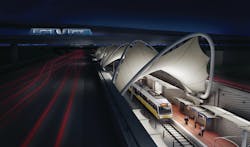
Fegan: As I look at the airport today and think of where it will be five years from now, we will have virtually all new terminals. We’ll have transit connections from both DART [Dallas Area Rapid Transit] and The T [Ft. Worth’s transit system]; we’ll have the north DFW connector finished; we’ll have the highway on the south end finished. We have seven runways today; we have plenty of capacity and are well-positioned for the future.
ab: As a user, one impression is that the new Skylink rail has transformed the DFW experience for passengers. True statement?
Fegan: Absolutely. The Skylink is probably the most transformational thing we’ve done. It has shrunk the airport dimension to the point that people now park in Terminal D because they know they have space there, and get on the train and get to Terminal A in five minutes. People use it to access concessions if they have time to kill.
Concessionaires use it to get from one store to another; TSA uses it to man the various stations at the airport; the airlines use it as well. It’s a transit system that probably rivals any mid-sized city in terms of the volume of people it carries every year –—14 to 15 million people each year.
ab: You’ve had a big year with air service development, notably on the international front.
Fegan: This year was probably the best in our history. We added 22 new destinations – nine international cities. We added Qantas this summer, flying to Brisbane and Sydney. Emerates just announced they’ll be starting daily service on February 2 with a 777 to Dubai. American added Rio de Janiero and Barbados. American Eagle has added four cities in Mexico – we have 17 cities in Mexico we serve today.
We added Virgin America and Spirit started this year. We expect to see more growth from the low-cost carriers at DFW. We’ve also seen a lot of growth on the cargo side. We added Air China Cargo from Shanghai. Korean does nine 747s a week, and it has increased their passenger frequency as well.
The one world alliance is shaping up and going to most of the important cities in the world.
ab: Are there any particular countries or regions that are on your ‘hot’ hit list?
Fegan: One of our target markets is Taipei. Clearly, China — we don’t have service to Beijing, Shanghai, or Hong Kong. All three of those can support service to DFW. Part of that is a pilot issue with American; their scope [clause] does not allow them to fly that without an extra crew. It’s one of the things that’s on the table in their labor negotiations.
It’s where airplanes like the 787 come into play. Three years from now there will be several hundred of these in the fleet and we’re hopeful the 787 will be transformational for the airport as well.
India is our largest unserved market. To the south, there are markets in Lima, Bogata, and others we feel we can support. The Middle East — we have Emerates, and have had interest from other carriers. In Europe, we have BA and Iberia as part of the one world alliance; but also Air Berlin is now part of that alliance and something could materialize with them.
We’re looking at Manchester, England. We have no service to Italy, and we think there’s a strong demand there. It’s finding the right airline with the right airplanes, and who is part of the right alliance at the right time. That’s really what it’s all about.
ab: Is there anything in particular you’ve learned along the way regarding air service development that could be shared as a best practice?
Fegan: We have a lot of the pieces. We have virtually unlimited capacity for an international carrier; we have great facilities with Terminal D; and we have a very aggressive incentive program which virtually makes it very inexpensive to near free from an airport cost standpoint for the first two years of their operation.
The real driver in all this is: How big is the market? This is a market that likes to travel, and it’s the fourth largest metropolitan area in the United States. We have 20 Fortune 500 companies located here. All the things that an airline is looking for we have here.
Another of it is, is it part of the airline’s strategy to serve this market? And that is driven largely by the alliance. The ones that seem to work the best are those that have a hub on both ends. It’s so powerful.
So, we’re one of the great super-hubs in the world. If we connect with other hubs there’s typically enough passengers to make them viable.
ab: Some airports and their sponsors are exploring the aerotropolis concept, the idea of building or rebuilding a region with the airport as the core for development. It seems that DFW is ahead of the game on that concept.
Fegan: We’ve got 18,000 acres of land and we’ve dedicated 12,000 acres for pure aviation uses. We laid it all out to make sure we don’t do anything to take away from our airfield capacity. That still leaves us 6,000 acres; from a commercial development standpoint, it’s a lot of land. It’s bigger than most downtowns.
We’ve been focusing on development that helps support this operation. We try to attract companies that can take advantage of the proximity to cargo and the passenger terminals. For example, in our warehouse distribution area, the International Commerce Park, we have great companies like Aviall, the largest aircraft parts company that ships parts all over the world. We have Pratt & Whitney, DHL. Our most recent deal was with the Dallas Cowboys world merchandising headquarters with a 200,000-square foot warehouse.
We have a development on the south end called Southgate, and in January we’ll be taking an action item to the board to hire a developer for that property.
It also generates revenue, which goes to offset our costs and makes us more cost-competitive. And we are very cost-competitive — we have one of the lowest cost structures of any airport in the country. When you combine our airport costs, the airline costs, plus any delay costs, this airport versus others is substantially lower.
ab: A year ago you completed a new use agreement with the airlines at DFW. What can you tell us about the agreement and the process?
Fegan: It’s a ten-year agreement and would be characterized as a hybrid. The non-airline revenues go into a certain fund; once they exceed $60 million, anything above we share with the airlines — 75 percent to the airlines, 25 percent to us. That $60 million is used for capital projects on the airport; anything above that $60 million requires airline approval through an MII [majority-in-interest clause].
As part of the use agreement we got a $1.9 billion capital improvement program approved for the four terminals; and another $250 million for non-terminal related projects. And we believe that within the next couple of days we’ll get another $250 million approved — for example, the new parking structure for Terminal A.
ab: Anything to say about negotiating with the airlines, versus ten, 20, or 30 years ago?
Fegan: Actually, our first use agreement lasted 35 years. It worked just fine. This one was designed to give us some more control of some capital. In the past we had a discretionary fund of about $8 million a year; everything else required airline approval, including some major maintenance.
It wasn’t the worst process I’ve been through; it was reasonable.
ab: A hot topic with DOT and the general media today is airliners that get stuck waiting on airfields due to extreme events, such as the October snowstorm in the Northeast that saw Hartford get an onslaught of airliner diversions. What do you see as the airport’s responsibility in such events?
Fegan: The word responsibility may not be the right word. We’re in the business of delivering facilities and services to our customers, and our customers are both the passengers as well as the airlines. We do feel a responsibility if an airline is struggling because of inclement weather or some irregular operation. We have reached out to the airlines on a number of occasions.
As people get diverted we monitor and attain information on all the flights perched to come into DFW. As time goes on, we will intervene if we have to.
We bought a bus and an automated jet bridge/stairway and we can offload people and take them right into the airport. We’ve also created some additional spare gates at one terminal; if every other gate is full, there are the spare gates available. We have a concessions irregular operations plan where we notify all the concessionaires; they agree to stay late and will stay open until all the customers are gone. We’ve had many nights where several hundred people spent the night in the terminals; we have cots and provisions — baby formula; diapers.
ab: What’s it like running a U.S. hub airport today versus 30 years ago, and what can we learn up new facilities that have emerged internationally?
Fegan: Over the years it’s gone from more of an operational exercise to more of a business operation. It’s a complex environment with a lot of different stakeholders. Twenty years ago airlines made all the decisions; today, it’s more of an equal partnership. The airlines have off-loaded a lot of their operational responsibilities to airports and we have embraced them.
I think over the years many international airports have learned from us and have taken it to another level altogether. We had a delegation just return from Singapore and they were talking about how incredible the concession program was and all the innovation that they saw in services to the concessionaires. Fly to Beijing or Incheon or Hong Kong and they have beautiful facilities.
It’s kind of a situation where the country, the airline, and the airport have come together and decided to do something fantastic from a strategic perspective to attract business to their part of the world. The international airports have done a fantastic job of pushing the envelope.
ab: If you had an audience of airport managers sitting in front of you right now, what one thing might you want to make sure you tell them?
Fegan: The one thing that we’ve done here that is kind of extraordinary is that we have transformed what was sort of stogy, traditional public agency into a high-performing, entrepreneurial business. There are not many opportunities out there in this country that allows the public sector to do that. And if I had any criticism about the public sector and the people who are responsible for managing it, it’s that I think being in the public sector is not an excuse for not running your airport like a business.
Unfortunately, many airports are under severe constraints in terms of their ability to do the things that we are able to do at DFW. That’s been a real competitive advantage for us. Our governing structure; the willingness of our board to allow us to have the resources to be successful. I wish every airport in the country had a similar situation because I see airport executives who are very competent but very frustrated and I feel for them. They’re very confident; want to do great things for their city; but they’re being held back by the constraints of being in the public sector.
Politics is a word that some airports find themselves struggling with.
(callouts)
If you were a doctor, you want to work at the Mayo Clinic. If you’re an airport planner, you want to work at DFW airport. If you have a planning orientation and you’re the CEO of an airport, it’s the right place to be.
Most of the people that we have hired have come from the private sector. Very few have come from another airport.
It’s finding the right airline with the right airplanes, and who is part of the right alliance at the right time. That’s really what it’s all about.