The Joystick Training Files
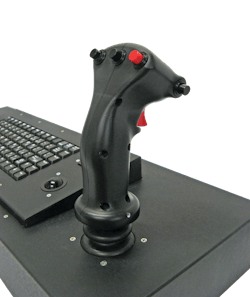
We are in the midst of a seachange in how military and flight simulation tools are developed, as commercial off the shelf (COTS) systems begin to replace expensive, custom-designed training simulators.
Fueled by a drive to remove American service personnel from harm’s way, budgetary concerns that are looking everywhere to reduce costs, and perhaps most of all by the supreme joystick-using skills of the generation that has grown up on video games, training simulation equipment is going mainstream. From flight simulators for military cargo planes, to a console for an unmanned aerial vehicle, to training modules for a planned virtual flight academy, cost effective simulators are blurring the line between recreational gaming and military simulation.
Driving motivation: Protecting service personnel
There has been a burgeoning interest in machines that can observe conditions and take direct action without placing American forces in front of weapons and in harm’s way. Along with this desire to protect American forces deployed in battle zones, there is also a focus on training service personnel in a different skill set that includes problem solving, serving as a counselor and helping groups resolve their differences. This strategy depends upon deploying extremely accurate weapons to make sure that any casualties inflicted are the desired ones, so troops don’t have to explain unintended civilian casualties.
The accuracy is in the hands of a new generation of troops, blessed with excellent eye/hand coordination, comfortable being removed from an object, and skilled at giving commands with hands and eyes. Years of Super Mario and its ilk have seen to that. Put a remote that looks like an Xbox controller into the hands of an 18-year-old and he or she can respond with great accuracy. Whereas an older generation of troops might have trained to drive a vehicle using a large steering wheel and gear shift pedals, the younger generation is already expert at manipulating something remotely.
Those responsible for training want to cash in on this wealth of experience, and more and more pieces of equipment are geared to take advantage of that skill set. Take for example, the Sky Warrior, PackBot and steering vehicles looking through a monocle similar to that used in Game Boy.
A change in how equipment is procured
About eight years ago, the controller industry began to really feel the military’s swing away from exclusively using large defense industry contractors for training and simulation equipment. Procurement specialists determined that they no longer needed to use a large contractor to write code for a piece of equipment when they could get a COTS system from Wal-Mart.
This broke what had been a significant barrier – the line in the sand between “games” and “simulation.” Since then, the line has been further blurred as the military found it could get training level controllers very cost-effectively. The key here is to develop simulation equipment that is less expensive, but still closely mimics what the troops will see in the field. Otherwise, if the training is oversimplified, users could experience the “negative training” phenomenon. This means a great deal of time is spent training the pilot or weapon operator, only to find that the real piece of equipment responds very differently. There is then the danger that trainers would have “blown” the user’s muscle memory.
As a result, the military is looking for a cost-effective simulation/training solution that lies somewhere between the oversimplified controller and one on the high end of the spectrum that costs millions of dollars.
One outcome has been the proliferation of desktop turnkey systems, which pair COTS controllers with targeted software, offering a stand-alone solution at a very cost effective price. Building off a proven hardware technology or software is the key to making that happen.
For example, the engine, tools and all software from Microsoft’s popular Flight Simulator line is now marketed by Lockheed Martin as a separate professional software called Microsoft ESP, a PC-based visual simulation software platform to better train warfighters for battle.
Lockheed Martin’s software development teams are extending the current capabilities of ESP and have recently created Prepar3D, an enhancement of the original Microsoft ESP program, to train military, academia and aviation professionals.
Prepar3D is a low-cost simulation platform that can be used to create simulation and training programs. Scalable from laptop to full-motion simulation systems, Prepar3D can be used for a variety of different vehicle types, including aircraft, ships, ground vehicles and submersibles. Building on a proven simulation framework for aviation training, Lockheed Martin is customizing Prepar3D for other ground, civil, and logistics applications. Engaging users in interactive, computer-created scenes with extremely realistic environments, the platform is becoming one of the best tools for training, evaluating and preparing personnel for peak performance in real world settings.
Controls for the software are developed by reviewing the human interface in the actual vehicle and mirroring these in the training scenario. The cost savings comes in because the controls need not be composed of Mil-Spec (military standard) materials, but can use industrial grade switches and materials that don’t cost nearly as much as Mil-Spec rated components.
The basic philosophy of this new breed of training simulators is that they don’t have to be made of military grade components to stand up to classroom training that takes place in an air conditioned room far away from the battleground. They do, however have to exhibit the same form, fit and function.
New breed of simulators at work
One area where the lower cost flight simulators are hard at work is military cargo planes, which may be continually flying to new destinations. Pilots may be equipped with excellent GPS devices, but still can run into difficulties constantly flying in and out of unfamiliar airports. CH Products has been involved in developing COTS products paired with Microsoft Flight Simulator, that give pilots the ability to “virtually” fly to an airbase on their laptop with a commercial yoke, pedal, and throttle quadrant. They can use the system to obtain situational awareness of unique landscape features, review the approach and practice the landing before doing the real thing the next day. This ability significantly reduces the stress from the very well trained pilots.
Another example is the Reaper Ground Control Simulator (RGCS) Console, which CH products developed as part of SDS International’s MQ-9 Reaper Mission Training Device (MTD) Simulator, a USB desktop training unit. The Reaper is part of a class of vehicles known as Remotely Piloted Vehicles/Aircraft (RPV/RPA). It is sold to military branches and supplierst. This high fidelity, cost-effective mobile unit is currently being used by U.S. military training and education facilities, including the Air National Guard (ANG) and the Air Force’s Air Education and Training Command, allowing them to train larger numbers of personnel – and train them faster.
Finally, the use of inexpensive controllers is central to the premise of the virtual flight academy, presently seeking funding to begin operations. The idea here is to use lower cost COTS training simulation equipment as part of a flight instruction curriculum that would replace the first 90 days of basic training. Almost like a “Pop Warner” training ground for pilots, the virtual flight academy would work to get youngsters interested in aviation, grooming them so if and when they show up at the flight academy, they will already know the basics of flight physics, mathematics, how planes work, and other aspects of STEM (science, technology, engineering and mathematics) that are critical to well-trained pilots.
The ultimate goal of military training and simulation systems is to protect American forces deployed in battle zones around the world by giving them the training they need to operate vehicles and weapons effectively. These new cost-effective high fidelity solutions are an important way the military is meeting this lofty goal.
Michael Sexton, product development, is with CH Products, Vista, CA, www.chproducts.com.