Military Airfield Gets Two “Like New” ARFFs for the Price of One
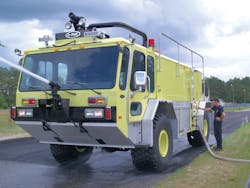
With the economy struggling, what do you do when you need new equipment? Some manufacturers are offering lease-purchase or special financing deals, or you can consider refurbishment.
When the fire chief of a American military airfield contacted Crash Truck Services at Company Two Fire Inc. about buying a mechanically new aircraft rescue and firefighting (ARFF) truck, he had one severely limiting specification: To meet the chief’s financial guidelines, the “like-new” truck had to cost less than half the price of a new ARFF with equal suppression capacity.
The rest of the specifications were pretty standard: The mechanically new ARFF had to have 1,500 gallons of water, 250 gallons of foam and meet OEM Part 139 requirements in force at the time of the truck’s original manufacture.
To make the deal work, Crash Truck Services agreed to remanufacture one of the many used ARFFs in its inventory: a used E-One Titan with a 1,500-gallon poly tank. Then the fun began.
The Titan was stripped to its frame rails and the engine, transmission and power divider were completely rebuilt.
Frame and drivetrain
All body panels were inspected for damage, corrosion or worn areas, and repaired to OEM standards or replaced. The existing doors and hardware were repaired as needed. Existing interior compartment features were repaired to meet the OEM standard.
All chassis springs were inspected and replaced if they did not conform to OEM specifications. Spring clips, bushings, leaves, coils and associated bolts and pins were replaced as needed. Spring hangar attachments to frame were checked for signs of metal fatigue and defective components were replaced as needed. Shock absorbers were replaced. The specs called for the unit to sit level with load.
The entire air brake system was remanufactured to original OEM standards. The brake shoes/disc pads were inspected and would have been replaced with new units if needed, but that is rarely required. Brake drums/rotors were inspected and machined to meet OEM tolerances and/or replaced as necessary. All brake lines were inspected and replaced as needed. The brake system on the refurbished Titan remained the OEM all-wheel type with split circuits so that failure of one circuit does not cause total brake failure.
New tires were installed. All O-rings and associated hardware were replaced.
The air system was examined and tested. Deficiencies or leaks were repaired. Areas that are affected by extreme heat were protected or replaced with heatproof materials. The existing air system reservoir was removed and cleaned. All new air lines, valves and solenoids were installed as needed. An air lockout system was installed using electric solenoid valves. In conjunction with the air lockout system, an appropriate size/type new air dryer was installed.
The front and rear differentials, as well as the front and rear axles, were inspected for oil leaks. Gear oil was analyzed for metal contaminates. Wheel spindles were checked for wear and metal fatigue. Bushings, bearings and seals were replaced as needed with new ones that meet or exceed OEM specifications. All drive lines were inspected and reinstalled with new U-joints.
A new radiator core was installed. All radiator and heater hoses were replaced. The entire cooling system was then pressure tested for leaks and repaired as necessary. All new hose clamps were installed.
All existing exhaust components that failed to meet OEM specifications were replaced. The exhaust system was cleaned and inspected.
Wiring and electrical systems
The wiring harness from engine to cab dash area was inspected and repaired as needed. All replaced wiring was standard copper of aircraft industry quality, and numbered to a wiring diagram furnished with the completed Titan. Battery trays, hold-down clamps, terminal connectors and battery cables were inspected and replaced as needed. A 165 amp remanufactured alternator with built-in regulator was installed.
The turn signal system was inspected and deficient components were replaced with approved devices, lights and wiring. All warning lights, fuel gauges, sending units, indicating lights, toggle switches, push buttons and relays were inspected and replaced or repaired as needed.
Fire fighting systems
The fire pump was disassembled, inspected and rebuilt. All bearings, seals and bushings were replaced. The impeller was inspected and replaced if it failed to meet OEM specifications. The wear rings were replaced. The pump shaft was inspected for grooves and replaced if it failed to meet OEM specifications. The pump was reassembled with new packing, packing gland assembly and new gaskets. Any broken bolts were replaced. Threaded studs which were broken or bent were drilled out and replaced.
All discharge piping was checked for leaks and excessive corrosion. Any pipe section or fitting which had 10 percent thickness affected by corrosion was replaced. All valves were rebuilt and discharge valves were converted to stainless ball-type. All parts were cleaned and restored to original condition.
All bolted flanges were disassembled; all gaskets and any defective bolts were replaced. All existing pump pressure gauges were replaced with liquid filled gauges of corresponding size and pressure ratings.
The old gasoline powered generator was replaced with a hydraulically powered unit and the scene lights were replaced.
The existing poly water and foam tanks were inspected and no damage or weakness was found. The inside of the tanks were thoroughly cleaned. All gaskets were replaced with non-hardening type gaskets and sealing compounds. Any damaged baffles were repaired or replaced as needed. New electric water and foam level gauges were installed in the cab and on the exterior pump panel.
The foam proportioning system was repaired to OEM condition to serve all discharge points. All materials utilized in the foam system were brass or stainless steel.
The roof and bumper turrets were repaired to OEM standards, including any accessories currently in place. Replacement roof and bumper turrets, selected by the customer, can be installed if requested.
The structural pump panel was reconditioned. The air throttle control on the structural panel was repaired or replaced as needed. The pressure relief system was inspected and repaired as needed.
The hand line reel was inspected and repaired as needed, in its original position.
The existing dry chemical system was inspected, repaired and returned to OEM standards.
Cab and interior
The cab interior was thoroughly cleaned and all damaged panels repaired or replaced. Cab heating and defrosting systems were remanufactured to OEM specifications. All cab windows, excluding the windshield, were inspected and replaced as necessary. The cab windshield was cleaned and buffed, and could have been replaced if requested.
The cab roof was resealed to prevent moisture from entering the cab interior. The flooring of the cab was inspected and repaired or replaced, as needed. Loose or deficient structural framing was repaired. The existing air conditioning unit was repaired and upgraded to the current 134A automotive Freon standard. A new 45,000 Btu air conditioning unit could have been installed in the cab if requested.
As each piece of the unit was reassembled, it was cleaned and repainted according to customer specification. All parts were coated with an anti-corrosive sealant. Two coats of automotive epoxy primer/sealer were applied prior to final paint finish lime yellow.
The existing DOT lighting was replaced with equivalent LED lighting that meets current DOT standards.
A new electronic siren was installed, with the speakers mounted low and forward of the cab. The siren was protected from foam dripping from the turret or water splashing up by tires. A control unit was installed in the cab.
The existing warning lights were repaired to meet current FAA and NFPA standards. Note: Warning lights could have been upgraded to LED at additional cost.
Delivery
In less than 120 days from the start of work on the chassis, Crash Truck Services delivered the rebuilt ARFF to the airfield and conducted training. A pre-acceptance test also was provided upon delivery by an experienced Crash Truck Services technician. The truck’s performance met or exceeded OEM performance specifications for acceleration, maximum speed, braking and pump performance. The foam system calibration was checked and adjusted to the total discharge capacity standards as well as foam quality and concentration. The warranty was one year from the written acceptance of the completed unit for all unit components repaired or replaced in the refurbishment process, excluding wheels and tires, batteries and light bulbs. The warranty covered all parts, labor and any other related costs. Two weeks later, the chief called to say he was so pleased with the first truck, please do it all over again with a second rig.
New airfield equipment including ARFF can be expensive, but there are alternatives as described in this example. Remanufactured airfield equipment offers many benefits, including extending the life of the equipment, and in some cases actually improving power and durability; backed by manufacturer warranties, parts availability and service; and uses about 85 percent less energy than mining, refining, melting and machining of new material offering a green solution.
So next time your airfield is in need of additional equipment, consider the many options, including the remanufacture of used ARFF.
For more information about the process, contact Bob Frenier at (800) 246-3511 or [email protected].