Robinson R-22: A look at this helicopter's powerplant
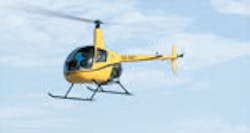
When it comes to rotary wing aircraft, there are a wide variety of helicopters to choose from. One helicopter company that has found a niche in the market is Robinson Helicopter. The company's piston engine aircraft are being used for a variety of applications throughout the world. We are going to take a look at one of its helicopters, the R-22, and discuss some basic topics concerning its powerplant -- the Lycoming O-360 series engine.
The powerplant
One of the things that a technician notices when first exposed to R-22s is the fact that they do not have helicopter H-rated engines installed in them such as the Lycoming HIO- or HO-360 series. Instead, they have O-360 series engines installed. These are basically the same engines certificated for fixed wing applications. The differences come with the accessories. That is what sets up the last letters of the designation. The carburetor location, the type of oil sump on the engine, and the accessory pads are accessories that change the designation.
When looking at the engine installed on the R-22, it helps to know a little history on why H-rated engines were developed in the first place. Well, when manufacturers in the 1940s and 1950s began putting piston engines in helicopters, they were no longer limited by the tip speed of a propeller. They could therefore turn the engines at a higher rpm to get more power. H-rated engines were thereby developed by the engine manufacturer in order to handle those increased rpm requirements. With these models, airplane engines that were originally designed to run at from 2,400 to 2,700 rpm were now able to operate at that of a helicopter -- approximately 3,000 to 3,400 rpm. They were also putting out the maximum amount of power possible.
Over time, with the introduction of turbine engines, the popularity of piston powered helicopters began to slide. The turbine engine became the engine of choice. It offered better governing and more power capabilities than its piston counterparts. There was also the perception that turbine engines were more reliable than pistons.
So, how did Robinson end up using O-series engines in its helicopters? When Frank Robinson began designing the R-22, he went back to the drawing board. He wanted to use a piston engine in the helicopter due to the decreased cost of production and lower operating expenses. However, he chose not to go with an H-rated engine. Instead, he decided to design a helicopter that would operate at the lower rpm that the fixed-wing certificated engines were designed for. He felt that the lower operating speeds would lead to increased TBO times and reliability. The original R-22s used Lycoming O-320 engines. The first production R-22s actually operated at 2,650 rpm instead of the 2,700 rpm rating of the engine. The manifold pressure was also flat rated.
When the Beta II versions of the R-22 came out in 1995, they had O-360 engines installed in them. Again, Robinson stuck with the philosophy of de-rating the engine and maintaining lower rpm. One factor in the O-360 engine that caused a slight concern to Mr. Robinson was that it had a slightly faster piston speed than the O-320 engine. This was due to the longer stroke. This factor has turned out to be a non-issue, and the O-360 has turned out to be a very reliable engine.
One thing that has to be remembered is that just because the engine installed on the R-22 is an O-360 series engine, one cannot treat it exactly the same as similar engines installed on fixed-wing aircraft such as the Piper PA-28-181. Manufacturers have slightly different maintenance requirements, and they vary from aircraft to aircraft. Always refer to the appropriate maintenance manual when working on any system.
Governing a piston engine
One issue that had always plagued the piston engine was how to effectively govern it. Some of the original governors were slightly more than crutches that barely kept the rpm at a steady rate. Robinson set out to develop a governing system to install on its helicopters that would be able to govern as good as the turbine ones were able to.
Initial R-22s used a
correlator to govern the engine. It consisted of a mechanical linkage
in the throttle system that tied it to the collective input. It was
a good system, and worked better than other correlators on piston helicopters,
but it only performed a rough governing job. It was not able to handle
fine adjustments in rpm. The turbine engine governors still reigned
supreme.
Robinson continued experimenting with governing systems in order to
obtain a more precise control of rpm. It ended up installing an electronic
system that governed the engine directly. This system applies throttle
through a friction clutch -- increasing or decreasing the throttle. The
system works by first taking a signal from a set of points that are put
in the spark system. An electronic circuit converts this signal into
a usable signal that controls permanent magnet DC motors. These motors
control the throttle by having a direct input into the throttle linkage,
using a friction clutch. After numerous flight tests and tweaking, Robinson
was finally able to get the combination of both damping and static stability
that worked the best.
When it comes to the actual governing duties, the correlator and electronic governor each provide different input into the process. The fine rpm adjustments are taken care of by the electronic governor while the large changes, such as during take off or going into a descent, are still controlled by the mechanical correlator. The new electronic governor added the fine tuning that Robinson had been striving to achieve. The governing system actually holds the rpm as close as the turbine engine governors do.
There are two safeguards to the governing system that provide protection in the event of governor malfunction. One is the way the throttle is set up. It is designed so that the governor can be overriden by applying firm input into the throttle. The other is a switch on the end of the collective that can directly switch the governor off.
This new governing system was incorporated in the mid 1990s. It has since been retrofitted on all R-22s.
Carburetor heat
A problem inherent to carburetors is that of icing. In the R-22, this problem is solved through carburetor heating assist. The heating assist is a linkage utilizing a friction clutch arrangement so that carburetor heat can be added or subtracted manually just like in other systems. But with the automatic carburetor heat assist, as long as the carburetor heat is left on "locked," then when the collective is raised, the carburetor heat is reduced. Likewise, when the collective is lowered, carburetor heat is added. So when the aircraft enters a descent (where carburetor icing is most likely to occur), the system will automatically increase carburetor heat. Additonally, at the bottom of a descent, when the aircraft is going into a hover, the carburetor heat assist is automatically turned off. This allows for an additional inch and a half of manifold pressure, allowing for maximum power at this important stage.
This has been an introduction to the R-22 engine. For more information, be sure to visit the manufacturer's web sites below.
Additional ReSources
Robinson Helicopters
www.robinsonheli.com
Lycoming
www.lycoming.textron.com
Service Bulletin 388C
One issue inherent to helicopters is that of high engine operating temperatures. Helicopters that are hovering or not moving forward fast do not have a lot of cooling air available. The problem is increased when student training is involved due to the amount of hovering practice. It is also worse in hotter environments like Florida or Arizona. These higher operating temperatures could lead to coking formation in the valve guide area that might eventually stick a valve.
Lycoming's service bulletin 388C addresses the issue of valve guide clearance. This inspection helps prevent engine failure due to sticking valves which can be the result of excessive carbon buildup between the valve guide and valve stem. It also helps to detect excessive wear (bell-mouthing) of the exhaust valve guide that could lead to broken exhaust valves. Lycoming recommends that helicopter engines have this inspection performed every 300 hours or earlier if valve sticking is suspected. Revision "C" which was issued Nov. 22, 2004 combines Service Bulletin No. 388B and Supplement No. 1 to Service Bulletin No. 388B and adds dimensions for fabrication of a tool to measure wobble.