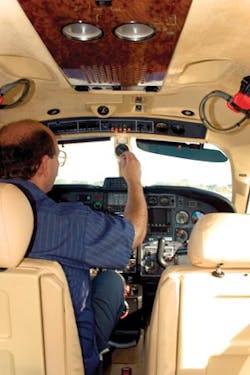
Compass swing — those two words bring images of a time-consuming task. Many of you are familiar with this task — sitting inside the aircraft, engines running, air conditioner off so it doesn’t disrupt the magnetic compass, as you taxi all around the compass rose, relying on your co-worker’s accuracy in lining the aircraft up with the line marked on the compass rose. In this article, we will discuss performing a compass swing as well as take a look at a new product designed to save time and headaches when performing this task.
When to Perform a Compass Swing
AC 43.13-1B lists several instances when a compass swing must be performed. These include:
Before You Begin
Before beginning a compass swing, there are a few tips to keep in mind. Ensure the area where the compass swing is performed is free of steel structures, underground pipes or cables, or equipment that produces magnetic fields. If the airport has a compass rose to perform compass swings, these areas are typically surveyed to assure it is free of interference.
Those performing the compass swing should remove any magnetic or ferrous items from their person. Use only non- magnetic tools when adjusting the compass. If there is any equipment aboard the aircraft that has any magnetic effect on the compass, ensure it is secured in the position it would be in during normal flight. Check the maintenance manual to ensure the aircraft is configured properly before beginning the compass swing.
Performing the Compass Swing
Mechanics typically use one of two methods to swing the compass on an aircraft. They either perform it on a compass rose at the airport, or use a calibrated master compass to align the aircraft during the swing. Always refer to the maintenance manual for manufacturer-specific swing procedures. Here are the steps involved in performing a compass swing.
1. With engines running and aircraft in
proper configuration, align the aircraft to the 0 degree (north) heading. If the aircraft compass is not in alignment with magnetic north, adjust the north-south compensator screw with a non-metallic screwdriver until the compass reads 0 degrees.
2. Align the aircraft to the 90-degree (east) heading. If the aircraft compass does not indicate 90 degrees, adjust the east-west compensator screw until it reads 90.
3. Align the aircraft to the 180-degree (south) heading. Note the indicated
heading on the aircraft compass. If it is not 180, adjust the north-south compensator screw to remove half the difference of the reading and actual heading. For example if the compass reads 184 while the aircraft is positioned at 180 degrees, adjust the north-south compensator until the compass indicates 182 degrees.
4. Align the aircraft to the 270-degree (west) heading. If the compass does not indicate 270, adjust the east-west compensator to split the difference as in the above step.
You are now ready to swing the aircraft around the headings. Starting with the current heading (270) mark down the actual reading on the compass. Turn the aircraft around the compass rose at each 30-degree heading and record the compass readings. Ensure there is not more than a 10-degree difference between any of the indicated headings on the compass and the actual heading. If the compass can’t be adjusted to meet the requirements, install another one.
Digital Compass Swing
There is now a unit that can make performing a compass swing somewhat easier. Manufactured by Capital Avionics and distributed by Avionics International, the CA-320 digital compass system can help take some of the headaches out of performing compass swings.
How it Works
The CA-320 consists of two components. The first component is the CA-320A transmitter. The unit is battery operated. It is a digital compass that is accurate to 0.5 degrees. It has a sight laser and a wireless transmitter. The unit mounts outside the aircraft and transmits headings to the second component, the receiver.
The receiver sits in the cockpit visible to the person performing the compass swing. It receives signals from the transmitter and displays the heading on a LCD screen. The transmitter and receiver are wireless, needing no power cords or data link cords for operation.
Find a Clear Area
The first step of using the digital compass system to perform a compass swing is to find a clear area to perform a swing. You want to make sure that the area is free of metal structure that would interfere with the magnetic compass. If there is a compass rose at your airport, that is a safe area to use. But remember, with this digital compass system, you do not need to be on the compass rose to perform the swing, just a clear area that will not interfere with the compass.
Set Up the Transmitter
The next step is to find a clear area on the wing where the transmitter will be mounted. This area should be free from excessive ferrous material. One way to find out if it is a good point is to place the transmitter on the ramp in front of the area on the wing where you are considering installation. Then, tow the aircraft forward. As the wing passes over the transmitter, look for any change in readings on the receiver. If there are no changes, this is a good place to mount the transmitter. Install the transmitter mounting bracket at this location.
Now you must align the transmitter to the aircraft. The easiest procedure the manufacturer recommends is to use a reciprocal alignment. You first start off by mounting the transmitter on the tripod in front of the aircraft. Then turn on the laser on the transmitter and use it to line up the transmitter to the center line of the aircraft. Once it is aligned properly, look at the reading on the receiver. Whatever that reading is, take the reciprocal reading (180 degrees out) and mount the transmitter on the mounting bracket at that reading. Just place the transmitter in its mounting bracket and rotate it until the desired reading is obtained on the receiver. Once the desired reading is obtained, tighten down the mounting hardware for the transmitter. Verify after tightening the hardware that the reading hasn’t changed. Now you are ready to perform your compass swing. The actual procedure for performing a compass swing remains the same except that you will be referencing the readings on the receiver instead of having to line up with the lines on the compass rose.
This has been a brief primer on compass swings. Be sure to refer to the manufacturers instructions for your aircraft when getting ready to perform your compass swing.
Compass Error
If you are in a clear area and are still encountering compass accuracy problems, check the mounting hardware for the compass and hardware in the vicinity of the wet compass and ensure it is brass and not ferrous. Other things to be aware of are magnetized control yokes, structural tubing, and improperly routed electrical wiring, all of which can cause unreasonable compass error.
Another area to check for is the area around the flux valves. Ensure that mounting hardware for the flux valves are non-magnetic. Also inspect the immediate area around the flux valves to ensure no ferrous hardware is present.
When working around a wet compass or flux valve, use only non-magnetic tools. Brass screwdrivers are preferable, especially when making admustments. Never use any magnetic tipped tools when working in the vicinity of wet compasses or flux valves as this can have an adverse effect on the compass system.
Additional Resources
Advisory Circular 43.13-1B
- Avionics International (800) 553-2233
- Capital Avionics (850) 575-4028