J. Irwin Miller: Business Leader, Social Reformer, Visionary
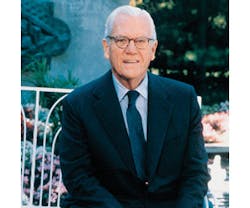
Joseph Irwin Miller, 95, will be eulogized as a great business leader, social activist and philanthropist whose influence will continue well into the 21st century.
He built Cummins from a family business into a Fortune 500 company with more than 25,000 employees in 131 countries and more than $6 billion in annual sales. He transformed his hometown of Columbus, Indiana, into a city of architectural wonders, earning it the nickname the Athens of the Prairie.
He embraced social reform. As president of the National Council of Churches from 1960 to 1963, he shaped the council into one of the strongest supporters of the civil rights movement. He helped organize the 1963 civil rights march on Washington and was one of three church leaders to organize the National Conference on Race and Religion that same year.
He advised Presidents both in the United States and abroad, from John F. Kennedy to Nelson Mandela. He received more than 20 honorary degrees from some of the most prestigious universities in the country and numerous awards, including membership in Phi Beta Kappa and the American Academy of Arts and Sciences. In 1967, Esquire ran his profile on the magazine's cover with the headline:
"This man ought to be the next President of the United States."
The Irwin Miller Transparency Test
For tens of thousands of Cummins employees, Miller's championing of fairness and equal opportunity and his unswerving commitment to integrity may be his greatest legacy. Long-time employees like to talk about a corporate measure used during the late 1970s. It was described as the Irwin Miller Transparency Test. Miller's theory was that if an individual was willing to explain to the local minister what he or she was doing, then it passed the transparency test and could "stand the light of day." It was a good guide for getting through tough times.
His desire to practice what he preached can be found in an excerpt from a 1945 memo to the company's executive committee when he wrote the following:
"We understand the fact that we must give a machine the best care and the best treatment if we are to receive from it the best work. We have sometimes shied away from the similar fact that we must give a person the best care and the best treatment if we are to receive from him the best work."
The employees' appreciation of Miller was reaffirmed at the April 1997 Cummins shareholders' meeting when an emotional Conrad Bowling, the then president of the Diesel Workers Union, paid tribute to the retiring executive. He said:
"You were at the top of the company with lots of important strategic world issues vying for your attention, yet you always had time for those of us on the shop floor dealing with the issues of today's production. We could talk to you, and we knew you would listen. You came to our gatherings, and we knew that you cared."
Miller's personal philosophy about the equality of all individuals is best characterized in this oft-quoted remark he made in 1983. "In the search for character and commitment, we must rid ourselves of our inherited, even cherished biases and prejudices. Character, ability and intelligence are not concentrated in one sex over the other, nor in persons with certain accents or in certain races or in persons holding degrees from some universities over others. When we indulge ourselves in such irrational prejudices, we damage ourselves most of all and ultimately assure ourselves of failure in competition with those more open and less biased."
A Man of Legacy
Miller was born in Columbus, Indiana, on May 26, 1909, to Hugh Thomas Miller, a college professor and politician, and Nettie Irwin Sweeney. His sister, Elizabeth Clementine Miller, was born in 1905. She died in 1998. The two grew up in the family home on Fifth Street and enjoyed lively dinner conversations, which frequently turned to politics. The young Miller also spent many hours in the workshop of Clessie Cummins, the diesel engine promoter who founded Cummins Engine Company in 1919 and who had been the family chauffeur. The family invested heavily in the Cummins engine, with W. G. Miller, the uncle of Miller, serving as one of the principles and a member of the Board of the newly created manufacturing entity.
With degrees from Yale (1931) and Oxford (1933) universities and following a brief apprenticeship with a family-owned grocery chain in San Francisco, Miller went to work for Cummins in 1934 as the company's second general manager.
In 1942 Miller was commissioned as a lieutenant in the Navy Air Corps, where he served aboard the carrier Langley. He saw action in the Marshall Islands, Truk and New Guinea, but was called home to assume the role of executive vice president of Cummins Engine. At the time, the company was engaged in important wartime production building engines for cargo trucks.
In the spring of 1943, Miller married Xenia R. Simons, a Columbus resident and Cummins employee. The two became parents of five children: Margaret, Catherine, Elizabeth, Hugh Thomas II and William Irwin.
A Strategy That Worked
During the 1940s and 1950s, the company's primary strategy was set forth by Miller. He was named president in 1945 and chairman of the board in 1951. Under his direction, the company set a high priority on research that would come up with new diesel technology, even if it meant obsolescing the company's own products. Second, Cummins worked to reduce costs, while maintaining high product standards. Third, the company created a national network of independent distributors through which it could develop and maintain a close relationship with customers.
Using this blueprint, Cummins sales increased from $20 million in 1946 to more than $100 million in just a decade. In 1956 the company launched its first overseas plant in Scotland. In the 1950s and 1960s, two presidents ran the company within the broad guidelines established by Miller, and by 1967 Cummins had cornered 50 percent of the diesel engine market.
In addition to helping direct the business of the diesel engine company, Miller realized that for Columbus to prosper it needed to offer an enhanced quality of life and cultural advantages. To that end, he directed the Cummins Engine Foundation, in the 1950s and again in the 1960s, to start paying the fees of promising young architects who were commissioned by Columbus to design public buildings, including schools. Six of the buildings that resulted from this effort are National Historic Landmarks. Sixty other buildings help sustain the Bartholomew County capital seat's reputation as a showcase of modern architecture.
Miller served as honorary chairman of Cummins Engine Company, director of Irwin Financial Corporation and Irwin Management Company Inc. In addition, he served as an emeritus trustee of the Museum of Modern Art; chairman of the Special Committee on U.S. Trade with Easter European Countries and the Soviet Union; chairman of the United Nations Commission on Multinational Corporations; trustee, National Humanities Center; trustee, Carnegie Institution of Washington.
Cummins Inc., a global power leader, is a corporation of complementary business units that design, manufacture, distribute and service engines and related technologies, including fuel systems, controls, air handling, filtration, emission solutions and electrical power generation systems. Cummins began delivering high-performance diesel engines for the military during World War II. Cummins continues to lead the way in military applications of diesel power. Headquartered in Columbus, Indiana, Cummins serves its customers through more than 680 company-owned and independent distributor locations in 137 countries and territories. Cummins also provides service through a vast dealer network of more than 5,000 facilities in 197 countries.