Anymore, it seems like everything in life revolves around staying in touch. The newspapers are full of advertisements listing the various rate plans and incentives while television commercials broadcast today’s hottest stars giving testimony as to why their service provider gives the most bang for the buck.
The equipment being sold goes from the most basic to extravagant or even lavish. Many of the wireless phones in use today can take pictures or video, play music, and even enable the user to access email and tie into other computer files. It is no longer required to even hold the telephone to your ear while placing or receiving calls.
Like many in our business I too have succumbed to “being connected” and now carry two phones and yes, one will allow me to connect to my email. In a previous life I was a tech rep for an aircraft manufacturer, a job requiring frequent travel and often more than 3,000 minutes a month in cell phone calls. I used to relish the time spent on commercial airlines, as my phone had to be switched off prior to departure, plus I am one of the lucky ones in that turbine engines running tend to lull me to sleep (unless of course I am under one doing what I do). Of course with voice and text messages, once I arrived at my destination it would sometimes take more than an hour to get “caught up.”
Numerous studies have been conducted regarding the usage of personal cell phones on aircraft. The results are mixed. The ability to be connected is now paramount especially in business aviation, and similar to the selection of a personal cell phone, one product or service will not satisfy everyone.
When planning for an airborne telecommunication system several factors need to be considered. What are the expectations? Will voice calling be enough or is there a need for fax and data? The aircraft’s primary mission and destinations may have an impact. One question to ask is if global coverage is needed.
Ground-based or satellite?
There are two general types of communication systems. The first uses a network of ground-based stations that are strategically located throughout a certain geographical area. This will provide voice calling, fax, and even data transfer as long as the aircraft is operating within the confines of the ground- based network. A dominant service provider here is Magnastar. The second relies on communication satellites orbiting the earth. These devices are generically referred to as satellite phone systems. Three of the leading service suppliers include Inmarsat, Iridium, and Globalstar.
Inmarsat is an international telecommunications company founded in 1979, originally as an intergovernmental organization. It operates a fleet of 11 (as of 2005) geosynchronous telecommunications satellites.
Inmarsat provides telephone and data services to users worldwide, using aircraft on-board receiver transmitters called “terminals.” An Inmarsat terminal contacts the satellite and communicates to a ground station through the satellite. It provides reliable communications services to a range of governments, aid agencies, media outlets, and businesses needing to communicate in remote regions or where there is no reliable terrestrial network.
Services include traditional voice calls, low-level data tracking systems, and high-speed data services as well as distress and safety services. The most recent of these provides general packet radio service (GPRS) type data at up to 144 k bit/s via the Broadband Global Area Network (BGAN) Internet Protocol (IP) satellite modem which is about the size of a notebook computer. Other services provide mobile Integrated Services Digital Network (ISDN) services used by the media for live reporting on world events via videophone. This is currently the only airborne telecommunication system recognized by the International Civil Aviation Organization (ICAO) for communication with Air Traffic Control (ATC).
Historically expensive, calls via Inmarsat have now dropped to a level where they are comparable, and in many cases favorable, to international roaming costs, or hotel phone calls.
Newer services using IP technology feature an always-on capability where the users are simply charged for the amount of data they send and receive rather than the length of time they are online. Voice call charges are the same wherever in the world the service is used.
The satellites use transponders that receive digital signals, reform the pulses, and then retransmit them to ground stations which perform billing and act as gateways to the public switched telephone network and Internet.
Inmarsat’s most recent series of satellites were launched in June and November 2005. These were the largest commercial tele-communication satellites ever put in orbit. Each is equipped with a global beam, 19 regional spot beams, and 228 narrow spot beams.
Globalstar is another group maintaining its own constellation of satellites and received its U.S. spectrum allocation from the Federal Communications Commission (FCC) in January 1995.
The first Globalstar satellites were launched in February 1998, but system deployment was delayed through a series of launch failures, notably the September 1998 loss of 12 satellites in a launch by the Russian Space Agency. In February 2000, it launched the last of 52 satellites: 48 primary use and four spares (reduced from the original plan of eight spares).
The first call on the Globalstar system was placed on Nov. 1, 1998, from Irwin Jacobs (chairman of Qualcomm) in San Diego to Bernard Schwartz (CEO and chairman of Loral Space and Communications) in New York.
In the fall of 1999, the system began limited commercial service with 36 of 48 planned satellites. In March 2000, it began full commercial service in North America, Europe, and Brazil.
Globalstar differs from Iridium in several important ways: Globalstar satellites are simple bent pipe repeaters; there is no inter-satellite linking. A network of ground gateway stations provides connectivity from the 48 satellites to the public switched telephone network; users are assigned telephone numbers on the North American numbering plan or the appropriate telephone numbering plan for the country that the overseas gateway is located in. Because there is no inter-satellite linking, each satellite must have a gateway station in view to provide service to any users it may see. Because there are no gateway stations to cover certain remote areas (such as oceans far from land), no service can be provided even though the satellites fly over them.
Globalstar orbits have an inclination of 52 degrees, compared to the near-polar 86.4-degree orbits used by Iridium. Globalstar also does not cover polar areas due to the lower orbital inclination. An inclination of 0 degrees means the orbiting body orbits the planet in its equatorial plane, in the same direction as the planet rotates. While an inclination of 90 degrees indicates a polar orbit, in which the spacecraft passes over the north and south poles of the planet; an inclination of 180 degrees indicates a retrograde equatorial orbit.
Iridium Satellite LLC is the only provider of truly global satellite voice and data solutions with complete coverage of the earth (including oceans, airways, and polar regions). Iridium delivers communications services to and from remote areas where no other form of communication is available. The Iridium constellation consists of 66 low earth orbiting (LEO), cross-linked satellites and has multiple in-orbit spares. It operates as a network and is the largest commercial satellite constellation in the world which makes it well-suited for industries such as maritime and aviation.
A select group of regional telecommunication providers has been recruited to be the link tying each individual user into this satellite network.
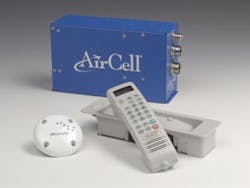
AirCell is one of the service providers with operations in the United States. The one key difference between AirCell and most of the other Iridium service providers is that they are one of the few that cater to aviation.
AirCell’s Axxess system was recently certified and is an all-new, multi-channel, wireless and broadband-ready satcom system designed for medium-to-large business aircraft. The standard Axxess system includes two Iridium satellite communications channels for quality voice and narrowband data services. Through its integrated expansion ports, up to two additional Iridium channels can be added to suit the operator’s needs. In addition, through the system’s Ethernet port, operators can add an Inmarsat broadband connection on a plug-and-play basis. The company has also recently won an FCC auction giving AirCell its own broadband network throughout the United States.
Plans are underway to implement the means of bringing high-speed data transfer capabilities to the service subscribers and current predictions will have this accomplished sometime in 2007. Another achievement of Axxess is the cabin WiFi capability. Although certification for this part of the system is expected around the third quarter of 2006, the hardware is currently being installed with new systems. The plan is that when certification is granted, several appropriate key strokes on a laptop plugged into the system’s maintenance ports will enable the wireless functions. Up to eight devices can be accommodated including WiFi compliant handsets, PDAs, and laptops.
As was mentioned earlier, data speeds with Iridium are at this time very low. This makes “surfing the net” a very trying event. Even sending an email can take considerably more time than most computer savvy executives are used to, so if data communication is a high priority, Iridium alone, at this time, is probably not the best solution.
It should also be noted that the Iridium satellite constellation has its own country code, which makes calls into this network subject to international long-distance charges. Some service providers will supply local access numbers so calls from the ground are significantly less costly.
The equipment installed in the aircraft will vary depending on which system is selected. As the Inmarsat system uses far fewer satellites than Iridium, the externally mounted antenna has to be steered toward the applicable satellite. This requires computations that are based on present aircraft position and attitude as well as a program that knows precise satellite positions. In addition a gimbaled and motor-driven antenna base is frequently used. As Iridium or Globalstar use a satellite blanket, antenna steering is not needed.
Equipment selection
Selection of an appropriate electrical power source is a decision that could have career altering implications. In the event an electrical distribution bus is selected that might be automatically terminated as a result of some standard operating procedure such as engine shutdown, it could leave the CEO, who at that moment was about to close a multimillion dollar deal, disconnected. In most cases, scheduled maintenance is all but non-existent. In the case of wireless devices that remain within the aircraft, it is important to verify the condition of internal batteries.
Some types of wireless phones are automatically switched on when aircraft power is applied but unfortunately need to be individually turned off. This can be a dilemma unless care is taken and phones are removed from the aircraft charging cradle during times when power may be required for maintenance or cleaning operations. One thing that can cause erratic or poor system operation irregardless of the type equipment is improper equipment bonding.
I guess the days of having some time to yourself when flying are about to come to an end and with newer technology the company aircraft will truly be an office in the sky.
Well, I think I am going to select the On Full Force (OFF) switch on both my phones for the rest of the day. How does the television commercial go? “Can you hear me now?”
About the Author

Jim Sparks
Jim Sparks has been maintaining aircraft for almost 40 years with the majority of the time involving Business Aviation activities. Jim’s endeavors have placed him on six of the seven continents contending with numerous situations from routine flight dispatch to critical AOGs. His career includes maintainer, avionics/electrician, educator, tech rep, and director of aircraft maintenance. In addition to other activities he is engaged with ASTM assisting in the global development of criteria defining the Next Tech for NEXTGEN. You can reach him at [email protected].