Falling into GSE
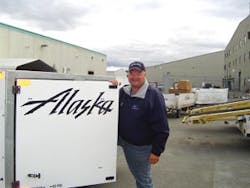
Q: How did you get into aviation?
A: I kind of 'fell' into it. As a young man I worked construction in Florida. I was injured on the job and as part of the available retraining programs, only one was offered that could lead to a college degree-Aviation Administration. So I found myself studying aviation and fell in love with it. The college supported a small airport training center and within 90 days of starting classes, I had my private pilot license. After graduating, I joined a commuter carrier-Mississippi Valley Airlines-first as a ramp agent, and then station manager at MSP.
Q: How did you get into GSE?
A: I had jumped from MVA to Air Wisconsin as their MSP station manager. At a manager's meeting, I was asked to help with deicing issues in their eastern system and the next thing I knew, I was their manager of GSE based in FWA. I started with myself and one mechanic buying used LA1000 deicers from Eastern & United, rebuilding them in the summer and supporting the system with traveling mechanics out of FWA. The best part of that was meeting and getting assistance from the GSE guys at both Eastern and US Airways on the deicers. Eastern was next to me in MSP and I asked them for help on learning GSE. They put me on a plane to MIA. At Eastern MIA, Jack Wyle and Bill Bierman took me under their wing and taught me about GSE maintenance and how to survive. At Allegany, Greg Nest and Jim Myroski were fast with advice and information on rebuilding deicers, finding parts and making things work. If anyone's to blame for me staying in GSE and learning the business, it's those four.
From there I went to SunAire Lines in Palm Springs as their GSE manager and as their manger of purchasing. Besides GSE maintenance, I purchased all station supplies for the system. I never did figure out how those fit together.
Q: How did you get into the majors?
A: Derek Jousten, manager of GSE for AirCal, talked me into joining AirCal as his northern supervisor, managing AirCal's GSE shops from the Bay to Alaska. I opened ANC for AirCal in 1986 and thought that was my Alaska experience. When American Airlines purchased AirCal, I was transferred to DFW into HDQ first as a GSE analyst, then as a senior engineer. I took the position of manager of GSE for American in about 1990. In 2000, I became manager of GSE technology development, working on electric equipment and fuel cells. 9-11 took care of that. I was one of the almost 20,000 that American laid off following 9-11.
I soon found myself at Elite Line Services, a contract maintenance company that specializes in conveyor, boarding bridge and GSE maintenance, first as their manager for the SEA STEP Project install and then as their Eastern Division Director.
Q: How did you end up in Alaska?
A: I knew the Alaska Airlines GSE manager, Larry Mathies from my American days. One of the cost studies that are always being done at headquarters was a cost comparison of internal vs. outsourcing GSE. They asked me for assistance on how outside pricing models would work. We (ELS) decided to be very open with them and show them exactly how we figure staffing, costs, margin, etc.
Basically, we opened our complete pricing model for GSE and taught them how it should be priced, what the margins are, what to watch out for and how to protect themselves. We never figured that we would really be a player if they ever did decide to outsource their complete GSE, but we wanted them to know us as a fair, open company, that always deals on top of the table.
Six months later, they called and asked us to do a timeline on the project if they decided they wanted us to do it. We delivered a four month buildup timeline to staff, train and assume responsibility for their complete GSE operation. They gave us three weeks. Tony Herrera and Damon Moore, also ex-American Airlines, joined me and on September 9th, 2004, ELS took over GSE and facility maintenance for Alaska Airlines. But that's another story. Today we manage all of their GSE & facility maintenance, equipment specifications, parts procurement and equipment sourcing with shops from Barrow down to the Bay supporting into Mexico. As part of the deal, somehow I found myself based in ANC as program director for Alaska Airlines and with my ANC staff providing technical support for all of ELS' GSE operations across the U.S. from HNL to DCA.
Q: What are some of the major trends you have seen developing over the past 20–30 years?
A: I can identify three major trends that had major impact. First, the environmental drive. I'm sure that every old-timer remembers the days of the first 707s leaving four black trails from their engines as they climbed out. GPUs slobbered diesel fuel all across the ramp, run-off from washing and steam cleaning GSE ran into the lawn or down the drain with batteries and tires thrown in the trash. Our entire industrial base, not just aviation, needed to clean up. The drive for electric equipment took a major hit with 9-11, but appears to be getting back on track now. I believe that almost all GSE will go electric in the next 10 years. We are converting to a full electric forklift fleet at SEA Cargo and have hybrid bobtails on order for ANC.
Second, the growing wave of a lack of responsibility. I watched it at American and everywhere else I've worked there's an ongoing lack of accountability. It was always the equipment's fault. It was always someone else's fault. You should have trained me better. You should have known I'd drive into that airplane. You should have known that I would disable the safety locks, pull off the protective cover and stick my hand in that belt.
Workers deserve to receive good training, but then as responsible adults, have the duty to themselves, their fellow workers and the company to act as responsible adults.
Third of course, is outsourcing. The economic conditions have made it not only a reality, but a necessity to survive. And you can't just blame the unions, it took management to give away the farm. I really believe it's a cycle. As the carriers regain their health and service companies lose focus, more carriers will bring pieces back in house with a much stronger management philosophy. Service companies that are sharp, totally customer focused, with trained and dedicated people will continue to be strong players.
Q: What was one of the biggest challenges you faced over the years?
A: I think the biggest challenge I ever faced was being forced into learning not to be a micro-manager. At American, I drove pretty hard. I had some great people and I drove them almost as crazy as I did myself. I used to think I was doing pretty well, but I remember one time when I was trying to quit smoking, one of my field techs stood on his desk and pleaded with me to PLEASE go buy a pack of cigarettes! It took a heart attack for me to learn to delegate. I quickly discovered that empowering people, giving them guidance and letting them do the job their way drove productivity sky-high. If you can get people excited, if you can show them that they make a difference and their contribution really matters, if you can learn to guide them, not tell them, you can build a staff that can move mountains. Here at Alaska, two of my top staff were the junior mechanics from Alaska Airlines. Mike Vesco was the outstation traveling mechanic. He is now hub manager, responsible for the complete state of Alaska including 21 stations and seven shops. Daniel Manary, also a junior mechanic, is now responsible for all training, safety and environmental in the Alaska Division and is supporting ELS' other GSE sites. They accepted the challenge and responded, not all do.
Q: Being a long-term vet, what advice would you give to our readers?
A: With American Airlines and now working with other carriers and service companies, I am amazed on how we lose site of who the customer really is. And I hate the line "treat the customer as you want to be treated." Treat the customer as a customer (who's paying the bill!) should be treated. Keep your people focused. At Alaska, our job is to give Alaska's people the best tools in the most effective, efficient and timely manner possible to do their job. They don't want to hear how I couldn't get going this morning, the people we replaced forgot that. It's my job to insure we never do. Oh, that does not mean the customer is always right, but it does mean that he/she always has our attention, our focus, our honesty and our very best.