Forced Air Technology
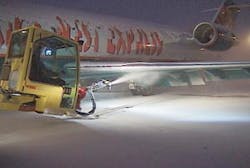
Over the last several years forced air deicing has proven to be a very effective method for safely removing frost and snow from aircraft thus saving money on deicing fluid and fluid recovery costs. At the same time, anti-icing fluid has continued to be applied using the conventional system without the assist of forced air.
For those of you not familiar with deicing operations, heated deicing fluid is applied to the aircraft (with and without the assist of forced air) to remove frost, snow and ice. After the entire aircraft surface is clean, cold anti-icing fluid is applied to the aircraft's wing and horizontal stabilizers to prevent them from refreezing prior to take-off. Once the anti-icing fluid is applied, holdover time (the maximum time the pilot has to get the aircraft airborne before the anti-ice fluid loses its effectiveness) begins. During the aircraft's rotation, the anti-fluid shears off of the wing and the aircraft's lift surface is free of anti-icing fluid.
In order for the anti-icing fluid to be effective it must maintain as high as viscosity level as possible during handling and application. Anti-ice fluid is applied "neat", as a concentrate, unlike deicing fluid which is mixed with water in varying degrees. It cannot be heated. The pumping system usually consists of a low pressure diaphragm pump dispersing 25 gallons or 95 liters per minute. Any degradation of the fluid reduces its holdover effectiveness.
Many operators over the years have discussed applying anti-icing fluid with forced air. And why not? Unlike deicing fluid, anti-icing fluid is thicker and requires less pressure due to its vulnerability to shear, thus lowering the viscosity rate. When applied to the aircraft, anti-icing fluid comes out in thick clumps and presents quite a challenge for the operator to apply a consistent coat on the wing surface in a timely manner.
Several years ago, a curious operator in Boston applied forced air over anti-icing fluid onto a hangar door and was pleasantly surprised to see how fast and evenly it applied the fluid in a wide pattern. They were anxious to start using the forced air with anti-icing fluid but found out that they needed the okay from the FAA and fluid manufacturers because the fluid was not designed to be applied in such a manner.
One operator who had been advocating using anti-ice fluid with forced air is FedEx GSE Engineer Ron Thompson, who for the past couple of years has been conducting unofficial tests, along with deicing equipment manufacturer FMC Technologies.
The tests revealed the following benefits of using anti-ice fluid with forced air over the conventional, non-forced air method:
- It provides an even, consistent coating.
- The application is easier, likened to spraying paint with spray gun.
- Less fluid is used because is lays down evenly and not in clumps.
- Application time is faster due to higher velocity and a wider spray pattern.
- Less application time results in less exposure to the environment.
- Using less fluid in a faster application time means reduced costs.
In November 2004, the formal process to approve the application using anti-ice fluid with forced air began when Thompson and representatives from the Federal Aviation Administration (FAA), APS Aviation (an independent, Canadian-based aviation testing laboratory) and FMC met at FAA offices in Atlantic City, New Jersey to establish the proper testing protocol. In addition, the test fluids and deicing trucks were selected and the initial fluid viscosity (mid-range) was established. The tests would begin at the FedEx facility in Pittsburgh, Pennsylvania, in January 2005.
For the tests in Pittsburgh, the group that met in Atlantic City was joined by representatives from the SAE G-12 Deicing Subcommittee and fluid company representatives from Octogon, Dow, Kilfrost and Clariant to evaluate the performance of Type IV anti-ice fluids applied with forced air using the predetermined equipment setup. The deicing trucks used were FMC models LMD-2000 and Tempest II from FedEx's deicer fleet. A Lockheed Jetstar wing, owned by Transport Canada, would represent an aircraft wing during the tests.
Added to the test was an air sleeve which was designed by FMC to give the forced air better direction when operating at lower speeds than those used with deicing fluid. The air sleeve consisted of "X" shaped aluminum, inserted into the forced air nozzle shaft.
The tests would validate whether the sleeve assists the air flow and more importantly, determine how much, if any, additional shearing it may cause to the fluid.
A temporary laboratory was set up on site and staffed by APS Aviation technicians. For testing the fluid samples, a Brookfield LV DV-1+ viscometer was used and all the fluids were stored in stainless steel totes in a controlled environment at 23-degrees Fahrenheit. In order to maintain testing consistency, all the fluid was sprayed at the same fixed angle and at a fixed distance between the nozzle and the wing. Viscosity of on-wing samples were measured by APS technicians immediately following the application.
After measuring the viscosity on the wing, APD technicians collected three samples from each fluid test. These included the fluid tote, on-wing with fluid applied without the air sleeve and on-wing with fluid applied with the air sleeve. The samples were taken to the APS onsite laboratory and analyzed by the Brookfield viscometer.
Test results concluded that the anti-ice fluid can be applied with forced air and is within the acceptable fluid degradation limits with or without the air sleeve.
In fact, the air sleeve equaled and even had less degradation in some cases when compared to tests without the air sleeve. Based on the results of the tests, the FAA issued bulletin number FSAT 05-02, which became effective on October 20, 2005, that addresses the use of forced air and forced air assistance with anti-ice fluid. The bulletin references the deicing equipment used in the test, the specific fluids used by brand name and charts which show the performance of these fluids (Clarient Safewing MP IV 2001, Kilfrost ABC-S, Octogon Max Flight 04) using FMC LMD-2000 and Tempest II deicing equipment.
The following statement was issued by the FAA. "Based on this information, operators using these two equipment models modified in the same manner as the test vehicles would be able to apply the listed Type IV anti-ice fluids using the forced air if they meet the lowest acceptable delivered viscosity values listed in the chart."
Through the determination of FedEx's Ron Thompson, along with the assistance of Clarient, Kilfrost, Octogon, Dow and FMC Technologies a new method to apply anti-icing fluid with existing technology that will save the airlines ground time and anti-icing fluid costs, was approved by the FAA. Though this procedure is currently limited to certain fluid types and deicing vehicles, it has laid the ground work for other manufacturers of deicing fluids and deicing vehicles who want to offer their customers forced air with anti-icing fluid in the future.