Past Contact: Mechanics in Aviation History
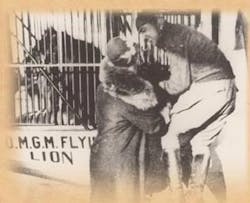
Imagine the Spirit of St. Louis with a cage for a fuelage and a full grown African lion as the passenger. If that conjures up a scenario from a black and white silent film, you would not be far off.
Fade in to black and white — 1927
Directly following Lindbergh’s cross-Atlantic flight in 1927, the Lone Eagle received a Spirit look-alike with which to scout potential airport terminal sites for Transcontinental Air Transport (TAT.) Developed by Ryan Airlines but later built by B.F. Mahoney Aircraft Corp., the B-1 Brougham had pilot-friendly modifications including a sweeping cockpit window. Lindbergh’s Brougham (NX4215) was apparently not his favorite, as he gracefully returned it.
While America lionized Lindbergh as a genuine hero, Metro Goldwyn Mayer studios in California saw the opportunity to promote its films through aviation. Already using a live male African lion named “Leo” seen (but not yet heard) roaring with its logo at the beginning of each MGM film, it launched a stunt to fly the big cat across the United States. Pilot Martin “Marty” Jensen was hired to ferry Leo nonstop between San Diego and New York in a specially modified Ryan Brougham with a glass-enclosed, iron-barred cage directly behind the cockpit.
With much fanfare, Jensen took off on Sept. 16, 1927 from Camp Kearny airfield, near San Diego, CA. Leo’s flying career and the MGM cross-country promotional flight were short lived however when Jensen’s heavy plane met thin air over the mountain forest called “Hell’s Gate Wilderness” near Payson, in northern Arizona. The Brougham, now called the MGM Special, crashed and luckily neither pilot nor lion were badly hurt. Leaving Leo with sandwiches, milk, and water, Jensen walked for days until he found help to transport the big cat back to Hollywood. MGM generated tremendous publicity over the mishap, but abandoned most of the wrecked plane.
This cliff-hanger feature would have gone “straight to video” remaining obscure folklore, were it not for our protagonist — Scott Gifford, A&P and vintage aircraft specialist.
Dissolve to Technicolor — 2006
Gifford owns and operates NostalgAire in Prescott, AZ. NostalgAire offers modern aircraft owners everything from minor repairs and servicing to complete restoration. Clients with vintage aircraft may not require the results for public display or air shows but Gifford’s MGM Special is intended for both.
Gifford hiked through Arizona’s rugged terrain in 1991, and identified what was left of the Brougham. He legally acquired the remains, transported the wreck to his hangar, and began the long-term project of rebuilding the aircraft, cage and all. His goal is to fly the air show circuit for one year then retire the plane to static display. So far, Gifford has financed the project alone, although he has sporadically considered corporate sponsorship. Oddly enough, none has come forth from MGM, although he has contacted the company.
Aviation museum curators adhere to professional standards by which aircraft are displayed with the proper designation of restored, rebuilt, and/or replica. Each classification depends upon many factors, which Gifford carefully considered before one twist of his wrench on the Ryan. “Restoration depends upon the final destination of the aircraft,” says Gifford. “The Smithsonian or Wright-Patterson AFB try to preserve everything possible and keep replacement and repair to a minimum. Every change must be thoroughly documented. An airworthy restoration [actually flown] requiring durability, ease of repair, and maintenance, has a different set of requirements, including strict regulations by the FAA. Flying museum aircraft [like the P38 Glacier Girl] adhere to a different standard, somewhere in between these examples. The MGM Special would probably be considered by museums to be a replica, since there will be a very small percentage of original structure and components.
“Restoring aircraft can be quite challenging,” Gifford explains. “A lot depends upon the desired degree of restoration. For example, when an old airplane is “restored” we consider using the original cotton or linen fabric or modern polyester fabric.”
Some vintage aircraft owners provide a restoration budget to finance the most accurate details like specially produced (correct) outer fabric sheathing to replace wiring; and wire bundles wrapped and tied with waxed chord instead of using modern nylon tie wraps.
Other options include repairing the original instruments or replacing them with modern instruments. For Gifford’s Ryan his current wish list includes components for a Pioneer Earth Inductor Compass; engine gauges (1920s vintage): oil pressure, oil temperature, and fuel pressure; and a throttle quadrant.
Gifford’s completed MGM Special will have five fuel tanks and a lion cage, and will not meet the Ryan B-1 Approved Type Certificate #25. He intends to license the restored aircraft under the Experimental, Exhibition category.
According to Gifford, the level of authenticity is literally in the eye of the beholder. “It’s more of having an eye for detail. Sometimes, however, it’s a case of cleaning and maintenance after the fact. Exterior glossy paint is easier to keep clean, whereas flat paint will stain and hold dirt and grime.”
Before the final installation of the Special’s cowling, the metal surface will be engine turned (or “swirled”) for aesthetic and practical reasons. This classic look is well-known among automobile restoration buffs as an art form requiring patience and skill. “I’ll do that myself,” Gifford says. “It was a trick they used since the cowling was hand formed out of soft aluminum. The swirls helped hide all of the dents and ripples.”
A licensed pilot since 1980, Gifford plans to fly the Special himself once it’s finished. “I’ll primarily be adding brakes and a tail wheel. In the 1920s the tail skid acted as the brake, digging into the sod,” Gifford wryly adds. “Tail skids don’t work well on concrete and asphalt and the aircraft becomes directionally unstable . . . not desirable for a pilot!” As far as communication, Gifford will need a chase plane to land at large airports where sophisticated avionics are required, but for landing alone elsewhere, he’ll install a hand-held radio with a hidden external antenna. There isn’t much instrument panel space on the Special and he doesn’t want to clutter it with new devices. Where he cannot use originals, Gifford intends to find modern instruments and place them inside vintage casings.
Safety trumps authentic replacement parts any day in the air. Leo’s cage was encased in 1/4-inch plate glass for windows. “Obviously this will not be a good idea for my plane,” says Gifford, “I’ll use Plexiglas instead.” Some of the original parts Gifford collected from the crash site include fittings, a main spar attach structure (repaired), landing gear shock struts (repaired), and the distinctive elevator trim control.
Gifford’s enthusiasm and dedication to this project is never more evident than when he proudly displays two key components: a Wright J-5 Whirlwind engine and a Standard propeller. Gifford’s wife Dawn scurried out with polish and made it shine, and they both examined every centimeter for pits or scrapes (none). “He married me for my free labor,” she jokes. Of particular pride is the reproduction vintage decal for the Standard Steel Propeller Company, which denotes that this prop was made prior to the merger of Hamilton-Standard in 1929.
The Wright J-5 Whirlwind engine Gifford will use on the Ryan has its own place of honor behind his desk at NostalgAire. Its special mounting/carrying rig just barely fits through the exterior office door so he can roll it out to be photographed. It is the same type as on the original aircraft, and he depends upon searching the Internet to find original parts, and new production runs of old assembly pieces like the exhaust valves, “which are impossible to find,” says Gifford. “I work with several shops which specialize in antique parts.”
In his spare time between overhauls and restoration work for paying customers, Gifford has formed a fuselage frame from original and custom-made replacement parts, with a tail assembly the shape of a giant guitar pick, which I recognized as a Ryan. Gifford’s passion may only be equaled by his patience. “Because of the expense and research involved,” says Gifford, “I expect to be at it many years.”
As I drove away from NostalgAire it occurred to me our A&P protagonist, Scott Gifford, is as unique as the airplane he is destined to build.
pplying his modern practical skills, Gifford is preserving the work done by the designers and mechanics before him.
I wrote screenplays for five years while living near “Hollywierd,” and could not resist interjecting script jargon. I have no doubt a producer will soon option this historical saga for a documentary or feature film.
Fade to credits.
Cast of characters
The Pilot
During the late 1920s Martin (“Marty”) Jensen was employed as a pilot by Lewis Air Tours, thrilling tourists with the first aerial views over Hawaii. In 1927 he entered his Breese 5 monoplane, Aloha, in the Dole Air Race between Oakland, CA, and Hawaii. He and his navigator (Capt. Paul Schluter) survived as one of the two aircraft to complete the trip. Seven of the 15 entrants perished making the attempt. By the time MGM’s executives hired Jensen (age 26) to fly Leo to New York, his wife, Marguerite, took his adventures in stride.
The briefest thumbnail profile of Jensen should include mention of “Jensen Field,” the WWII airfield which bore his name between 1940-1946 (alternately known as “Clark Field”) at Charleston, SC.
Aviation historian John Underwood knew Jensen during the 1950s-1960s while Jensen lived in Southern California. Underwood remembers Jensen at OX5 and Silver Wings meetings during the 1960s. Although he had retired from Douglas Aircraft Corp. by that time, “Marty always had something on the drawing board. He was an extraordinarily talented individual,” recalls Underwood, “but had little business sense, which is why there is no Jensen Aerospace Corp. today.”
Although I did not follow up on the details, Underwood flew the Langley, a “little twin” designed by Jensen. Bendix once hired Jensen to help develop a helicopter, but Underwood was particularly impressed with Jensen’s innovative designs which contributed to the Meyers OTW (“Out to Win”), a WWII trainer aircraft.
The Lion
At the center of this story is Leo, a male adult African lion whose regal parentage is not recorded. However, MGM acknowledged that he was not the same lion photographed for use in its famous roaring logo.
During the1920s small traveling circuses “wintered” in warm climes like Los Angeles, CA, and Sarasota, FL. The original “logo” lion used only as a photographic model, was purported to have been part of Gay’s Lion Farm of El Monte, CA. The King of Beasts roared aloud for the first time in 1928 at the advent of “talkies.” He was later advertised as the “MGM Lion.”
“Leo,” the 350-pound feline chosen to fly with Jensen, was borrowed from the Al G. Barnes Circus wintering in Culver City, very close to the back lot of MGM Studios.
MGM’s bizarre PR scheme to fly Leo across the United States was hyped a week in advance by exhibiting him on its lot. MGM employee, Pete Smith, recalled Leo in a “huge circular cage under the care of a trainer from the Barnes Circus.”
Following Leo’s rescue from the wrecked MGM Special he was returned to California, regained his health, and again traveled with Barnes’ Circus as “Leo, the MGM Flying Lion.” According to Dawn Gifford’s research, Leo was well-behaved before, during, and after his precarious adventure with Marty Jensen. Our best guess is that he was pampered and treated royally the rest of his natural life. In keeping with his noble and dignified career, he was apparently not stuffed for public display upon his demise.
The Studio Executive
Pete Smith was director of publicity for MGM Studios during 1927 when his boss, Louis B. Mayer asked him to create a stunt attracting “national attention to the MGM trademark,” (i.e., Leo the lion). Smith proposed that a live lion be flown from California to New York with newspaper and radio publicity en route. By the mid 1960s Smith was contemplating an autobiography and recalled the New York reception scheduled for the arrival of Leo and Jensen. “At Long Island airfield, Howard Dietz [the MGM representative] had arranged a big reception for Leo including brass band, search lights, etc. which waited all night long in vain. It was planned to exhibit the animal in the lobby of the Capitol Theatre on Broadway.”
Although Smith manipulated the press as part of his job for MGM, he failed to track down the studio’s press release pictures for his own book. “Don’t Ask for Photographs,” he advised a researcher, “there just aren’t any.” Forty years later the images have emerged and now reach millions via Internet archives.