In aviation as in fashion and the movies, good looks count. This is why aircraft paint jobs need to look as perfect as possible; be they adorning a Beechcraft Bonanza or an Airbus A380.
The actual task of painting aircraft is extremely time-consuming and complex. This is why "we request our customers give us 30 days to paint their aircraft," says Chuck Siehr. He is the regional group sales manager for the northern United States and Canada, at Landmark Aviation in Springfield, IL. "Painting an aircraft properly is both a science and an art form, requiring skilled and patient technicians."
So how do the pros do it, and what can you learn from them? Here's what AMT learned from talking to Siehr and Jim Burress, general manager of Dean Baldwin Painting in Roswell, NM.
Preparing the canvas
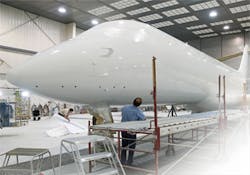
In aviation painting, the aircraft serves as the canvas, and what a canvas it can be! Even the smallest aircraft has hard-to-reach places to spray-paint; requiring the use of special platforms. In the case of large aircraft like the B747, these platforms can be a few stories in height.
But size is just the beginning. Whatever their size, aircraft all contain parts that aren't meant to be painted. This requires technicians to cover them using specialized barrier materials, including paper, mylars, and tapes. In the case of a Boeing 777-200LR, for instance, the nacelles on each of its two GE90-110B1 turbofans have diameters measuring 11.25 feet across. That's a lot of paper and tape!
The masking process becomes doubly important when an aircraft is being repainted. This is because the aircraft is stripped of its existing paint job before the new livery is applied. Not only does this ensure better adhesion to the airframe, and a chance to look for telltale signs of corrosion on the aircraft's stripped skin, but it also helps keep weight down, thus fuel costs down. According to Boeing, a complete fuselage and tail paint job on a 747-400 weighs 555 pounds.
Meanwhile, even brand-new airframes require masking and surface preparation before paint is applied. Specifically, the skin is chemically etched using phosphoric acid, to "roughen up" the surface and give the paint something to stick to.
The paint
Acrylic urethane and polyester urethane paints are the options when it comes to painting aircraft. According to Chuck Siehr, it is "the polyurethanes" that are the most popular: "They come in two parts that are mixed just before application, which interact chemically with each other in a process called polymerization to provide a hard, durable finish."
Aviation paint providers include Pratt and Lambert, Sherwin-Williams, PRC Desoto (PPG), Akzo Nobel, and Axon. Jet Glo and Acry Glo by Sherwin-Williams are two popular brands. Typically, one coat of corrosion primer is laid down followed by two to three successive coats of paint; then any decorative striping and clear coat are applied. High-end business jet paint requirements go a step further, requiring a sanding surfacer to be applied after the corrosion primer.
Paint selection is where the most serious errors occur in aviation, says Jim Burress. "Manufacturers take the time to specify which brands and types of paints work best with their aircraft," he tells AMT. "Unfortunately, some paint shops have a 'What, Me Worry?' attitude that results in them not checking the aircraft's manual before spraying begins. Ideally, you should be trying to produce a paint job as good as or better than the factory's as possible, to give customers the best appearance and longest wear. That's why you should always go to the manual first and use the product specified or an equivalent product that meets the manufacturer's specifications."
"Dry film thicknesses of each paint layer as directed by the coatings manufacturer must be strictly adhered to by the aircraft refinisher for corrosion resistance, long-term durability, and gloss retention," says Richard Giles, technical services representative, Sherwin-Williams Aerospace. "Typical primer thickness is 1 mil and topcoat thickness is 3 mils and greater."
Adding to the complexity is the fact that "each paint uses resins with their own unique heat and humidity requirements for proper curing," Burress says. "This means that you need to create an environment in your hangar conducive to painting. This should include the use of heat, air movement, and in some cases humidity control, if possible."
The paint booth
Such spaces are commonly called paint booths; a name that understates their scope and their requirements. First and foremost, an aviation paint booth has to be large enough to hold whatever aircraft you are painting. Second, it must have space for platforms and access ways around the aircraft, to allow for complete prepping and coverage.
In a perfect world, an aviation paint booth not only needs heat and humidity control, but also ventilation to keep the air free of paint particles. Given that air-powered paint sprayers are used to coat airframes, these ventilators must be both powerful and efficient. "Whatever you do, you must be sure to draw overspray away from the aircraft," Burress says. "You also want to keep your technicians — who must be fully outfitted in protective breathing masks and full-body overalls — clean, so that they don't transfer anything to the aircraft skin."
Finally, aviation paint booths require excellent all-around lighting, and must be kept clean. "You don't want bugs getting in, because a single bug's tracks can really mess up a paint job; forcing you to redo that section," says Chuck Siehr. "You also want to ensure that your technicians' paint guns and other tools are maintained in top shape at all time, because you can't walk away from a drying paint job for anything more than minutes."
Surface preparation is key
When it comes to spray-painting aircraft, the goal is to make smooth, sweeping horizontal passes, with each one overlaying the edge of the last. A clean paint gun nozzle and contaminant-free air hose also matters: Never use air hoses that have been exposed to oil in any way (i.e. by being used with air tools), because the smallest trace of oil can ruin a paint job.
This said, "A successful aircraft paint job is 90 percent preparation and 10 percent spraying," says Chuck Siehr. This means more than just masking off nonpaint parts: Painting technicians must also work with chemical stripping compounds that penetrate the old paint and "bubble it off." "You can't allow this stripper to get onto rubber or composites," he tells AMT. "It must be used and removed with extreme care." For those areas where stripper can't be used, the surface is prepared to reveal its original exterior using specialized sanding equipment and sandpaper with a grit range from 150 to 300.
Once the skin is clean, it is inspected for damage and corrosion. Once any needed repairs are completed, the skin is etched using phosphoric acid to passivate the surface and promote paint adhesion. Then the primer and paint coats begin; each application being punctuated by a 12-hour baking process. "The first six hours run at 95 F, and the next at 110 F," says Siehr. "We time it so that the baking begins at the end of the day. To keep an eye on the process, our paint shop manager's home computer is linked directly to our paint shop sensors and controls. Should something not go to plan, he'll be alerted."
This is a bird's-eye view of the painting process. In reality, "there are 30 steps involved in taking an aircraft from start to finish, which is why we require 30 days per plane," Siehr says.
The most important tip
It is now clear just how demanding a task it is to paint an aircraft properly. However, the tips provided above are not the most important things to know about the process, says Jim Burress. Instead, what matters most is "communication."
"It is amazing how few people understand that, to serve your customer properly, you need to talk to him before, during, and after the job is done," Burress explains. "You need to understand what they want done and what their requirements are, which may include additional training and what specific materials should be used to do it. They need to know the stages of the process, and what your job entails. It's just not right to take custody of a multimillion dollar aircraft, paint it, and then expect them to pick it up and pay for it without more than a few words. [This is why] as part of our process to improve communication and customer satisfaction, we recently achieved ISO 9001:2000 certification."
The bottom line: Excellence in aircraft painting counts. That's why it is worth the time and the effort to offer top-rate services, should you choose to, in order to attract and keep clients.