Gemini 100
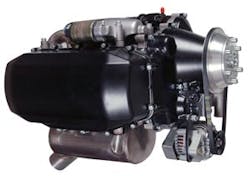
There is a new piston engine being developed for the Light Sport Aircraft (LSA) market. Powerplant Developments Limited announced the introduction of a new piston engine, the Gemini 100, at a press conference during EAA’s AirVenture in Oshkosh this past July. This new engine is a diesel-powered engine, but a design that aircraft maintenance professionals may see as radical. Although the engine may seem like a radical design, it is actually based on a proven engine design that had been around since the 1920s. We will take a look at this new diesel engine that just may be showing up in your maintenance shop in the near future.
The Gemini 100 engine is being brought to market by Powerplant Developments Limited. Located in West Sussex, England, Powerplant Developments Limited is a joint venture formed by the alliance of two experienced aircraft engine companies in the United Kingdom — Westlake Air Services which is known for advanced piston engine design and engineering, and Jade Air plc, an aviation engine repair and overhaul facility.
Engine basics
The Gemini 100 is a two-stroke, three-cylinder, six-piston 100 horsepower engine that has been designed to meet the needs of LSA designers, manufacturers, and owners. It was named the “Gemini” because of its twin-crankshaft, two-pistons per cylinder layout. Powerplant Developments says the Gemini will deliver a significant number of advantages over the Avgas- and diesel-powered engines currently available to LSAs. Some of these benefits include improved power-to-weight ratio, greater reliability, easier operation, flexibility to run on both Jet-A and diesel fuels, and lower engine/accessory installed weights. The first Gemini engine is in its final stages of development.
Back to the future
The new Gemini engine is a ‘next-step’ evolutionary design that is actually based on a long time, well-proven concept. In fact, the concept of an opposed-piston, two-stroke diesel engine has been around since the 1920s. It was originally introduced by Junkers when it developed its six-cylinder, 12-piston, “Jumo” engine. The Junkers Jumo 205 was the most famous of a series of successful engines that were the first and, for nearly half a century, the only, diesel engines for aircraft. The Jumo 205 powered various German airships, as well as the Junkers Ju 86 bomber and the Blohm & Voss Ha 139 airliners.
Powerplant Developments has taken the proven concept of an opposed-piston, two-stroke diesel engine and improved the design to create an engine specifically designed for the growing LSA market.
Engine design
The Gemini engine is an example of simplicity in design and operation. Unlike reciprocating engines we see in the aviation market today, The Gemini 100’s twin-cylinder, opposed piston engine has two pistons in each cylinder with the combustion chamber formed between the crowns of the pistons.
The cylinders are ported on each end with one ring of ports opened by the intake piston to supply the fresh air charge and the other ring opened by the exhaust piston to allow the spent charge to exit to the exhaust system. Gas flow through the cylinder is therefore in one direction (uniflow), which leads to more efficient scavenging than in a conventionally scavenged engine. In the Gemini engine a positive displacement compressor supplies the incoming air and also provides a degree of supercharging that improves engine power.
This design eliminates the need for cylinder heads, camshaft, and associated valve gear. It has two half-length crankshafts linked by a gear train driving a centrally mounted propeller. There is no long, centralized, crankshaft in the engine. Instead, the Gemini engine has two half-length crankshafts that are shorter than a conventional crankshaft; providing excellent torsional stiffness.
In addition, to ensure that crankshaft problems are eliminated in the Gemini 100 engine, the half-length crankshafts are manufactured with high-quality “EN40” steel — a material frequently used in Formula One racing engines routinely operating at up to 19,000 rpm.
The Gemini engine’s power can be increased by the installation of a conventional exhaust gas-driven turbocharger in series with the compressor.
Powerplant Development’s team currently has both a 125-horsepower and a 200-horsepower turbocharged version of Gemini engine in development.
Engine lubrication is through high-pressure oil with a dry sump. Fuel injection is provided by a mechanical pump that feeds injectors located in each cylinder.
Due to its simple design and fuel injection system, the Gemini 100 engine features “single-lever” operation without the need for a Full Authority Digital Engine Control (FADEC) system. However, Powerplant Developments says the anticipated expansion into higher horsepower engine models and into the certified aircraft OEM market will necessitate its development of a state-of-the-art FADEC system for future certified engine programs.
Engine weight
The 100-horsepower Gemini engine weighs only 155.43 pounds (70.5 kg), giving it a high power-to-weight ratio. The installed Gemini engine, including the heat exchanger, associated hoses, and fittings, is an amazing 166 pounds providing LSA designers with a significant weight advantage with the Gemini.
Fuel
Powerplant Developments states the Gemini 100 engine will provide operators with fuel efficiency and cost-savings. Its projections show that at cruise power settings, (75 percent power at 5,000 feet) the Gemini 100 will have an hourly fuel consumption of 4.75 gph of Jet-A compared to the 6.6 gph of Avgas required by a typical Rotax 912 engine.
The Gemini 100 engine not only burns less fuel, it uses less-costly Jet-A fuel.
The Gemini 100 engine is designed to provide a 2,000-hour TBO (compared to 1,200 hours for the Rotax 912).
Powerplant Developments is initially targeting Light Sport Aircraft (LSA) operators and original equipment manufacturers (OEM) both in the United States and the European Union. In the near future, the company plans to introduce higher power variants of the engine. These larger engines will feature a turbocharger to increase power while offloading the supercharger drive to the further benefit of both increased power and fuel efficiency. Current design studies have been completed for Gemini engines up to 600 horsepower.
Delivery of the first non-certified Gemini 100 engine to the Experimental Light Sport Aircraft (E-LSA) is planned for April 2008 and to the Certified Light Sport Aircraft (S-LSA) in November 2008. Delivery of the 125-horsepower turbocharged Gemini 125 engine to the Certified Light Sport Aircraft (S-LSA) market will also take place in November 2008.