Least Noticed - Most Important
For the average traveler, the passenger boarding bridge is the least noticed part of the traveling experience. When asked, they often reply they didn’t even notice it. Most travelers are also unaware that the bridge, aside from its intended function, is an integral part of the airport’s safety and security system. In addition to protecting them from weather extremes, it keeps passengers safely out of harm’s way on the crowded and hazardous ramp area.
In today’s world it is expected that all products provided for public use are designed with safety and security in mind, in addition to extremely reliable functionality. Passenger boarding bridges need to be designed and installed with the public’s safety, security, and the reliability of its systems always in mind.
HISTORY OF THYSSEN
On September 29, 1891, August Thyssen announced he and his brother Joseph owned all shares in the coal mine Gewerkschaft Deutscher Kaiser. On December 17, 1891, the first steel is tapped at the new Gewerkschaft Deutscher Kaiser steelworks in Hamborn near Duisburg. These two events are regarded as the dates on which the Thyssen Group was founded. The company’s global expansion in the early part of the Twentieth Century was brought to an abrupt halt by the world’s current events. Although August Thyssen lost numerous foreign interests, in Germany his company remained largely intact. Potential market opportunities convinced him to establish a new group in 1925 which comprised of iron and steel companies in Ruhr, Germany. The company was liquidated in the 1940s and in 1953 August Thyssen-Hütte AG was established in Duisburg with the purpose of putting the largely dismantled Thyssen iron and steel works back in operation. By the mid 1960s, August Thyssen-Hütte AG grew to become Europe’s largest producer of crude steel and the fifth largest worldwide.
HISTORY OF KRUPP
On November 20, 1811, Friedrich Krupp (1787-1826), a member of an old Essen family of merchants and two partners, founded a factory for the manufacturing of English cast steel and products made from it. Following his untimely death, his widow Therese Krupp (1790-1850), took control of the small business with just a handful of employees and her eldest son Alfred (1812-1887). Alfred continued with the production of cast steel but shifted the manufacturing focus to finished products and primarily precision rolls. In 1875 Krupp chose three superimposed railway tires as his company logo, which gained worldwide recognition. Alfred Krupp was able to meet the company’s growing raw materials requirements by acquiring ore and coal mines and steel mills. His only son, Fredrich Alfred Krupp (1854-1902), continued to expand the company into both a vertically and horizontally integrated enterprise. After World War I, production operations including construction of locomotives, trucks, agricultural machinery, and excavators were added but it took many years before success was achieved in these operations. At the end of 1943 the company was converted back to a sole proprietorship and to the eldest Krupp son, Alfried Krupp von Bohlen und Halbach (1907-1967). In subsequent years the remaining manufacturing operations form the basis of a restructured group. A broad product range was created in an attempt to “crisis-proof” the company and secure job continuity. In the years to follow, activities of the group were expanded with the key objectives of improved customer service, enhanced market presence and concentration on core businesses.
MERGER
As early as the 1980s, negotiations were conducted on a merger of Thyssen Stahl AG and Krupp Stahl AG. In August 1997, Thyssen and Krupp held talks on expanding their cooperation. They identified immense potential for strategic development and operating synergies in a full merger which was made official on March 17, 1999, when ThyssenKrupp AG was entered in the Commercial Register.
PASSENGER BOARDING BRIDGES
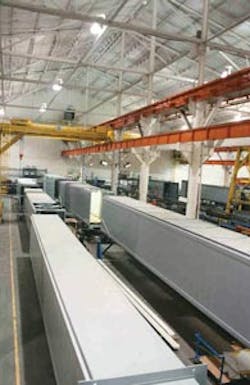
In the 1970s, Thyssen applied its extensive knowledge and experience with steel to the development of passenger boarding bridges for airports in Germany. A manufacturing and engineering facility was created in Kassel, Germany. ThyssenKrupp engineers studied every detail of passenger boarding bridge design, construction, operation and maintenance. Using their knowledge of steel, the engineers were able to design lightweight but extremely strong tunnel sections. Years of manufacturing experience produced designs that could be built to tight tolerances allowing greater precision. This resulted in a smooth, quiet operation that was and continues to be highly reliable.
1970S — 1980S GROWTH AND EXPANSION
Thyssen’s success in the boarding bridge industry was reinforced with the project at Madrid-Barajas Airport. In order to provide the 70 bridges needed for the project, the manufacturing had to be done in Spain. A manufacturing plant was established in Mieres (Asturias) to supply the airport. The globalization of the ThyssenKrupp passenger boarding bridge business had begun. Large orders were received from Gatwick and Heathrow Airports in Great Britain. To date, ThyssenKrupp has installed more than 2,000 passenger boarding bridges worldwide.
UNITED STATES
Thyssen purchased Stearns Airport Equipment Company in 1998 to support entry into the US market. Production of the Stearns product was quickly discontinued in favor of the technically advanced Thyssen bridge. The manufacturing facility was relocated and redesigned and immediately began producing bridges for US airports under the name Thyssen Stearns. The first 40 bridges were produced and installed in San Francisco’s new international concourses. The smooth aesthetics and advanced operational technology made the bridges popular. Orders rapidly came in from Los Angeles, San Diego and Edmonton and Toronto, Canada.
THE NEW MILLENIUM
In 2003, the company name was changed to ThyssenKrupp Airport Systems to reflect its actual corporate structure. Numerous major and visible improvements brought to the US market were now firmly established as the norm. Improvements included smooth walls and roof to prevent collection of water, the use of galvanized steel to prevent rust, the implementation of steel floors to prevent rotting and hydraulic elevation systems for smooth operations and an increased service life. Nearly 700 bridges have been manufactured with large orders from Chicago Midway Airport, Miami, Toronto, and JFK Airport in New York.
Manufacturers can set themselves apart by reacting quickly to changes in the market. Customer requests and feedback should be quickly implemented into the manufacturing process and bridge models constantly analyzed for improvements to enhance reliability, reduce maintenance costs and increase durability. At ThyssenKrupp, new products are continually introduced to accommodate new super jumbo aircraft and the increased population of regional jets. Boarding bridges should also be designed to accommodate various accessories such as: ground power units, pre-conditioned air units, cables hoists, bag slides and potable water cabinets.
It’s true, that when a passenger a boarding bridge operates properly, it won’t be noticed by most travelers. Instead, travelers are focused on the important business meeting or the loved-one waiting for them at the other end. By providing a complete solution to its customers and a commitment to continuous improvement and innovation, ThyssenKrupp Airport Systems will continue to serve the market with one of the largest and most important, but least noticed piece of equipment at the airport.