On The Brink
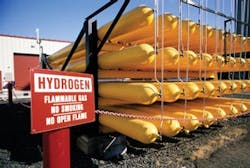
Research in hydrogen power technology is on the brink of commercialization. Progress in hydrogen extraction methods, storage and transportation have made it feasible for national and local government agencies to establish pilot projects in hydrogen-fueled transportation and to introduce goals for the establishment of hydrogen infrastructure into legislation and near-future planning.
In both his 2003 and 2006 State of the Union Address, President Bush discussed growing concerns about the consumption of fossil fuels and encouraged research in the area of alternative fuels — particularly hydrogen power. He established the $1.2 billion Hydrogen Fuel Initiative in 2003 to develop technology for commercially viable hydrogen-powered fuel cells, with the goal of intorducing it to general transportation at costs competitive with gasoline by 2015.
Advantages of Hydrogen Power
Hydrogen energy shows promise among technologies currently under development. It has the highest energy content per unit of weight of any known fuel source, making it more efficient. Hydrogen is the most abundant element in the universe and on Earth, it can be extracted from readily available sources such as water, coal or waste. When burned in an engine, it produces no emissions — just water. Research and development projects underway also show prospects for a zero-emissions extraction process using renewable energy sources or sequestration of carbon dioxide. Hydrogen-powered fuel cells also demonstrate safety and maintenance benefits, including decreased preventive maintenance requirements and reduced exposure to hazardous materials for users and maintainers.
Aviation Facilities Are Ideal Testing Grounds
Currently, hydrogen power is not considered a commercially viable energy solution because the technology has not reached maturity and there is no readily available production, transportation or delivery infrastructure for hydrogen power in any state. The most commonly available hydrogen extraction processes, such as cryogenic separation and electrolysis, require a significant amount of energy, depending on the source of energy used.
Therefore, hydrogen power does not yet demonstrate a significant energy savings or show a dramatic reduction in greenhouse gas emissions. Figure one demonstrates the true carbon dioxide emissions per mile, based on the fuel source and extraction method. Hydrogen derived from gasoline produces nearly as much carbon dioxide as common gasoline combustion. Methods that are still under development, such as hydrogen extraction from methane or extraction from renewable energy sources, show the real future promise of hydrogen power.
Technical and economic barriers to commercializing hydrogen power include lack of transportation and delivery infrastructures, high costs of capital and significantly low economies of scale. Expanding the customer base through research projects not only increases public awareness and demonstrates the feasibility of hydrogen power, it helps develop the commercial infrastructure, amortize capital investment and improve economies of scale. Government and quasi-government airport facilities can more readily be converted and adapt to hydrogen power infrastructure and logistics than commercial gas stations. The DOD in particular, as the largest consumer of fossil fuels in the United States, is in a unique position to provide a significant contribution to developing and expanding hydrogen technology.
Aircraft ground support equipment (GSE) is a good candidate for a hydrogen-powered pilot project for two reasons. First, GSE is a major contributor to the carbon dioxide emissions problem. Airport traffic is responsible for 2-3 percent of carbon dioxide emissions in U.S. metropolitan areas, and this number is expected to increase as the air transportation industry grows. Of the three categories of airport traffic, including aircraft, GSE and commuter traffic into and out of airports; GSE and commuter automotive vehicles are the most feasible candidates for conversion. If an airport facility or program office chose to run a pilot project for hydrogen-powered support equipment, despite emissions generated by hydrogen extraction, the facility stands to benefit from environmental, safety and maintenance advantages. By carefully selecting a hydrogen refueling source, problems related to emissions from extraction can be reduced or eliminated.
The Need for Research in Alternative Fuels
Federal and local governments in the United States are enacting policies like the Hydrogen Fuel Initiative to encourage the development and use of alternative fuels and in some cases, establish goals for potentially requiring the use of alternatives. California’s Executive Order S704, for example, orders building a network of hydrogen fueling stations sufficient to make hydrogen power accessible to every Californian by 2010. Concerns motivating this trend include national security, economic and the environment.
| ||||||||||||||||||
National security and dependence on foreign oil is the primary concern of the Hydrogen Fuel Initiative, as 55 percent of the oil consumed by the U.S. is imported and this is expected to grow to 68 percent by 2025. Many of the major importers to the U.S. are considered unstable areas. See figure two for a list of the top 15 oil exporters to the U.S. at the time of this report.
Top Oil Exporters to the United States
Many economists argue there are no regional markets for oil, therefore no country can exclude itself from the price fluctuations of the global market. Nonetheless, the President’s statements as well as national and state government investment into alternative fuels research indicate that energy security is a matter of significant political concern. Furthermore, if political concerns for energy security drive initiatives to cease the import of crude oil to the U.S. (as evidenced by increased interest in exploring domestic oil reserves), domestic energy will become significantly more expensive if a mature alternative energy technology is not yet available. Currently, crude oil imported from the Persian Gulf is less expensive than domestic oil or any available energy alternative.
Other economic concerns include the rising cost and volatility of oil prices. The most common factors driving price volatility include economic or political instability in countries providing oil, natural disasters and the accessibility of oil in the ground. Historically, political and natural disasters have caused spikes in prices that eventually subsided. The Iranian revolution in 1979, for example, increased crude oil prices from $15 per barrel to $40 per barrel. Damage to oil infrastructure in the Gulf of Mexico during Hurricane Katrina saw prices exceed $70.00 per barrel for the first time in history.
While these factors cause volatility in oil prices, the declining availability of oil reserves will have a more lasting effect. While the world is not running out of oil, it is running out of oil that is economically recoverable. As oil companies drill into deeper and less-accessible sites, the cost of doing business will gradually increase, as will the price of oil. Increases in fossil fuel efficiency and research into synthetic fossil fuels will not be enough to keep energy affordable in the long term.
Reduction of greenhouse gas emissions is another significant environmental goal motivating alternative fuels research. Carbon dioxide produced by burning fossil fuels is the most significant known cause of global warming — commonly considered the most threatening environmental issue. Emissions from automotive vehicles constitute 25 percent of the total greenhouse gas emissions for the U.S. The U.S. believes research on increased fuel efficiency and alternative fuels is the answer to improving air quality and reducing environmental risk.
Technical Options For Hydrogen-Powered GSE
Options to consider in developing a hydrogen-powered GSE project include types of equipment to be powered by hydrogen, types of fuel cells to be used, refueling and storage, transportation to and around the facility and if the project will include hydrogen extraction.
Possible GSE candidates for hydrogen fuel cells include any self propelled vehicles, such as tow tractors or loading equipment and electrical power and hydraulic carts. Numerous fuel cells have been developed, but most hydrogen automobiles are powered by a proton exchange membrane (PEM) fuel cell, which, in simple terms, generates electricity through the reaction of hydrogen and oxygen.
Reliable and affordable storage equipment for refueling facilities is readily available and can be leased and maintained through a number of vendors or purchased outright and managed on site. Gas handling and storage is not a new industry, although methods are always evolving. Refueling can be accomplished using free-flow or pressurized delivery systems. Free flow systems are simpler, but do not ensure complete refueling of the on-board vehicle tank. Pressurized systems are more complex and costly, but more efficient.
Hydrogen production (extraction) methods include thermal (most common), such as natural gas reforming and coal gasification, electrolytic, which splits water molecules by passing current through water, and photolytic, which relies on sunlight to split water via biological or electrochemical materials. The production options which currently produce commercially viable quantities of hydrogen are natural gas reforming, cryogenic gas separation and electrolysis.
Environmental Considerations for Extraction Options
The use of hydrogen power yields both risks and benefits. The obvious benefit is derived from end use applications; hydrogen-powered fuel cells generate zero emissions. Generating hydrogen for fueling those cells, however, has unique risks depending on the method used.
There are multiple possible methods for hydrogen generation. All methods require some source of energy, some more than others. Options range from powering the process using the common electrical grid to using purely renewable energy sources. Some methods use fossil fuel feedstocks, such as coal, while others use renewable feedstocks like water.
The most obvious environmental concern with electrolysis is it requires the use of electricity. If a common, commercial fossil-fueled electrical grid is used as the source of electrical power, the amount of fossil-fuel energy used to generate hydrogen and the corresponding atmospheric emissions may negate the environmental benefits. Fossil-fueled electricity produces greenhouse gases and other pollutants. If the system is powered by the Pacific Gas and Electric power grid in California, for example, energy sources used to power the grid range from wind power to imported electricity from out-of-state coal power plants. The average percentage of power derived from renewable sources is 25 percent across the U.S., but up to 40-45 percent in California. There is, however, the option of powering the electrolysis system using a separate, dedicated grid powered purely by renewable sources, such as wind or solar energy. This may achieve hydrogen generation with zero emissions.
The reforming method most commonly uses fossil fuels as a feedstock; however, reforming methods using renewable liquid fuels, such as ethanol or methanol, are also under development. Reforming using fossil fuels does generate CO2 emissions, but there is still a 40 to 50 percent reduction in these emissions when compared to gasoline-powered cars. Greenhouse gas emissions from reforming renewable liquid fuels are predicted to be 60 to 85 percent lower. When methanol is used as a feedstock, despite its benefits as a renewable energy source, there is an environmental downside that should be addressed. It is a known neurotoxin, even when ingested in small amounts and it can be absorbed through skin. Special handling procedures are required to mitigate this risk, but methanol is not expected to put the general population at risk.
The concern with cryogenic separation is again emissions resulting from fuel consumption for an energy-intensive hydrogen generation process and greenhouse gases emitted by processing coal as a feedstock. Cryogenic separation methods that sequester greenhouse emissions and are powered by renewable sources are currently under development, but are not technologically mature and are costly.
Other options for advanced gasification are being developed with the intention of reducing the need for fossil fuel-based energy inputs.
There are several other technologies under development that will reduce or eliminate emissions from hydrogen generation, although they are mostly in research and development. These include photobiological, photochemical, biomass gasification, coal gasification with sequestration of CO2 emissions and high temperature thermo-chemical hydrogen production.
| ||||||||||||||||||||||||||||||||||||||||||||||||||||||||||||||||||||||||||||||||||||||||||||||||||||||||||||
Realizing Commercialization
The key to reaching technological maturity and commercialization of hydrogen power technology is in achieving economies of scale, building infrastructure and increasing public awareness and confidence. Running a hydrogen-powered GSE project helps the industry accomplish this and may result in some cost savings in the long run. Political and economic pressures are drawing increased attention to alternative fuel research. Hydrogen power is a viable and affordable option.
This article was written based on research conducted with the assistance of LCDR Brian Maxwell of Commander, US Pacific Fleet and LT Dean Alton of the USS Abraham Lincoln, under the supervision of Dr. William Gates and Dr. Kenneth Doerr of the Naval Postgraduate School.