CU-A1 fuel cluster P/N 441761-7 was returned from customer to our facility in December 2005 for oil leakage at the overboard drain port. Oil leakage from the CU-A1 fuel cluster has been experienced four times in the field, causing an increased removal rate of the fuel cluster.
Background
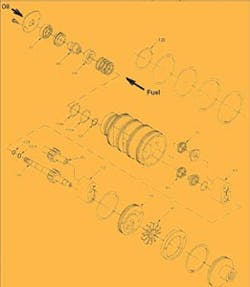
The CU-A1 fuel cluster was designed and manufactured by Honeywell, and is utilized on 331-500 and 331-600 APU engines. The CU-A1 fuel cluster is made up of the fuel pump, fuel filter, torque motor, pressure regulator, flow divider, etc. The fuel pump has a pump housing, boost pump, impeller, gear set, two bearings, two seals, seal rotor, packing, etc. See Figure 1. The gear shaft is connected to the APU oil sump and lubricated by oil from the oil sump. On the oil side, sealing is achieved by packing (115B) which seals between the fuel pump housing and outer diameter of carbon seal (30), packing (100B) which seals between gear shaft (105) and the inner diameter of seal rotor (45) and packing (120) captured between the fuel pump outer surface and fuel pump bore in fuel cluster. Seal rotor (45) rotates with gear shaft. Carbon seal (30) remains static. Sealing between seal rotor (45) and carbon seal (30) prevents oil leakage.
The fuel cluster component maintenance manual requires that the fuel cluster drive spline is lubricated with lubricating oil MIL-PRF-7870 Type II at pressure of 1-2 psig and leakage of one or more drops in five minutes from overboard drain is not acceptable during final test.
Testing, measurement and overhaul
Tests were performed when fuel cluster CU-A1 was received on test stand at static (0 percent), start (10 percent), full speed (100 percent) and shut-down (0 percent) for five minutes at each point. Oil pressure was maintained at 2.0 psig. Oil leakage from the overboard drain was confirmed. The oil leakage rate increased in proportion with the fuel pump rotation speed.
Fuel cluster CU-A1 was disassembled and inspected and the findings were seal (30) and seal rotor (45) were worn out and were chipped at the rim. See Figure 2. Wear was also detected on the surface of bearings (60) and (65). See Figure 3. In the wave springs (70) and (85) load test, spring load is 9.6 pounds and 10.4 pounds respectively at a spring work height of 0.117 inches. The out of limit value is 12 pounds at 0.117 inches. Therefore the spring failed the load test. Wave springs are shown in Figure 4. Additionally, severe wear was detected on plate (50) during inspection.
Testing was performed on fuel cluster CU-A1 after seal (30) and seal rotor (45) were replaced.
Test results showed that oil leakage was reduced by 95 percent after seal (30) and seal rotor (45) were replaced.
Fuel pump bearings, wave springs, seal, seal rotor, gear set, housing and packings were replaced. All parts were cleaned and reassembled in accordance with customer request and fuel cluster component maintenance manual.
The overhauled fuel pump was reinstalled in the fuel cluster and tested on test stand. The pump passed the break-in test. An endurance test was performed.
The final test was performed on test stand according to test specification in CU-A1 fuel cluster component maintenance manual. The fuel cluster passed final test. No oil leakage was found during final test after overhaul.
Analysis and summary
Three failure modes have been identified that can contribute to the oil leakage problem, one of which is failure of sealing between carbon seal (30) and seal rotor (45). The root cause is excessive wear of carbon seal (30) and seal rotor (45). See Figure 1.
The second failure mode is failure of packing sealing due to side-loading of the gear shaft mechanism at high rotation speed. Two root causes for this failure mode have been identified: excessive wear of bearings (60) and (65); and malfunction of wave spring (70) and (85).
During operation, the differential pressure between the fuel pump inlet and outlet presses the gear set and bearing against the inlet side of the pump housing. Excessive wear of bearings (60) and (65) can lead to the tilt of gear shaft (105), which results in the displacement of the gear shaft end and the improper working of packing (100B) and (115B). The gear set and bearings are preloaded with compression wave spring (70) and (85). This maintains a preload on the gear set to limit play and prevent fretting and impact damage due to vibration. Malfunction of wave spring (70) and (85) can cause the centerline of gear shaft (105) to be out of parallel with the gear bore centerline. Either of the two above mentioned effects can cause side-loading of gear shaft resulting in failure of packing sealing. Also, tilt of gear shaft (105) can result in the tilt of boost pump impeller (40) causing contact of impeller vane and plate (50) and excessive wear of plate (50).
The third failure mode is the failure of packing (120) between fuel pump outer surface and fuel pump bore in fuel cluster.
Test results indicate that the worn and chipped seal is the primary contributor to the fuel cluster CU-A1 oil leakage. Severe wear on impeller outlet plate (50) indicates that there existed side-loading in fuel pump gear shaft (105), which resulted from excessive wear of bearings and failure of wave spring after fuel cluster runs for a long time. Side-loading of the gear shaft caused the improper packing sealing at the spline shaft, which is another contributor to the fuel cluster CU-A1 oil leakage. Aging and extrusion of packings can also contribute to the oil leakage.
Conclusion
It is can be concluded that oil leakage from APU fuel cluster CU-A1 was caused by the excessive wear and chipping on plain encased carbon seal, wear on bearings, failure of the wave spring and aging and extrusion of the packings.
Corrective/preventive actions
Root causes were not detected the first two times when fuel cluster CU-A1 was returned from field for oil leakage. The reason is that our facility didn’t have pressurizing lubrication system on an old test stand. The third time fuel cluster CU-A1 was tested, on a new test stand which has a pressurizing lubrication system, the test stand had just been set up and had no draining oil collecting system. So the root cause was not detected due to the difficulty in visually checking draining oil in the test stand. A draining oil collecting system was designed and installed to improve the oil leaking inspection on the current test stand. Draining oil can be measured with a measurement cup.
If oil or fuel leakage is reported, the unit will be disassembled such that all seals will be inspected and replaced as required, thus not just limited to the external packings (120). See Figure 1. The fuel pump will be removed from the fuel cluster, disassembled, the seal, seal rotor, bearing and wave spring will be inspected. All packings will be replaced.