Harlan A. 'Bud' Gurney (1905-1982)
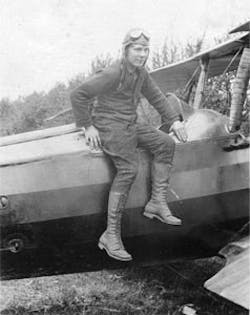
In the spring of 1922, Harlan A. Gurney was working his way through high school at the Nebraska Aircraft Corporation factory in his hometown of Lincoln, when he met the man who would become his life-long friend. NAC’s owner, Ray Page also operated “Page’s Flying Pageant” and offered flying lessons, attracting at least one student who arrived from Missouri. “I was working in the engine room when the boss came in with this young fellow and told me to teach him all I knew about engines,“ Gurney recalled years later.
The two teenagers worked together, soon sharing adventures on an Excelsior motorcycle, with a common goal to become pilots. For each of them, barnstorming, wing-walking, and carrying the U.S. Air Mail during the 1920s began a long and successful career in aviation. Gurney’s new pal was a few years older and a lot taller. His name was Charles Augustus Lindbergh.
The handy assistant
Born July 15, 1905, Gurney was third of 13 children raised near Beatrice, NB, and later in Lincoln, where his father was a successful building contractor. After WWI, the family fell on hard times just as young Gurney was entering high school. Without money for supplies and clothes, Gurney made the first of many painful and remarkably responsible decisions toward his goal to finish his education. At the age of 13, he ran away from home, hitching a ride on a train with no plan except to find a job. Within days, the hungry and travel-weary boy concealed his identity and traded room and board to work as a hired hand on a farm north of Lincoln.
Bright, inquisitive, and hard working, the teenage Gurney learned how to run a dairy farm, work in a pattern factory, and wait on tables. More than once he earned, and lost, enough money to return to Lincoln and attend a semester of high school. He was a voracious reader and self-taught on subjects ranging from trigonometry to Greek philosophy. Although remaining on good terms, he never lived with his parents again rather than burden them with his welfare.
During a semester as a freshman, he rented a room not far from the Lincoln Standard Aircraft Company. By 1921, Gurney had set his sights on working at Standard’s assembly plant owned by Ray Page.
Bud and Slim
With woodworking skills gained watching his father make furniture, Gurney crafted a scale model of a J1 Standard which Page accepted in exchange for a job at the factory. Bud swept shop floors, straightened tools bins, and did some woodwork on the frame of Page’s Fokker D7. Standard and the Dayton Aircraft Corporation of Ohio quickly combined to form the Nebraska Aircraft Corporation, operated by Page.
Gurney was good with his hands and learned fast. In addition to wood finishing, his responsibilities included removing nuts and bolts from engines so they could be reused to make “new” Hispano-Suiza power plants. It was during this time that he met the tall, lanky, Lindbergh who Gurney called “Slim.” Lindbergh called him “Buddy,” which he later shortened to “Bud.” The two nicknames stuck for life.
Working day and evening at the factory Gurney had no extra time to study, yet he excelled in class. He spent his Sundays at the flying field south of town. Here he helped assemble airplanes without pay, eventually meeting the factory manager, Otto Timm, already noted for his distinguished military career as a flight instructor. It didn’t take long for Gurney to become Timm’s “handy assistant.” Testing a Lincoln Standard fresh off the assembly line, Timm invited both Gurney and Lindbergh for their first flight. In later years, Gurney recalled that he watched the world below “become a map,” listening to the “breath of the engine.” Said Gurney, “I knew then I wanted to fly more than ever!”
Between 1922 and 1923, Lindbergh took flying instructions, worked at the factory with Gurney, and had gained experience making parachute jumps and wing-walking while barnstorming. In the spring of 1923 he bought a “Jenny” in which he made his first solo flight, then flew it to Lincoln that winter.
It was Lindbergh who first coaxed Gurney into parachute jumping on a dare. Surviving the fall, and unexpectedly earning $11.00 from spectators, Gurney saw a quick, albeit dangerous way, to earn money for school. This new skill led to several seasons in an air circus which traveled across Nebraska. When he wasn’t featured as a “jumper” or “wing-walker,” he doubled as ground crew, gassing airplanes, changing engine oil and spark plugs, and covering the planes with canvass at night. This led to barnstorming with Erroll Bahl, a WWI veteran aviator and aircraft designer. Bahl built his Lark airplane in a shop at Lincoln, where again, Gurney apprenticed. He learned frame design, and became proficient at covering wings with fabric, earning adult wages. As often as he could, Gurney had “stick time” in a Jenny or Standard, learning to fly. Gurney had been using parachutes sold by Charles and Kathryn Hardin, but by the time Lindbergh returned to Lincoln with his Jenny, he had hand-fabricated a parachute of his own design. The boys tested the chute, and decided to go barnstorming in eastern Nebraska. “I was working,” Gurney remembered, “but quit to go with him.” In later years Lindbergh would write two books in which he recounted their adventures including a forced landing during a rainstorm in a muddy field. Hoping to avert total damage to the plane, the boys pushed the tail into the wind while lightning struck around them.
Gurney later discerned that he and Lindbergh had both been knocked out for several minutes, but they had managed to save the plane.
Both Lindbergh and Gurney were skilled at making repairs, occasionally sending for spare parts while stranded in a farmer’s pasture. Routine maintenance included sewing tears in the fabric, sometimes using wood crates to carve a replacement of a broken spar or rib, or cleaning the engine distributor head, draining the carburetor jet wells, and oiling the rocker arms.
This short barnstorming trip established a trust between the two maturing young men, but it was Gurney’s near fatal fall from the Jenny which cemented the bond to his friend, “Slim.” At the St. Louis Air Races in 1923, Gurney anticipated much-needed pay for a parachute “double-drop.” Mid-air his chute collapsed in the vortex of another plane and he landed “too hard for bones to take.” Hospitalized for weeks, his only daily visitor was Lindbergh, who took care of Gurney’s medical bills. Gurney recuperated in St. Louis, working for a brief time doing “piece work” at the Fisher Body plant.
Returning to the flying field at Lincoln, Gurney picked up work doing engine overhauls and painting and varnishing planes. He eventually soled and barnstormed across Nebraska as part owner of a Lincoln Standard. After an unusually profitable season, he had earned $3,500 and owned the Standard. Buoyed by success, he returned to Lincoln to completely rebuild his plane. While doping the wings, fire broke out forcing Gurney through a window as his savings, and his airplane went up in smoke. The event was catastrophic, as Gurney later summarized it: “Rich one moment, poor the next.” With no money for room and board, Gurney borrowed $10 and headed out of town to find a new job. Foremost on his mind was returning to school.
He could not have known it at the time, but his future was being shaped by the forthcoming Air Mail Act of 1925 which created a job, again working alongside his pal, “Slim.”
Flying the mail
In 1926, Robertson Aircraft Company won the government contract to fly the mail between St. Louis and Chicago, and hired Lindbergh as chief pilot at Lambert Field, (St. Louis) Lindbergh hired Gurney to completely rebuild the company’s small fleet of DeHavilland DH4 aircraft, a war surplus open-cockpit biplane powered by a 400-hp Liberty engine. It wasn’t long before Gurney was in the air among those dedicated and remarkable pilots who flew in fog, sleet, rain, and snow, often with fatal results. Forced landings or bail-out parachute jumps were not uncommon. The staggering loss of 31 of the original 40 air mail pilots and many aircraft caused a complete restructure of the Air Mail system by 1932. Gurney lost close friends, and made headlines as a pilot who “got through” when others could not. In 1927, when Lindbergh left to make his epic cross-Atlantic flight Gurney replaced him as Robertson’s chief air mail pilot and flight instructor. Lindbergh returned to make one final mail run with Gurney and former Robertson pilots, Leslie Smith, Eyir Sloniger, Thomas Nelson, and Philip A. Love. They carried more than 100,000 letters from St. Louis to Chicago bearing a special commemorative legend meant to inspire confidence in the future of aviation. Gurney did not see Lindbergh often after that, but in January of 1929 “The Lone Eagle’s” Tri-Motor iced over in Illinois. Mechanics attempting to thaw it out with blow torches damaged the plane leaving him in need of a ride to meetings in St. Louis. Gurney made the round trip from Lambert Field in Robertson’s private Cessna, returning Lindbergh to his hectic, high profile life.
Now gainfully employed, Gurney found love, married, and started a family of his own. While he was in charge of daily operations at Robertson, Gurney left his desk to join desperate aerial attempts to locate missing mail and passenger planes. Flying photographs of the 1928 Democratic Convention, Leslie Smith went down in Missouri during a sudden storm. Joining the search, Gurney identified Smith’s body, found wearing the parachute he had no time to use. So close was he to Smith that a few months later he named his first child, Harlan Leslie Gurney. Gurney’s reliability was legendary. “You could put Slim or my father in any airplane and they could fly it,” says Gurney’s son, also now nicknamed “Bud.” In 1929, dozens of aircraft hired by national news services waited at Louisville to take off with photographs of the Kentucky Derby. The weather was dodgy and only Gurney successfully delivered the scoop to the Chicago Tribune.
Eventually Robertson was absorbed by Universal Air Lines, for which Gurney was district flight manager. He then worked for Transcontinental Air Transport (the “Lindbergh Line”) until signing on as a Captain with United Airlines in 1932. He was 27 years old.
In the years ahead both “Bud” and “Slim” each knew great success as well as personal tragedy. Sometimes far apart both geographically and philosophically, they kept in touch, and even managed to reunite to fly vintage aircraft over the California hills. In his 1927 book, We, Lindbergh wrote, “One of the interesting facts bearing on the life of aviators is that they rarely lose track of one another permanently.”
It would be true for many aviators, although Charles Lindbergh could never have guessed that 30 years later he would again fly a Lincoln Standard which was tuned up by his barnstorming friend, “Bud” Gurney.
To be Continued in Part II – “The Captain is an A&P.”
Giacinta Bradley Koontz is an aviation historian and author. She was the founder and director of the Portal of the Folded Wings Shrine to Aviation and Museum from 1995-2001 (the site of Charles Taylor’s grave in North Hollywood, CA). Giacinta holds a BA in anthropology with a minor in U.S. history. Most recently she has been awarded a partial grant from the Wolf Aviation Fund to write her second book, highlighting the life of Amelia Earhart’s mechanic, Ernest Eugene Tissot Sr.